Workstat Pension Report 20269-page PDFFree download
The Pension Picture 2026
Inside Nigeria's ₦31.8 trillion retirement system: how fast it is growing, where the money is invested, who is covered, and what every employer must get right on each payroll run.
- The system in 2026
- Where the money sits
- Who is covered, and who is not
Get the full report
Free. The Pension Picture 2026 (PDF).
The report in five numbers
The figures that matter most, before you read the detail.
What is inside
- The system in 2026Assets, accounts and how fast both are growing
- Where the money sitsAsset allocation, and why government bonds dominate
- Who is covered, and who is notAccounts, new registrations and the informal gap
- The employer's checklistRates, deadlines, penalties and group life
- Methodology and sourcesWhere each number comes from
Who it is for
Rates, deadlines and penalties under the Pension Reform Act 2014.
Plain numbers on growth, investment and coverage.
The 10% employer contribution and group life cover.
The summary
Nigeria’s contributory pension scheme held ₦31.8 trillion at the end of August 2026, a record, after growing by ₦3.8 trillion in the first eight months of the year. For employers it is easy to see pension as one more deduction. This report puts that deduction in context: how big the system is, where contributions go, and what the law expects of every employer.
The system in 2026
Assets rose from ₦28.04 trillion in January to ₦31.8 trillion in August, about 13.4% in eight months. August alone added ₦289.4 billion. Retirement Savings Account membership stood at 11,391,008 contributors.
Nigeria's pension system, August 2026
Where the money sits
Pension funds are invested conservatively. Federal Government securities held ₦17.80 trillion in August, about 56% of all assets. Domestic equities held ₦6.32 trillion, corporate debt ₦2.21 trillion, mutual funds ₦326.64 billion and foreign equities ₦280.66 billion.
Where pension money is invested
Assets by class, 31 August 2026.
FGN securities ₦17.80tn
Federal Government bonds and treasury bills, about 56%
Domestic equities ₦6.32tn
Shares listed in Nigeria
Corporate debt ₦2.21tn
Company bonds and commercial paper
Everything else ₦5.47tn
Money market, mutual funds, foreign equities, real estate and other assets
The weighting matters to members because returns follow government borrowing rates. It matters to employers because a late remittance means the member’s money misses the returns the fund earned while it was owed.
Who is covered, and who is not
11.39 million accounts sounds large, but the scheme mainly reaches formal employers. PenCom registered 143,248 new accounts in the first quarter of 2026, and the five largest administrators took 54.41% of them. The Personal Pension Plan, built for self-employed and informal workers, has struggled to attract money.
The employer’s checklist
The Pension Reform Act 2014 applies to employers with three or more employees. The 2025 tax reforms did not change it.
The employer's pension rules
For employers with three or more employees.
| Obligation | The rule | If it slips |
|---|---|---|
| Accounts | Every employee has a Retirement Savings Account with a PFA of their choice | Contributions cannot be credited |
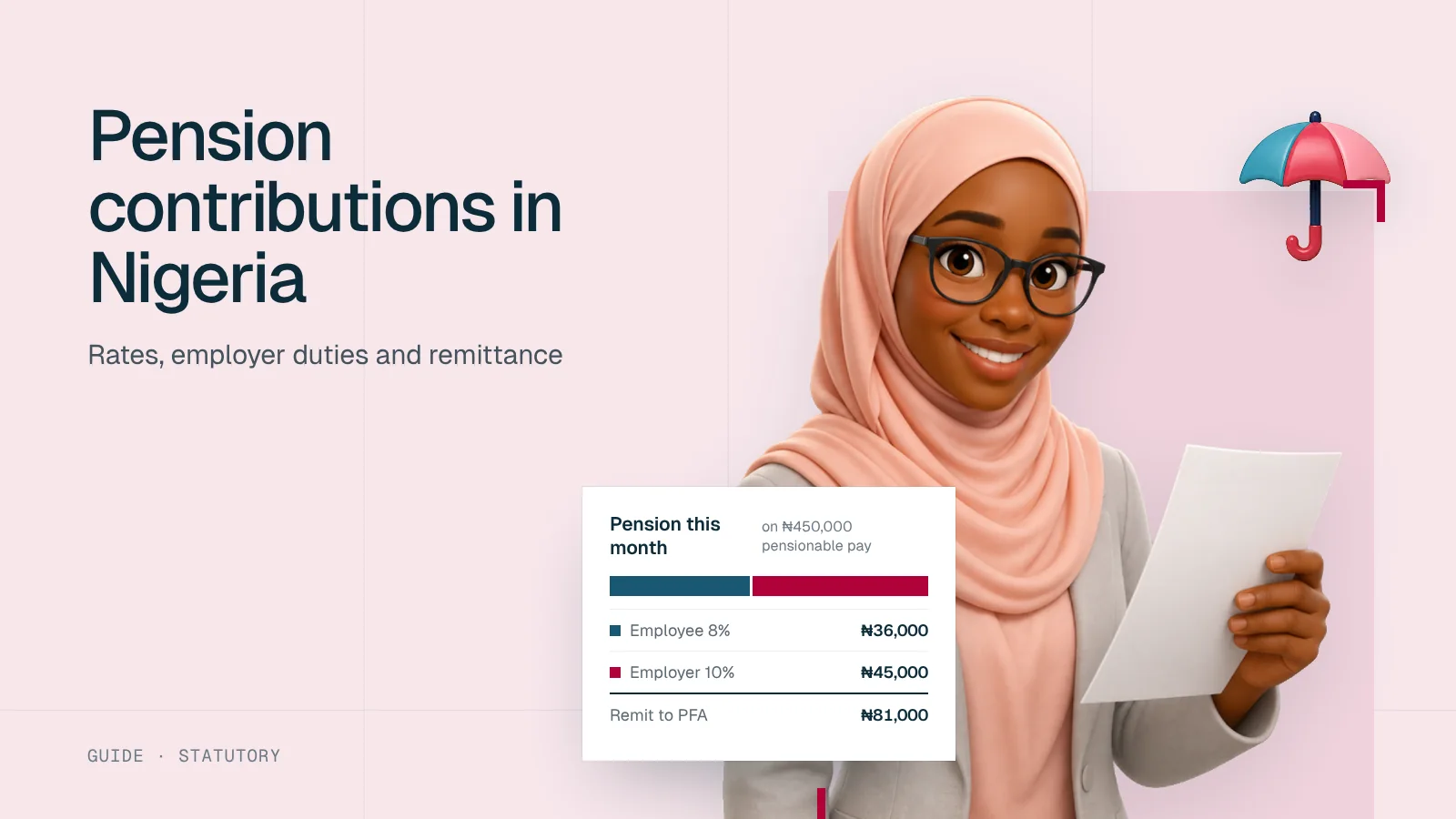
| Contributions | 8% from the employee and at least 10% from the employer, on basic, housing and transport | Under-funded accounts and liability for arrears |
| Remittance | Within seven working days of paying salaries | Penalty of at least 2% of the unpaid amount for each month |
| Group life | A policy worth at least three times annual total emolument | The employer carries the liability |
| Records | Remittance schedules and evidence for every month | Slow, costly member disputes |
In October 2026 PenCom reported recovering ₦36.6 billion from defaulting employers and said enforcement would intensify. Pension arrears are a cost that grows the longer it waits.
Work out a month's contributions
Our pension calculator splits any salary into the employee and employer amounts you need to remit.
The full report includes the asset tables, the membership figures and the employer checklist on one page you can print.
Methodology
This report brings together public data published by the National Pension Commission (PenCom) and reported in the financial press, with the employer rules in the Pension Reform Act 2014. Asset and membership figures are for 31 August 2026 unless stated; growth is measured from January 2026. Percentages are Workstat calculations from those totals. No survey or private data was used.
Employee management made easy
Keep employee records, attendance, leave, payroll and performance in one connected system.
Sources
- Nigeria's pension assets grow by ₦3.8 trillion in eight months (Nairametrics, October 2026)
- Pension fund assets rise to ₦31.8trn in August (Daily Market Forces)
- PenCom registers 143,248 new pension accounts (Nairametrics, August 2026)
- PenCom recovers ₦36.6bn from defaulting employers (ThisDay, October 2026)
- PenCom Q1 2026 pension industry dashboard
- New Pension Reform Act 2014: compliance highlights (Proshare)
- Pension Reform Act 2014
Frequently asked questions
Short answers to what employers ask us most about this topic.
How big is Nigeria's pension industry in 2026?
₦31.8 trillion at 31 August 2026, according to PenCom data, up from ₦28.04 trillion in January.
How much must employers contribute to pension?
At least 10% of each employee's monthly basic salary, housing and transport allowance, on top of the employee's 8%, under the Pension Reform Act 2014.
When must pension contributions be remitted?
Within seven working days of paying salaries. Late payment attracts a penalty of at least 2% of the unpaid amount for each month it stays unpaid.
Do small businesses have to run a pension scheme?
The Act covers employers with three or more employees. Smaller employers and self-employed people can still save through the Personal Pension Plan.
Get the full report
Every table, chart and worked example in one PDF. Tell us where to send it and we will deliver it to your inbox and WhatsApp.
- Full data tables and charts
- Methodology and every source
- First look at the next edition