Employment letter and offer letter templates (Nigeria)
Four employment letter samples for Nigerian employers, with the particulars the Labour Act requires within three months of starting work, and notes on probation, pay and notice.

Every new hire in Nigeria should leave with two documents: an offer they accepted and a written statement of the terms they work under. The second is a legal requirement for workers covered by the Labour Act. This page explains what each letter must contain and gives four samples you can adapt. The Word download includes all of them.
What the law requires
Section 7 of the Labour Act sets the deadline and the content.
The employer must give the worker a written statement “Not later than three months after the beginning of a worker’s period of employment with an employer”
Labour Act, section 7(1)
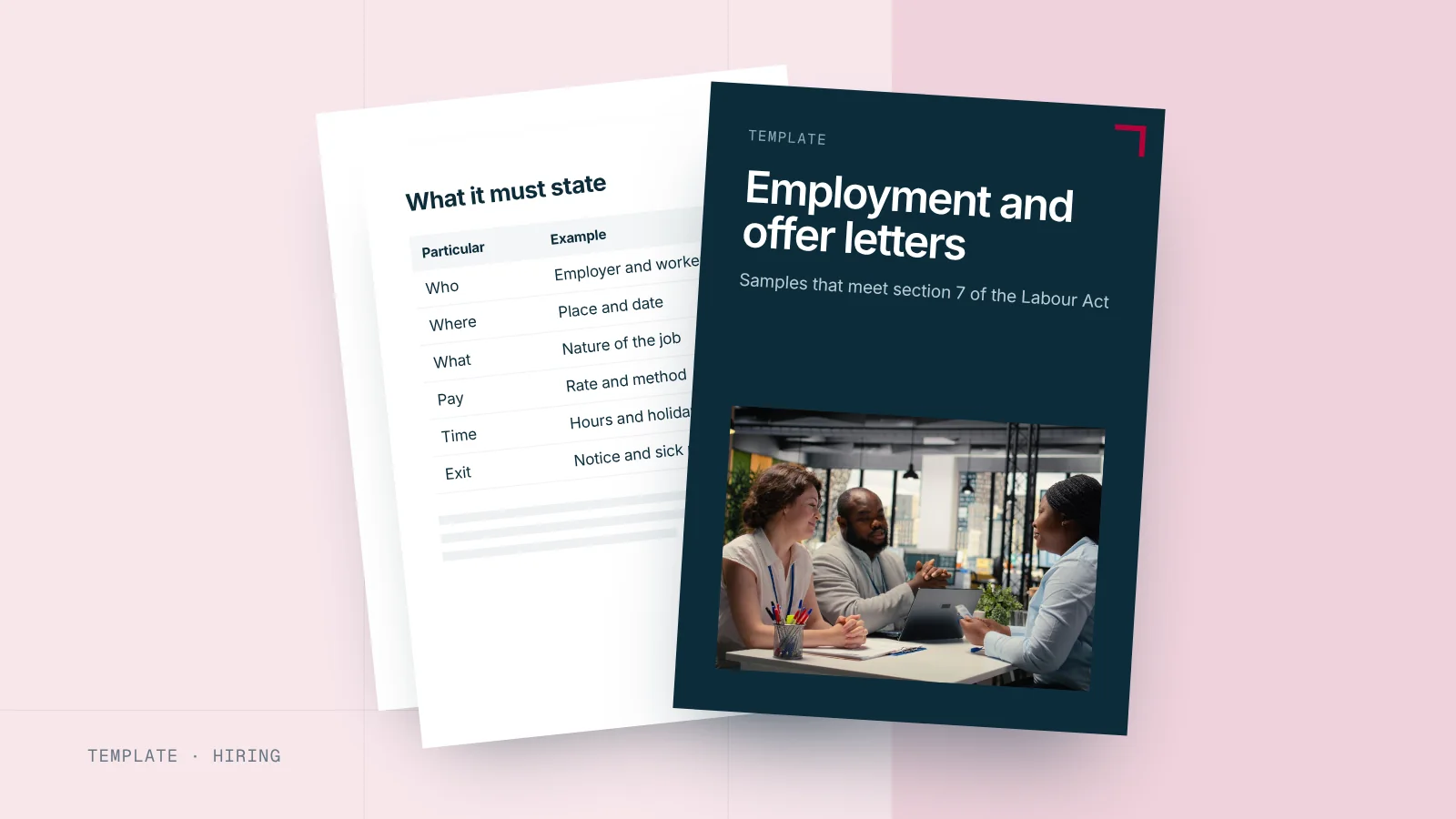
The statement must cover the particulars in the graphic below. If terms change later, the employer must tell the worker in writing within one month of the change. The statement can refer to another document the worker can reasonably access, such as the handbook, for details like the leave policy.
What a Nigerian employment letter must state
The Labour Act’s definition of “worker” excludes people “exercising administrative, executive, technical or professional functions”, so section 7 does not strictly apply to some managerial and professional staff. Give them the same written terms anyway; it protects both sides and avoids arguments about who is covered.
The hiring paperwork in order
From offer to confirmation
Offer letter
The role, pay, start date and conditions, with a date to accept
Acceptance
The candidate signs and returns the offer, or accepts by email
Employment letter or contract
The full terms, including every section 7 particular, ideally on day one and no later than three months
Onboarding records
TIN, Pension Fund Administrator and RSA PIN, bank details and next of kin
Confirmation of appointment
At the end of probation, in writing
Our onboarding checklist covers the records in step four.
Sample 1: offer letter
Offer of employment
[Company letterhead]
[Date]
[Candidate name]
[Address]
Dear [Candidate name],
Offer of employment: [Job title]
We are pleased to offer you the position of [job title] in our [department] at [location], reporting to [manager’s title].
Start date: [date].
Gross monthly salary: ₦[amount], made up of basic salary ₦[amount], housing allowance ₦[amount], transport allowance ₦[amount] and [other allowances] ₦[amount]. Salary is paid monthly in arrears on or before the [day] of each month, after deduction of PAYE, your 8% pension contribution and any other statutory deduction.
Probation: [number] months from your start date.
This offer is conditional on [satisfactory references / verification of your qualifications / a guarantor’s form / medical clearance].
Your employment letter, setting out your full terms and conditions, will be issued on your first day.
Please confirm your acceptance by signing and returning a copy of this letter by [date].
Yours sincerely,
[Name]
[Title]
I accept this offer on the terms above.
Signed: ____________ Date: ____________
Sample 2: employment letter
This sample covers every particular in section 7. Clauses in square brackets need your details; delete any that do not apply.
Letter of employment
[Company letterhead]
[Date]
[Employee name]
[Address]
Dear [Employee name],
Letter of employment
Further to your acceptance of our offer dated [date], we confirm your employment on the following terms.
1. Employer. [Company name], [RC number], of [registered address], [a member of the [group name] group].
2. Position and place of work. You are employed as [job title] in the [department], based at [address]. You were engaged at [place] on [date], and your employment began on [start date]. Your duties are described in the attached job description, which may be updated as the business needs change.
3. Type of contract. [Permanent / Fixed term ending on [date]].
4. Probation. The first [number] months are a probationary period. Either party may end the contract during probation by giving [period] notice in writing. You will be told in writing whether your appointment is confirmed.
5. Pay. Your gross salary is ₦[amount] a month: basic ₦[amount], housing ₦[amount], transport ₦[amount] and [other] ₦[amount]. Salary is calculated monthly and paid by bank transfer on or before the [day] of each month. PAYE, your pension contribution of at least 8% of basic, housing and transport, [NHF of 2.5% of basic,] and any deduction you agree to in writing will be deducted.
6. Hours of work. Normal hours are [8:00 a.m. to 5:00 p.m., Monday to Friday], with a [one-hour] break. Work beyond normal hours is overtime and is [paid at [rate] / compensated with time off] when approved in advance.
7. Holidays. You are entitled to [number] working days of paid annual leave in each year of service, in addition to public holidays. Leave is taken at times agreed with your manager, in line with the Leave Policy.
8. Sickness. If you are unable to work because of illness, you must tell your manager on the first day. You are entitled to paid sick leave of up to [12] working days in a calendar year when supported by a certificate from a registered medical practitioner, [and to further sick pay under the Leave Policy].
9. Pension. Your employer contribution is [10%] of basic, housing and transport, paid with your contribution to your chosen Pension Fund Administrator.
10. Notice. After confirmation, either party may end this contract by giving [one month’s] notice in writing, or pay in lieu of notice. This is not less than the minimum required by section 11 of the Labour Act for your length of service.
11. Policies. You must comply with the Employee Handbook and company policies, which you can read at [location or link]. Policies may be updated from time to time, and changes will be communicated in writing.
12. Confidentiality. You must not disclose confidential information about the company, its customers or staff, during or after your employment, except as required by law.
13. Special conditions. [Any special terms, such as a guarantor, a training bond or a company vehicle.]
Please sign and return a copy of this letter to confirm that you accept these terms.
Yours sincerely,
[Name], [Title]
I accept the terms of employment set out above.
Signed: ____________ Date: ____________
Sample 3: confirmation of appointment
Confirmation of appointment
[Date]
[Employee name], [Job title]
Dear [Employee name],
Confirmation of appointment
We are pleased to confirm your appointment as [job title] with effect from [date], following the successful completion of your probation.
[Your salary is reviewed to ₦[amount] a month from [date].] All other terms in your letter of employment dated [date] remain the same. From the date of confirmation, the notice period in clause [number] of that letter applies.
Congratulations, and thank you for your work so far.
Yours sincerely,
[Name], [Title]
Sample 4: letter confirming employment
Banks, landlords and embassies often ask for this. Include salary only with the employee’s written consent.
Letter confirming employment
[Company letterhead]
[Date]
[Recipient name and address, or “To whom it may concern”]
Confirmation of employment: [Employee name]
This is to confirm that [employee name] has been employed by [company name] since [start date] as [job title] in our [department]. [His/her/their] employment is [permanent / on a fixed-term contract ending on [date]].
[With the employee’s consent: [Employee name]’s gross annual salary is ₦[amount].]
Please contact [name, title, email, phone] if you need to verify this letter.
Yours faithfully,
[Name], [Title]
Notes on common clauses
Probation
No law fixes the length of probation. Be specific about how performance will be judged, and confirm or extend probation in writing before it ends. Silence leaves the status unclear.
Notice
The Labour Act sets minimum notice by length of service: one day for three months or less, one week up to two years, two weeks up to five years, and one month after five years. The contract can require longer notice, not shorter. Try our notice period checker in the termination guide.
Guarantors
Many Nigerian employers ask for a guarantor, especially for roles that handle cash or stock. If you do, use a separate guarantor form, say what the guarantor is responsible for, and keep the signed form on file.
Restraint of trade
Clauses that stop an employee working for a competitor after leaving are read narrowly by Nigerian courts. Keep any restraint short, limited to what protects a real business interest, and take legal advice before relying on one.
Download the Word file to adapt these letters to your letterhead and policies.
Employee management made easy
Keep employee records, attendance, leave, payroll and performance in one connected system.
Sources
Frequently asked questions
Short answers to what employers ask us most about this topic.
What is the difference between an offer letter and an employment letter?
An offer letter makes a conditional offer of a job and asks the candidate to accept. The employment letter, or contract of employment, sets out the full terms once the offer is accepted. Some employers combine them; if you do, make sure every particular in section 7 of the Labour Act is included.
Is an employment letter compulsory in Nigeria?
The Labour Act requires the employer to give a written statement of the main terms of employment within three months of the start date, unless a written contract that covers them has already been given. An employment letter is the usual way to meet this.
How long is probation in Nigeria?
No law fixes the length. Three to six months is common in private-sector contracts. State the length, how performance will be reviewed, and the notice period during probation.
What is a letter confirming employment?
A short letter, often requested by banks, landlords or embassies, confirming that a person works for you, their job title, start date and sometimes their salary. Only include salary with the employee's consent.