Workstat Pay Report 202610-page PDFFree download
Take-Home 2026
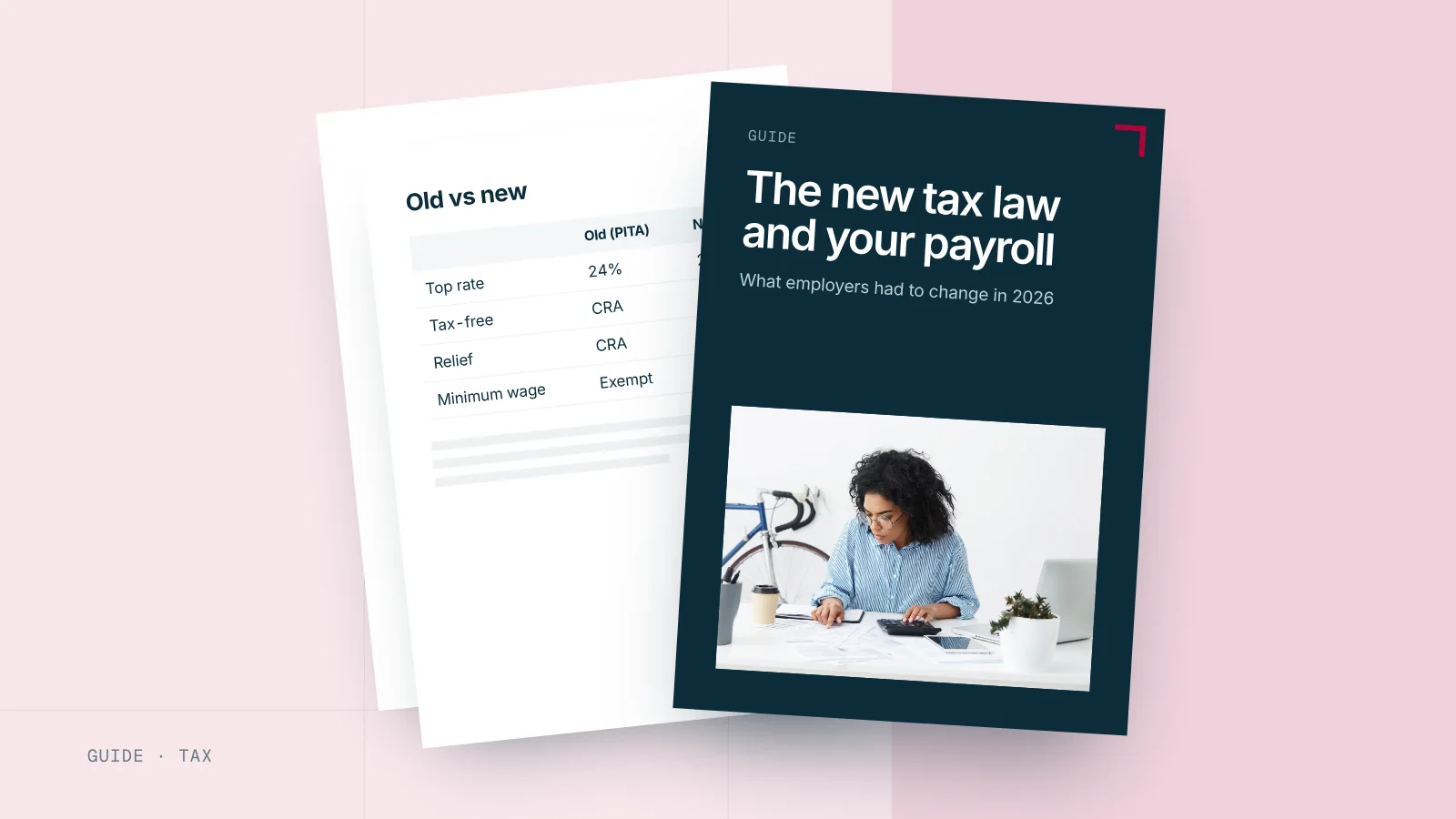
How the Nigeria Tax Act 2025 changed PAYE at every salary level: the new bands, who pays less, who pays more, what rent relief is worth, and what payroll teams had to change.
- The new bands
- Who pays less, who pays more
- What rent relief is worth
Get the full report
Free. Take-Home 2026 (PDF).
The report in five numbers
The figures that matter most, before you read the detail.
What is inside
- The new bandsWhat changed on 1 January 2026, and what stayed the same
- Who pays less, who pays morePAYE at 15 salary points, old law against new
- What rent relief is worthThe new deduction, worked through at four rents
- The payroll checklistSet-up, payslips, remittance and annual returns
- Methodology and sourcesEvery assumption behind the numbers
Who it is for
Old and new PAYE at 15 salary points, with the assumptions shown.
Where effective rates rise, and what that does to senior offers.
What the change means for take-home pay at your salary.
The summary
On 1 January 2026 the Nigeria Tax Act 2025 replaced the PAYE rules employers had used since 2011. The Consolidated Relief Allowance went, a 0% band of ₦800,000 arrived, and the top rate rose from 24% to 25%. This report works through what that did to take-home pay at every salary level.
The short version: low earners pay less, most people between about ₦150,000 and ₦1.3 million a month pay roughly what they paid before, and the change bites hardest at the top.
The new bands
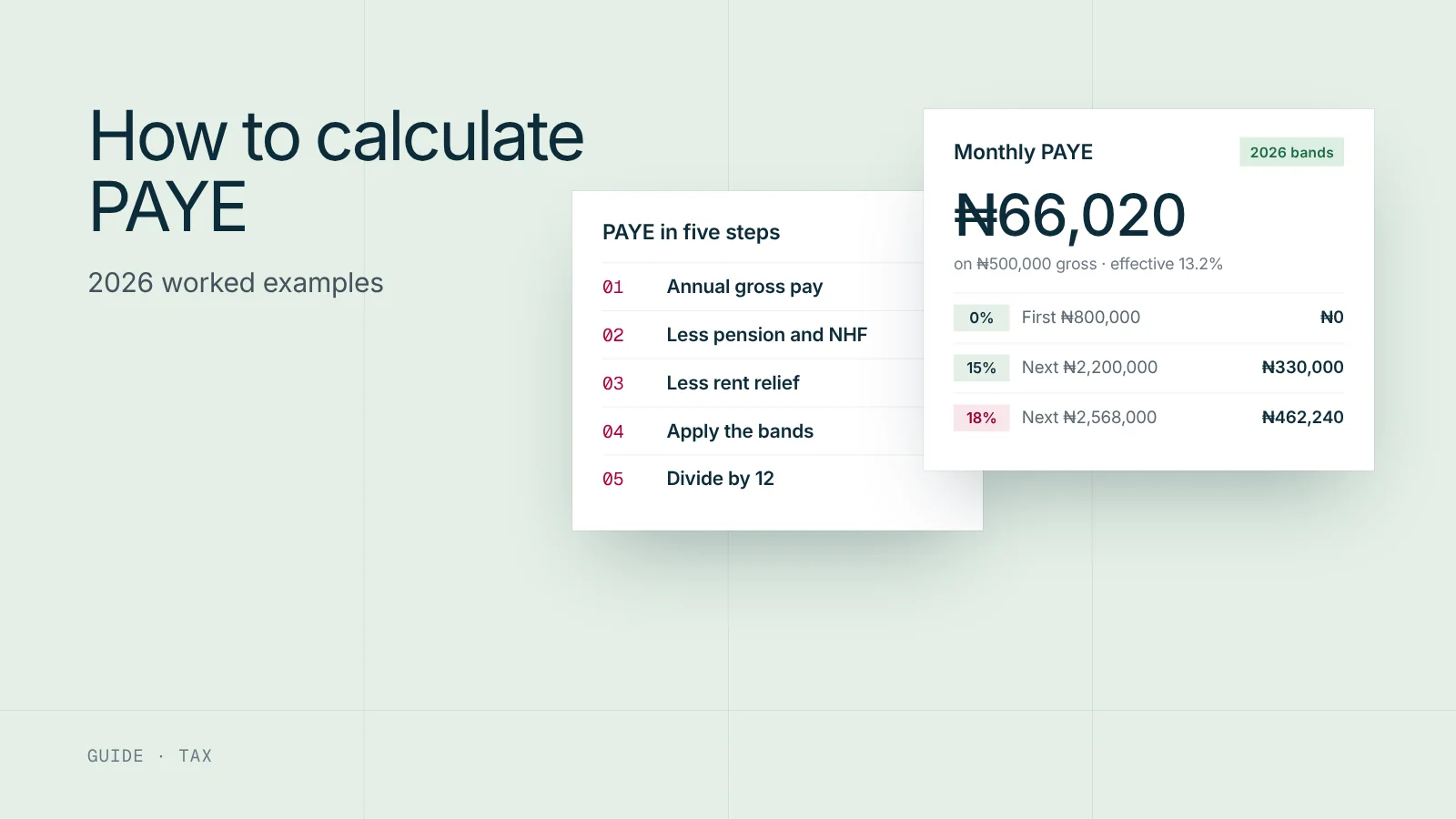
PAYE is now charged on annual taxable income in six bands. Taxable income is gross pay less pension contributions, NHF and the reliefs the Act allows, including the new rent relief.
PAYE bands from 1 January 2026
Applied to annual taxable income, after pension, NHF and reliefs.
- 01
0% on the first ₦800,000
Tax-free for every employee
- 02
15% on the next ₦2.2 million
Taxable income from ₦800,001 to ₦3 million
- 03
18% on the next ₦9 million
From ₦3 million to ₦12 million
- 04
21% on the next ₦13 million
From ₦12 million to ₦25 million
- 05
23% on the next ₦25 million
From ₦25 million to ₦50 million
- 06
25% above ₦50 million
The top rate, up from 24%
Employment income at or below the national minimum wage of ₦70,000 a month is exempt. The 2025 reforms also renamed the Federal Inland Revenue Service the Nigeria Revenue Service, but PAYE for most employees is still paid to the state where they live.
Who pays less, who pays more
We ran the same salary through both laws at 15 points between ₦70,000 and ₦10 million a month. Under ₦150,000 the new law is clearly kinder. Between about ₦150,000 and ₦1.3 million the two laws land within a few thousand naira of each other. Above that, the new law costs more every time, and the gap widens with pay.
| Monthly gross | Old law PAYE | New law PAYE | Change |
|---|---|---|---|
| ₦100,000 | ₦5,420 | ₦3,920 | −27.7% |
| ₦250,000 | ₦25,387 | ₦24,800 | −2.3% |
| ₦500,000 | ₦66,027 | ₦66,020 | 0.0% |
| ₦1,000,000 | ₦153,387 | ₦149,540 | −2.5% |
| ₦2,000,000 | ₦327,307 | ₦342,260 | +4.6% |
| ₦5,000,000 | ₦844,267 | ₦987,500 | +17.0% |
| ₦10,000,000 | ₦1,705,867 | ₦2,147,500 | +25.9% |
Monthly PAYE on common salaries under the new tax law
Assumes basic, housing and transport are 90% of pay, 8% employee pension, and no other reliefs.
Less a tax cut than a reshuffle: relief at the bottom, almost no change in the middle, and a bigger bill at the top.
What rent relief is worth
The Act replaced the Consolidated Relief Allowance with rent relief: 20% of the annual rent an employee pays, up to ₦500,000. It reduces taxable income, so what it saves depends on the employee’s top band.
Rent relief in four numbers
The deduction that replaced the Consolidated Relief Allowance.
| Annual rent | Relief | Saving at 15% | Saving at 18% | Saving at 25% |
|---|---|---|---|---|
| ₦600,000 | ₦120,000 | ₦18,000 | ₦21,600 | ₦30,000 |
| ₦1,200,000 | ₦240,000 | ₦36,000 | ₦43,200 | ₦60,000 |
| ₦2,500,000 | ₦500,000 | ₦75,000 | ₦90,000 | ₦125,000 |
| ₦4,000,000 | ₦500,000 (cap) | ₦75,000 | ₦90,000 | ₦125,000 |
Employees need to declare rent and keep evidence. Collect a simple declaration at the start of the year and apply the relief monthly, rather than leaving staff to claim it back.
The payroll checklist
- Remove CRA from payroll formulas and load the six 2026 bands.
- Exempt staff earning ₦70,000 a month or less, and check pro-rata and part-month cases.
- Collect rent declarations and apply rent relief up to ₦500,000 a year.
- Keep pension (8% employee) and NHF (2.5% of basic) as deductions before tax.
- Show the band calculation on payslips so staff can see why their tax moved.
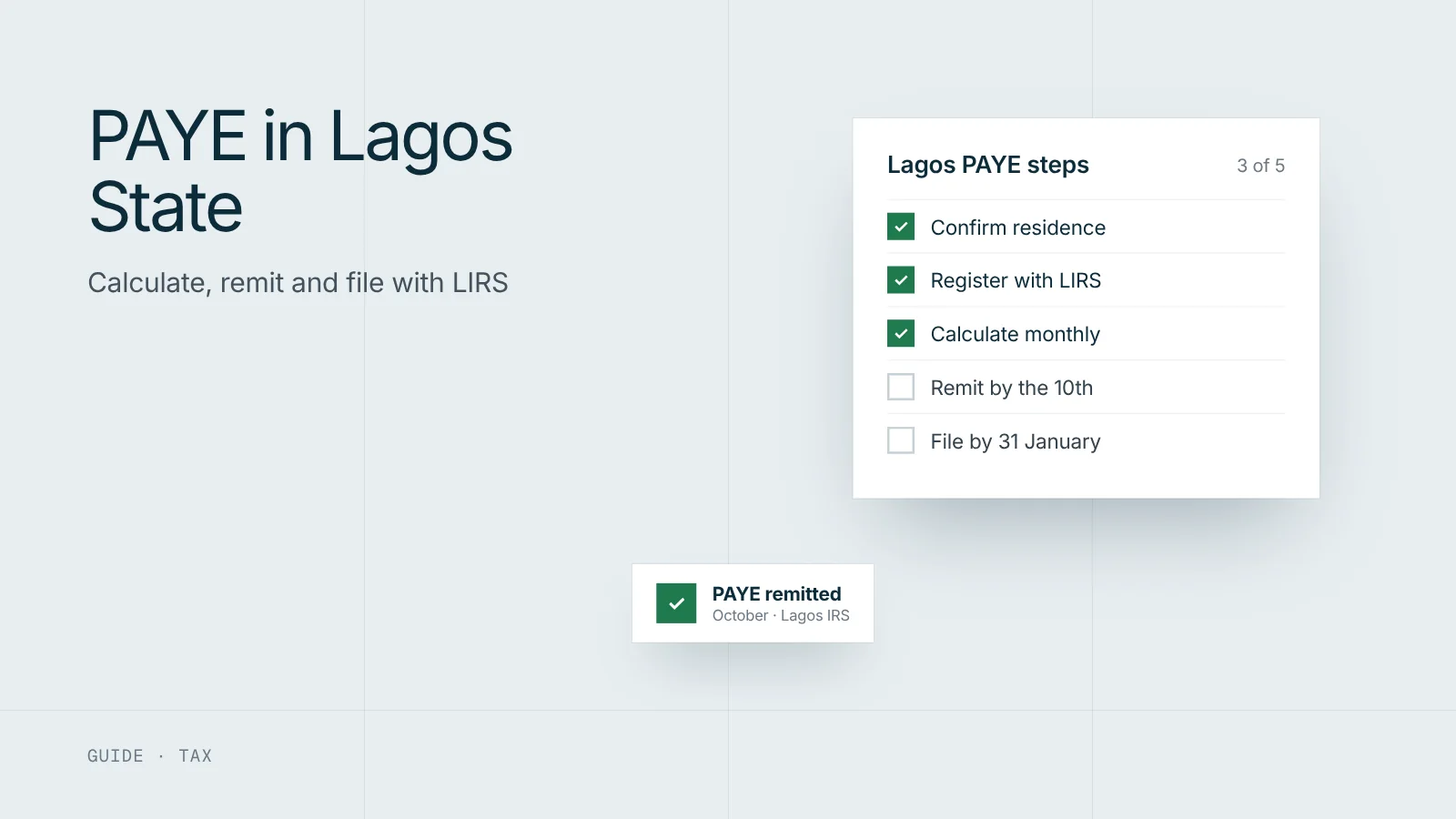
- Remit PAYE to the right state by the 10th of the following month, and file annual returns by 31 January.
Check any salary in seconds
Our PAYE calculator runs a salary through both laws, with rent relief and pension, so you can answer staff questions before payday.
The full report has all 15 salary points with effective rates and net pay, the rent relief tables and the worked calculations behind every figure.
Methodology
Figures are Workstat calculations, not survey data. We applied the Personal Income Tax Act (as amended) and the Nigeria Tax Act 2025 to monthly gross salaries from ₦70,000 to ₦10,000,000.
Assumptions: basic, housing and transport make up 90% of gross pay; the employee contributes 8% of that to pension; no NHF, life assurance or other reliefs unless stated; rent relief only where shown. Old law: Consolidated Relief Allowance of ₦200,000 or 1% of gross (whichever is higher) plus 20% of gross, the six bands from 7% to 24%, and the 1% minimum tax. New law: the six bands from 0% to 25% effective 1 January 2026, and the exemption for earnings at or below the national minimum wage. Results are rounded to the nearest naira.
Employee management made easy
Keep employee records, attendance, leave, payroll and performance in one connected system.
Sources
- Nigeria Tax Act 2025: taxation of employment income (Mondaq)
- Understanding personal income tax under the Nigerian Tax Act 2025 (Mondaq)
- Nigeria Revenue Service
- Personal Income Tax Act (as amended), section 33 and the Sixth Schedule
Frequently asked questions
Short answers to what employers ask us most about this topic.
Did PAYE go up or down in 2026?
Both, depending on pay. On our assumptions PAYE fell for low earners (by 28% at ₦100,000 a month), stayed within a few thousand naira between about ₦150,000 and ₦1.3 million a month, and rose above that, by 26% at ₦10 million a month.
What is the tax-free amount under the Nigeria Tax Act 2025?
The first ₦800,000 of annual taxable income is taxed at 0%. Employment income at or below the national minimum wage is exempt altogether.
Is rent relief automatic?
No. It applies to rent the employee actually pays. Employers should collect a declaration and evidence before applying it. The relief is 20% of annual rent, capped at ₦500,000.
Where do employers pay PAYE now?
PAYE on employment income is still remitted to the tax authority of the state where the employee lives, by the 10th of the following month. The federal agency was renamed the Nigeria Revenue Service in the 2025 reforms.
Get the full report
Every table, chart and worked example in one PDF. Tell us where to send it and we will deliver it to your inbox and WhatsApp.
- Full data tables and charts
- Methodology and every source
- First look at the next edition