PAYE calculator Nigeria 2026
Free PAYE and salary calculator for Nigeria using the Nigeria Tax Act 2025 bands. Work out take-home pay from gross, or gross from net, and compare with the old law.
- Free, no sign-up
- Built on current Nigerian rates
- Print or save the result as a PDF
| Item | Monthly | Annual |
|---|
| Band (annual taxable income) | Rate | Taxable in band | Tax |
|---|
| Old law (PITA) | New law (NTA 2025) |
|---|
Old law figures use the Consolidated Relief Allowance and the PITA bands that applied until 31 December 2025, for comparison only.
| Employer cost | Monthly | Annual |
|---|
ITF applies to employers with 5 or more staff or annual turnover of ₦50 million and above. NSITF covers the Employees' Compensation Scheme.
Rates effective 1 January 2026. Source: Nigeria Tax Act 2025, Fourth Schedule (rates) and Section 30 (deductions and rent relief).
Estimates only, based on the rates shown. Confirm figures with your State Internal Revenue Service or a tax adviser before filing.
How the calculator works
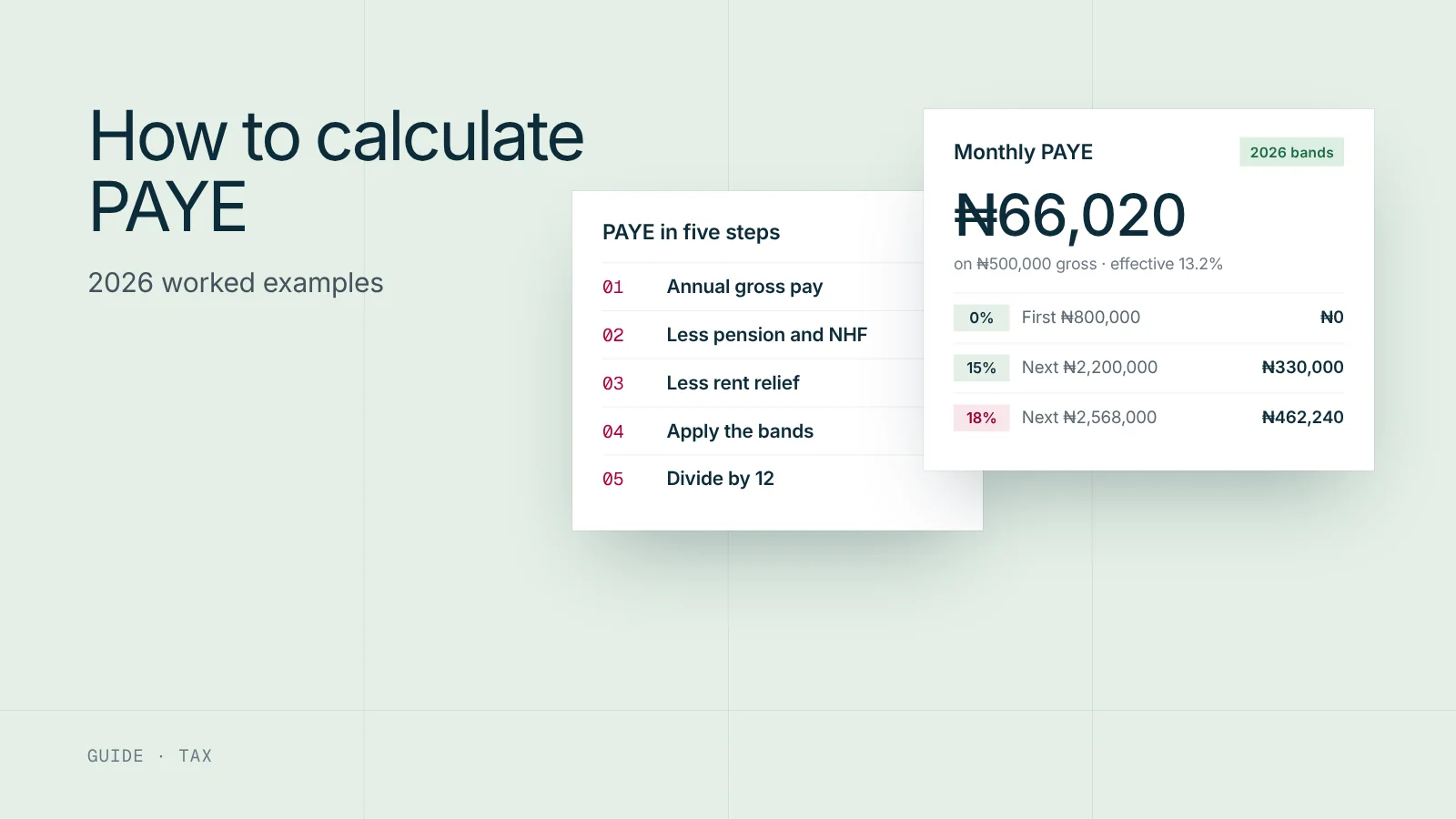
The calculator follows the order set by the Nigeria Tax Act 2025, which took effect on 1 January 2026:
- Start with annual gross employment income: basic salary plus every allowance.
- Subtract allowable deductions: your pension contribution, NHF, NHIS, life insurance premiums and mortgage interest on an owner-occupied home.
- Subtract rent relief: 20% of the annual rent you pay, up to ₦500,000.
- Apply the progressive rates to what is left. The first ₦800,000 of taxable income is taxed at 0%.
- Divide by 12 for monthly PAYE.
If gross pay is at or below the national minimum wage of ₦70,000 a month, PAYE is nil and the calculator says so. Our guide on how to calculate PAYE by hand works through each step with a full example.
PAYE rates in Nigeria from 2026
| Annual taxable income | Rate |
|---|---|
| First ₦800,000 | 0% |
| Next ₦2,200,000 (up to ₦3,000,000) | 15% |
| Next ₦9,000,000 (up to ₦12,000,000) | 18% |
| Next ₦13,000,000 (up to ₦25,000,000) | 21% |
| Next ₦25,000,000 (up to ₦50,000,000) | 23% |
| Above ₦50,000,000 | 25% |
Each rate applies only to the slice of income inside its band. Moving into a higher band never makes the whole salary taxed at the higher rate. Move the slider below to see which bands a salary reaches and how much tax each slice adds.
Which bands a salary reaches
Drag the salary to see the tax on each slice of income under the 2026 rates.
Show the numbers
Source: Nigeria Tax Act 2025, Fourth Schedule (rates) and Section 30 (deductions and rent relief). Assumes basic, housing and transport make up 90% of gross, 8% employee pension on that amount, no rent relief or other reliefs. Rates effective 1 January 2026. Estimates only.
PAYE on common salaries
These figures assume basic, housing and transport make up 90% of pay, the employee contributes 8% pension on those three, and there are no other reliefs. Your own split and reliefs will change the result, so use the calculator above for real decisions.
| Monthly gross | Monthly PAYE | Take-home after PAYE and pension | Effective PAYE rate |
|---|---|---|---|
| ₦70,000 | ₦0 (exempt) | ₦64,960 | 0% |
| ₦100,000 | ₦3,920 | ₦88,880 | 3.9% |
| ₦150,000 | ₦10,880 | ₦128,320 | 7.3% |
| ₦250,000 | ₦24,800 | ₦207,200 | 9.9% |
| ₦400,000 | ₦49,316 | ₦321,884 | 12.3% |
| ₦500,000 | ₦66,020 | ₦397,980 | 13.2% |
| ₦1,000,000 | ₦149,540 | ₦778,460 | 15.0% |
| ₦2,000,000 | ₦342,260 | ₦1,513,740 | 17.1% |
| ₦5,000,000 | ₦987,500 | ₦3,652,500 | 19.8% |
Monthly PAYE on common salaries under the new tax law
Assumes basic, housing and transport are 90% of pay, 8% employee pension, and no other reliefs.
Rent relief can lower PAYE
Rent relief is the main new relief for employees. If the employee on ₦500,000 a month pays ₦1,200,000 a year in rent, rent relief is ₦240,000 (20% of the rent, below the ₦500,000 cap). Taxable income falls from ₦5,568,000 to ₦5,328,000 and monthly PAYE falls from ₦66,020 to ₦62,420, a saving of ₦3,600 a month.
Employers can only apply the relief if they have the information. Decide what evidence you will accept, such as a tenancy agreement or rent receipt, and collect it before the first payroll run of the year. Enter the annual rent in the calculator to see the effect for any salary.
Rent relief cap
Rent relief reaches its ₦500,000 cap when annual rent is ₦2,500,000. Rent above that adds no further relief.
Old law compared with the new law
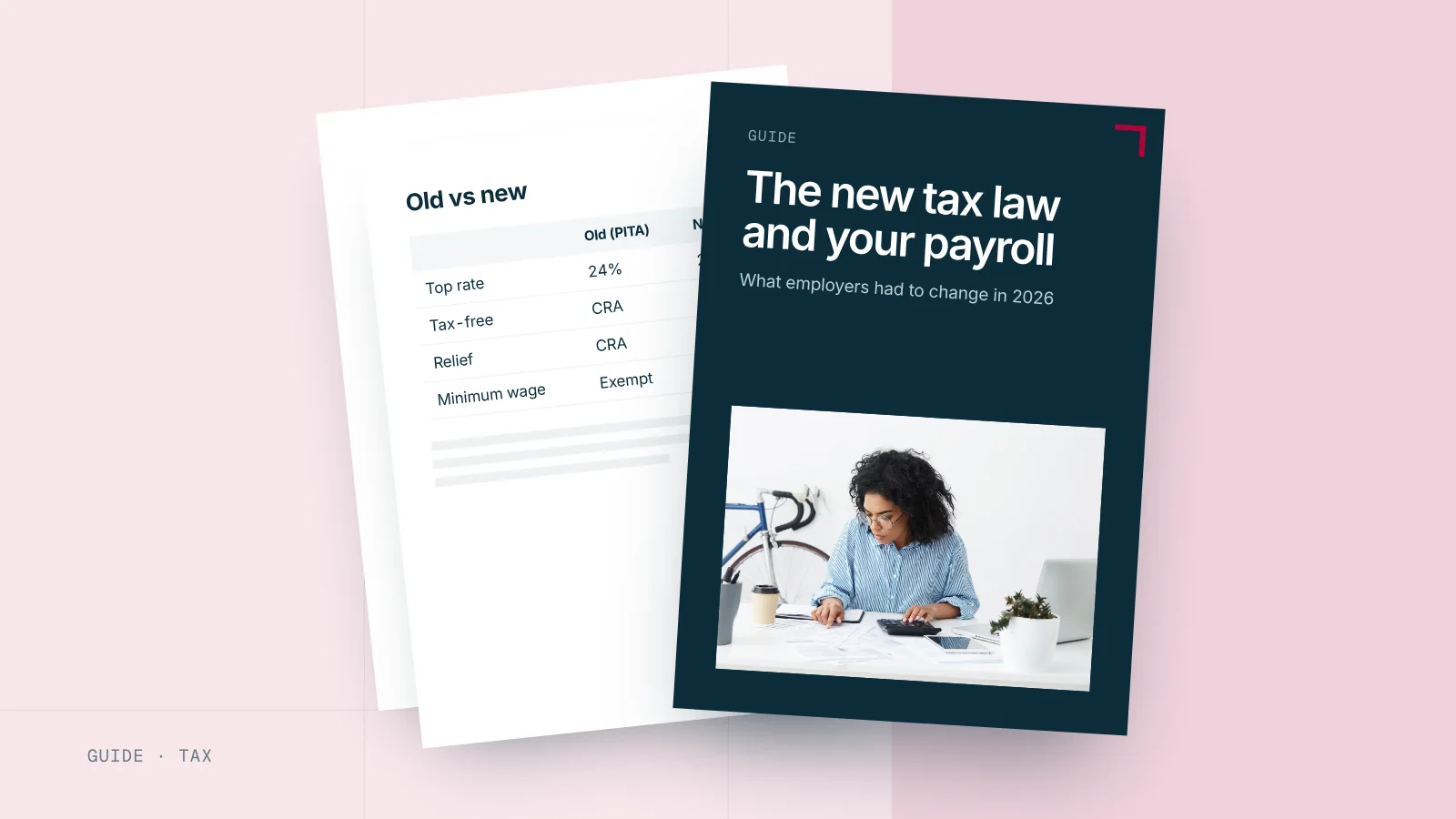
The comparison tab shows what the same salary would have paid under the Personal Income Tax Act rules that applied until 31 December 2025, with the Consolidated Relief Allowance and the old bands of 7% to 24%. For most salaries in our example the monthly difference is small. Lower earners generally pay less, and very high earners pay more because the top rate rose to 25% and the CRA has gone.
Monthly PAYE before and after 1 January 2026
Same salary split and 8% pension, no other reliefs.
Show the numbers
Source: Nigeria Tax Act 2025, Fourth Schedule (rates) and Section 30 (deductions and rent relief); Personal Income Tax Act (as amended) for the old rules. Assumes basic, housing and transport make up 90% of gross, 8% employee pension on that amount, no rent relief or other reliefs. Rates effective 1 January 2026. Estimates only.
The pattern is uneven in the middle because the old CRA grew with gross pay while the new 0% band is a fixed ₦800,000. That is why staff on similar salaries may see different changes. Our guide to the new tax law for employers explains what to tell staff.
Gross to net and net to gross
Most people start with gross pay and want to know take-home pay. Employers often need the reverse: an offer letter promises a net figure, or a candidate asks for a take-home amount. Switch the calculator to net to gross, enter the take-home figure and it finds the gross salary that produces it, using the same split and deductions. Use the result to set gross pay in the contract, because PAYE and pension are worked out on gross.
What the calculator assumes
- Pension: 8% of basic, housing and transport, the employee minimum under the Pension Reform Act 2014. Untick it for staff who are not in the scheme.
- NHF: 2.5% of basic salary when ticked. See our NHF guide on who contributes.
- Salary split: 50% basic, 25% housing and 15% transport by default. Change it to match your structure. Our salary structure guide explains the choices.
- One employer, regular pay: bonuses, benefits in kind, a second job or other income can change the tax due. The result is an estimate for one employee.
The rates come from Workstat settings and are reviewed when the law changes. If you spot a difference from your state tax authority’s figures, tell us through the feedback link and we will check it.
Why your payslip might show a different figure
If your payslip PAYE differs from the calculator, one of these is usually the reason:
- A different salary split. Pension depends on basic, housing and transport. If your employer’s split differs from the default, pension and taxable income change.
- Reliefs your employer holds. Rent relief, NHF, life insurance or NHIS that your employer applies and you did not enter here, or the reverse.
- A cumulative method. Some payroll systems recalculate tax each month on year-to-date pay. After a bonus, a pay rise or a month of unpaid leave, the monthly PAYE moves even though the annual total ends up the same.
- Arrears or one-off payments. Backdated pay and bonuses are taxed in the month they are paid.
- Old rules still in the system. If PAYE looks higher or lower than this calculator by a similar amount every month, ask payroll whether the 2026 rules are set up. Our new tax law guide lists what had to change.
If none of these explain it, ask your payroll team for the working. Employees are entitled to understand the deductions on their pay.
For payroll teams
If you run payroll for more than a handful of staff, the calculator is useful for checking individual cases, but it is slow for a whole team. The free payroll template applies the same rules in Excel for up to 50 employees, and the payslip generator turns one employee’s figures into a payslip you can download.
Run payroll with Paystat
Process payroll with structured, consistent calculations and a full history of every pay cycle.
Sources
Frequently asked questions
Short answers to what employers ask us most about this topic.
How much tax will I pay on ₦100,000 a month in Nigeria?
About ₦3,920 a month under the 2026 rates, if basic, housing and transport make up 90% of pay and you contribute 8% pension with no other reliefs. Annual pay of ₦1,200,000 less ₦86,400 pension leaves ₦1,113,600 taxable. The first ₦800,000 is taxed at 0% and the remaining ₦313,600 at 15%. Rent relief or NHF would lower it further.
Is CRA still used to calculate PAYE in 2026?
No. The Nigeria Tax Act 2025 removed the Consolidated Relief Allowance from 1 January 2026 and introduced rent relief of 20% of annual rent paid, capped at ₦500,000.
Do minimum wage earners pay PAYE?
No. Employment income at or below the national minimum wage is exempt under the Nigeria Tax Act 2025. The calculator applies this automatically.
Can I work out the gross salary needed for a target take-home pay?
Yes. Switch the calculator to net to gross, enter the take-home pay you want to offer, and it finds the gross salary that produces it with the same split and deductions.