Key takeaways
- A salary structure has two parts: grades with pay ranges, and the split of each salary into basic pay and allowances.
- The split matters by law: pension is worked out on basic, housing and transport, and NHF on basic salary alone.
- A low basic salary raises take-home pay slightly but cuts the employee's pension savings and any benefit worked out on basic.
- Public sector bodies use consolidated structures set by government. They are not a template for private employers.
A salary structure answers two questions every employee asks sooner or later: why am I paid this, and how do I get paid more? Without one, pay is set role by role, and differences that nobody can explain build up. This guide shows Nigerian private employers how to build a structure from scratch, and why the split between basic pay and allowances deserves more attention than it usually gets.
Building a salary structure in six steps
- 01
List the roles
Every job in the business, with what it involves
- 02
Group into grades
Roles of similar size and responsibility share a grade
- 03
Price the grades
Set a midpoint for each grade from pay data you trust
- 04
Set the ranges
A minimum and maximum around each midpoint
- 05
Choose the split
Basic, housing, transport and other allowances
- 06
Check the law
Minimum wage, pension base and NHF on basic
Grades and pay ranges
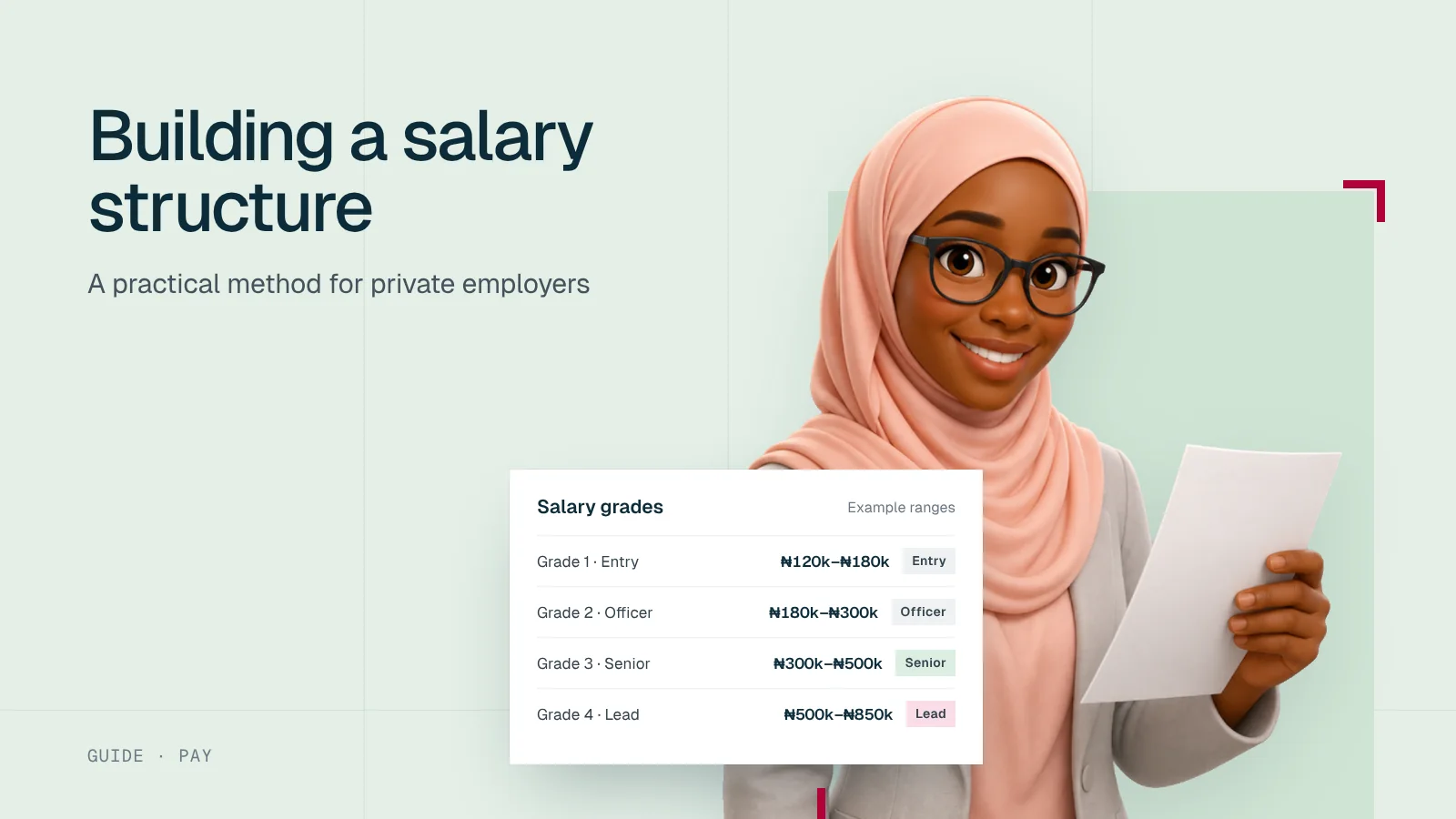
Start by listing every role and grouping roles of similar size into grades. Size means responsibility, skill and impact, not the person in the job today. Start with as few grades as you can explain to staff; you can split a grade later.
Each grade then gets a pay range: a minimum, a midpoint and a maximum. The midpoint is what a fully competent person in that grade should earn. New or developing staff sit below it; experienced staff above it.
Two choices shape the ranges:
- Range spread: how far the maximum is above the minimum. A spread of 50% means the maximum is 1.5 times the minimum.
- Midpoint progression: the gap between one grade’s midpoint and the next. Bigger gaps make promotion worth more.
The table shows the method with a 50% spread and roughly 20% between midpoints. The figures illustrate the arithmetic and are not market rates. Price your own grades from pay data you trust.
| Grade | Minimum | Midpoint | Maximum |
|---|---|---|---|
| 1 | ₦80,000 | ₦100,000 | ₦120,000 |
| 2 | ₦96,000 | ₦120,000 | ₦144,000 |
| 3 | ₦116,000 | ₦145,000 | ₦174,000 |
| 4 | ₦140,000 | ₦175,000 | ₦210,000 |
| 5 | ₦168,000 | ₦210,000 | ₦252,000 |
| 6 | ₦200,000 | ₦250,000 | ₦300,000 |
Every grade minimum must be at or above the national minimum wage of ₦70,000 a month. Check this each time the minimum wage is reviewed. Our minimum wage guide has the current figure and a quick check.
Workstat’s salary benchmarks report is being prepared. Until it is published, use surveys from sources you can name and date.
Splitting pay into basic and allowances
Most Nigerian employers split each salary into basic pay plus allowances such as housing and transport, and often others such as meal, utility or leave allowance. No law fixes the split for the private sector, but the law uses it:
- Pension is worked out on at least basic, housing and transport.
- NHF is 2.5% of basic salary alone.
- PAYE is worked out on total pay. Allowances are taxable unless the Nigeria Tax Act 2025 exempts them.
- Contract benefits such as gratuity, leave allowance or overtime are often worked out on basic pay.
Workstat’s calculators use 50% basic, 25% housing, 15% transport and 10% other as a default. It is a convention for illustration, not a legal requirement.
What a low basic salary does
Some employers keep basic low and put most of the salary into “other allowances”. Take-home pay rises slightly, but the employee’s retirement savings fall. Here is the same ₦300,000 salary under two structures, for an employee who contributes to NHF:
₦300,000 a month under two structures
The second structure gives ₦7,134 more take-home pay, but ₦16,200 less goes into the employee’s Retirement Savings Account every month, and the employee pays more tax because the pension deduction is smaller. Staff who compare payslips notice, and the structure can look like a way to cut the employer’s contributions. Choose a split you are comfortable explaining.
What each part of a salary is used for
With Workstat's default split of a ₦300,000 monthly salary.
Basic (50%) ₦150,000
Counts towards: Pension, NHF, PAYE, and often gratuity and overtime
Housing (25%) ₦75,000
Counts towards: Pension and PAYE
Transport (15%) ₦45,000
Counts towards: Pension and PAYE
Other (10%) ₦30,000
Counts towards: PAYE, and pension if your contract includes it
Pay reviews and progression
A structure only stays fair if it is maintained:
- Review the ranges every year. Move them with the market and with price rises, and check every minimum against the national minimum wage.
- Decide how people move through a range. For example, by performance rating, with larger rises for staff below the midpoint. Our appraisal form gives you the ratings.
- Put every change in writing. A pay letter should state the new salary, the split and the effective date. See our employment letter templates.
- Fix the outliers. Staff paid above the maximum keep their pay but may get lump-sum rises; staff below the minimum move up as a priority.
Public sector salary structures
Public sector workers are paid on consolidated salary structures approved by government, for example CONPSS for the federal civil service, CONUASS for university academic staff, CONPOSS for the police, CONAFSS for the armed forces and CONPASS for paramilitary services. Each sets grade levels and steps with fixed amounts and its own allowances.
These structures are designed for public service conditions and are not a template for private employers. Private businesses set their own grades, ranges and split, subject to the minimum wage, pension and NHF rules above.
Salary structure checklist
Design
Split
Maintenance
Ticks are saved in this browser only.
Run payroll with Paystat
Process payroll with structured, consistent calculations and a full history of every pay cycle.
Written for: HR, business owners
Run payroll with Paystat
Process payroll with structured, consistent calculations and a full history of every pay cycle.
Sources
Frequently asked questions
Short answers to what employers ask us most about this topic.
What is the standard salary structure in Nigeria?
There is no legal standard for the private sector. Many employers split pay into basic, housing, transport and other allowances, and Workstat's calculators default to 50% basic, 25% housing, 15% transport and 10% other. Whatever split you use, pension must be worked out on at least basic, housing and transport.
Can I pay a consolidated salary?
You can agree a single figure, but you still need to show basic, housing and transport separately, because pension and NHF are calculated on those amounts. Record the split in the contract and on every payslip.
How often should a salary structure be reviewed?
At least once a year, and whenever the national minimum wage or tax rules change. Check every grade minimum against the current national minimum wage of ₦70,000 a month.