Workstat Wage Report 20269-page PDFFree download
The ₦70,000 Question
Two years after the ₦70,000 minimum wage took effect, prices are up about 42%. What the floor buys now, why food costs bite harder, what labour is asking for, and what employers should plan for before the next review.
- The floor
- Two years of prices
- Food first
Get the full report
Free. The ₦70,000 Question (PDF).
The report in five numbers
The figures that matter most, before you read the detail.
What is inside
- The floorWhat the 2024 Act says, and who it covers
- Two years of pricesWhat inflation did to ₦70,000
- Food firstWhy low earners feel price rises more
- The next reviewLabour's demand and the 2027 timetable
- What employers can do nowPay floors, tax and budgeting
Who it is for
What the floor is worth now, and what may change in 2027.
Plain numbers on prices since July 2024.
The cost of moving pay floors, with worked examples.
The summary
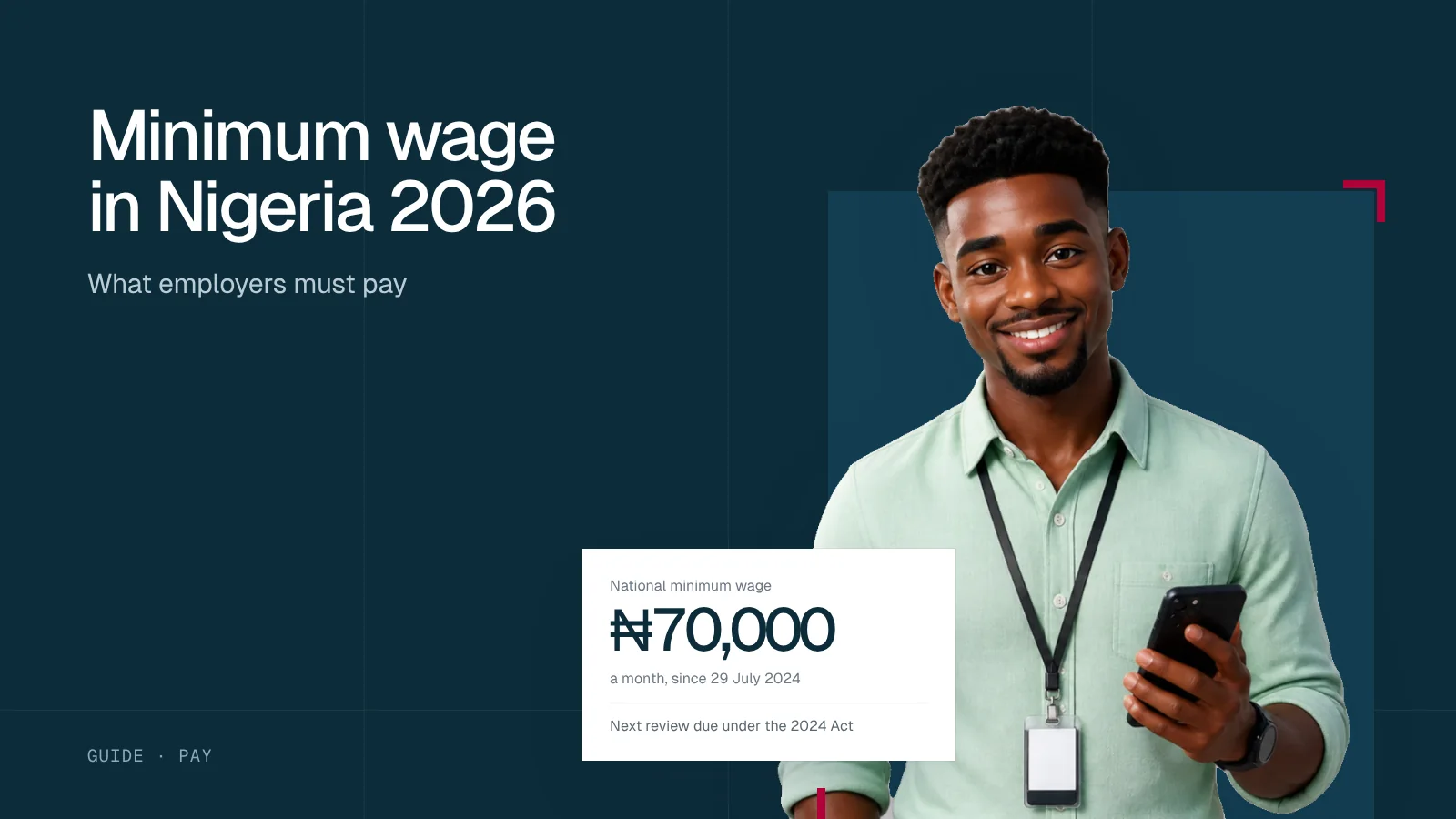
The National Minimum Wage (Amendment) Act 2024 set the national floor at ₦70,000 a month from 29 July 2024 and shortened the review cycle to three years. Two years on, the number is the same. Prices are not.
The floor
The minimum wage applies to employers in the public and private sectors, except establishments with fewer than 25 workers, part-time workers, workers paid by commission or piece rate, and seasonal workers. It is a floor for total monthly pay for full-time work. Earnings at or below it are exempt from PAYE under the Nigeria Tax Act 2025, but pension still applies: on ₦70,000 the employee contributes ₦5,040 and takes home ₦64,960.
How the national minimum wage got here
- 01
2011: ₦18,000
National Minimum Wage (Amendment) Act 2011
- 02
2019: ₦30,000
National Minimum Wage Act 2019
- 03
July 2024: ₦70,000
Amendment Act 2024, with a review at least every three years
- 04
August 2026: ₦500,000 asked
The NLC sets its benchmark for the next review
- 05
2027: review due
Three years after the 2024 Act
Two years of prices
Chaining the NBS headline inflation rates from July 2024 to September 2026 gives a rise in consumer prices of about 42%. In July 2024 money, ₦70,000 is now worth about ₦49,400.
The minimum wage in today's prices
| Monthly pay in July 2024 | Needed in September 2026 to buy the same |
|---|---|
| ₦70,000 | ₦99,260 |
| ₦100,000 | ₦141,800 |
| ₦150,000 | ₦212,700 |
| ₦250,000 | ₦354,500 |
Food first
Headline inflation fell to 14.63% in September 2026, but food inflation was 19.59%. Low earners spend more of each naira on food, so the price rise they feel is closer to the food number than the headline. Food prices did fall 1.55% between August and September, but one month does not undo two years.
For a worker on ₦70,000, the inflation rate that matters is the price of a market basket, not the headline.
The next review
Organised labour has opened its case. On 7 August 2026 the NLC set ₦500,000 as its benchmark, arguing that ₦70,000 no longer covers food, transport and rent. Lagos workers have called for ₦225,000 at state level. The 2024 Act provides for a review at least every three years, which points to 2027. Any new national figure needs a new law.
What employers can do now
- Check who in your workforce sits within 20% of the floor, and what a new figure would cost.
- Review pay against prices once a year, using the latest NBS headline and food rates.
- Keep pay structures simple, so a new floor can be applied without rebuilding every grade.
- Remember the PAYE exemption ends just above the floor: a raise from ₦70,000 to ₦75,000 brings tax into play.
Check pay against the floor
Use our minimum wage guide and checker to see whether the Act applies to you and how far any wage is from the minimum.
Methodology
Real value is measured in July 2024 naira. We chained NBS headline inflation: the year-on-year rate for July 2025 (21.88%), the year-on-year rate for July 2026 (15.43%), and the month-on-month rates for August 2026 (0.71%) and September 2026 (0.06%). Together these give a rise of about 41.8% from July 2024 to September 2026; ₦70,000 divided by 1.418 is about ₦49,400. The NBS rebased the CPI to 2024 in January 2025, and its rebased year-on-year rates are used throughout. Wage demands are as reported in the press.
Employee management made easy
Keep employee records, attendance, leave, payroll and performance in one connected system.
Sources
- The National Minimum Wage (Amendment) Act 2024: key updates (Mondaq)
- Fact-check: does the new minimum wage apply to all employers? (CDD)
- Nigeria's headline inflation drops to 14.63 per cent (Voice of Nigeria, October 2026)
- September 2026 inflation and food prices (Legit.ng)
- NLC demands ₦500,000 minimum wage (Legit.ng, August 2026)
- Lagos workers demand ₦225,000 as NLC prepares for wage negotiation (The Guardian)
- National Bureau of Statistics, Consumer Price Index reports
Frequently asked questions
Short answers to what employers ask us most about this topic.
What is ₦70,000 worth in 2026?
About ₦49,400 in July 2024 money. We chained the NBS headline inflation rates from July 2024 to September 2026, a rise of about 42%.
Is the minimum wage going up in 2026?
Not yet. The NLC has called for ₦500,000, and the 2024 Act provides for a review at least every three years, which points to 2027. Any change needs a new law.
Who has to pay the minimum wage?
Employers in the public and private sectors, except establishments with fewer than 25 workers and some categories such as part-time, commission and seasonal workers.
Do minimum wage earners pay PAYE?
No. Employment income at or below the national minimum wage is exempt under the Nigeria Tax Act 2025. Pension contributions still apply where the employer is covered.
Get the full report
Every table, chart and worked example in one PDF. Tell us where to send it and we will deliver it to your inbox and WhatsApp.
- Full data tables and charts
- Methodology and every source
- First look at the next edition