Performance appraisal form template and guide
A free performance appraisal form you can adapt, with a five-point rating scale, objectives, competencies and a development plan, and a practical guide to running reviews that staff trust.

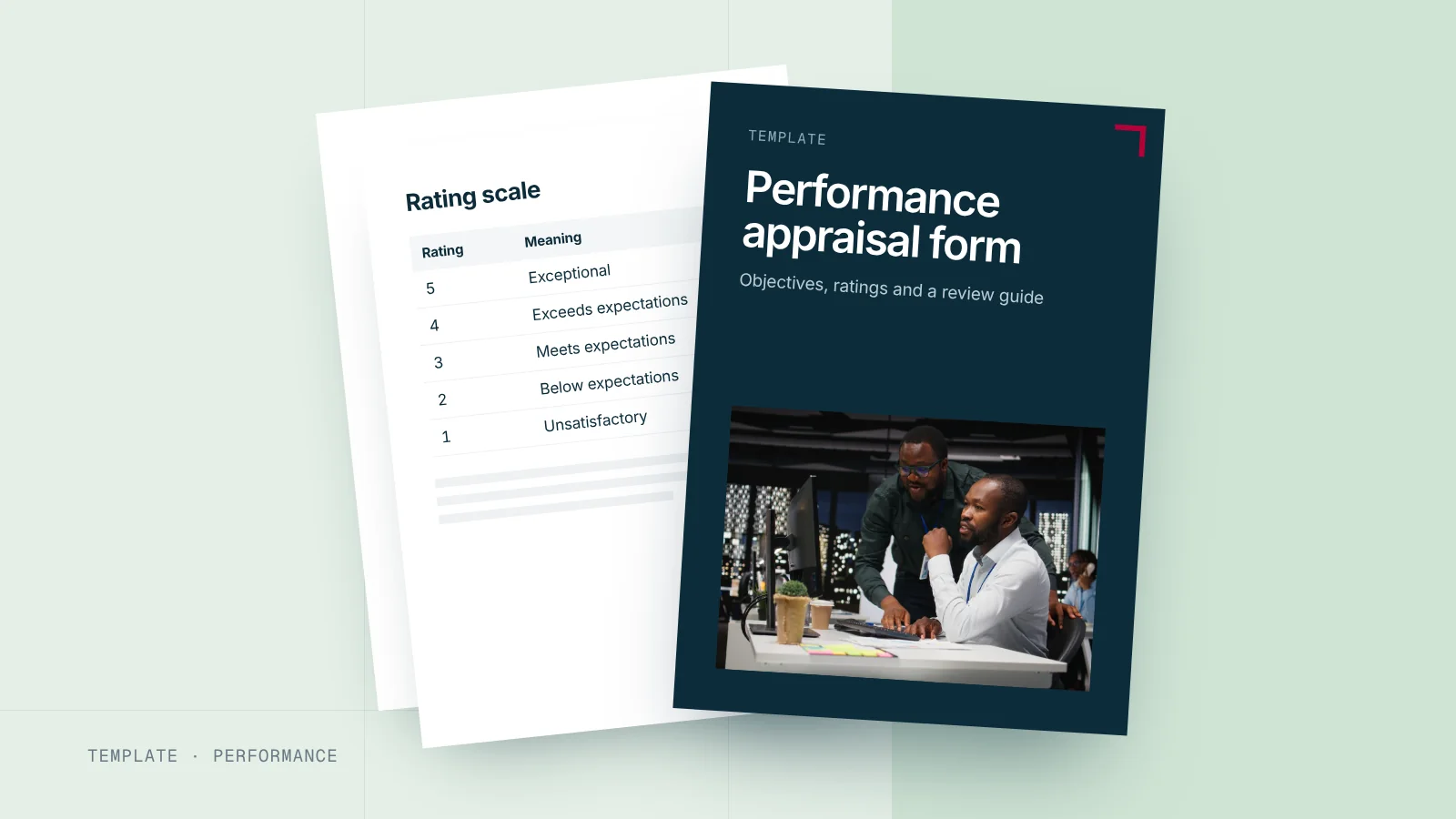
A performance appraisal form gives the review a structure: what the employee was asked to do, how well they did it, and what happens next. This template is deliberately short. Long forms get filled in at the last minute and read by nobody. Download the Word version below and adapt the competencies to your organisation.
A year of performance management
Set objectives
Three to five measurable objectives at the start of the year
Check in each quarter
Short conversations on progress, blockers and support
Self-assessment
The employee rates themselves with evidence before the review
Review meeting
Discuss results, agree ratings and set a development plan
Calibrate and record
HR checks ratings are consistent, then files the signed form
The rating scale
Most disagreements about appraisals come from ratings that mean different things to different managers. Define every point on the scale in words and put the definitions on the form.
| Rating | Label | What it means |
|---|---|---|
| 5 | Outstanding | Consistently exceeded every objective; a model for others |
| 4 | Exceeds expectations | Met every objective and exceeded several |
| 3 | Meets expectations | Met the objectives and standards of the role |
| 2 | Partly meets expectations | Met some objectives; clear improvement needed |
| 1 | Does not meet expectations | Did not meet most objectives; a formal improvement plan is needed |
A healthy distribution usually has most people at 3, fewer at 4 and 2, and very few at 5 and 1. If every rating is a 4 or 5, the scale has stopped telling you anything.
The appraisal form
Part A: employee and review details
Employee name: [name]
Job title: [title]
Department: [department]
Reviewer: [name and title]
Review period: [from date] to [to date]
Type of review: [Annual / Mid-year / Probation]
Part B: objectives
List three to five objectives agreed at the start of the period.
Objective 1: [objective, with the measure, for example “Reduce payroll errors to fewer than two a month by June”]
Result: [what was achieved, with evidence]
Rating (1 to 5): [ ]
Objective 2: [objective]
Result: [result]
Rating (1 to 5): [ ]
Objective 3: [objective]
Result: [result]
Rating (1 to 5): [ ]
Part C: competencies
Rate each competency from 1 to 5, with one example of behaviour seen during the period.
Job knowledge and quality of work: [rating] [example]
Reliability and attendance: [rating] [example]
Communication and teamwork: [rating] [example]
Customer focus: [rating] [example]
Initiative and problem solving: [rating] [example]
For managers, leading and developing people: [rating] [example]
Part D: overall rating and comments
Overall rating (1 to 5): [ ]
Reviewer’s summary: [two or three sentences on the main strengths and the main area to improve]
Employee’s comments: [the employee’s view of the review]
Part E: development plan
Development goal 1: [skill or behaviour to develop]
Action: [training, project, coaching or reading]
Support needed: [from the manager or company]
Review date: [date]
Development goal 2: [goal]
Action: [action]
Support needed: [support]
Review date: [date]
Part F: sign-off
Employee signature: ____________ Date: ________
Reviewer signature: ____________ Date: ________
Second-level manager or HR: ____________ Date: ________
The employee’s signature confirms that the review was discussed, not that they agree with every rating.
Writing objectives that can be rated
Objectives should be specific enough that the employee and the manager would give the same rating. Compare:
Vague objectives compared with ratable ones
Three to five objectives is enough. More than that and the review turns into a list.
Running the review meeting
- Prepare. The employee completes a self-assessment a week before. The manager gathers evidence: results, feedback, attendance records.
- Start with the employee’s view. Ask them to talk through their self-assessment before you give yours.
- Discuss each objective with evidence. Agree where you can; record where you disagree.
- Agree the development plan. Two goals that the employee owns, with support you will actually provide.
- Close clearly. Summarise the overall rating and what happens next, and give the employee time to add comments before signing.
Making ratings fair
- Use the whole period. Keep short notes after each quarterly check-in, so the review is not based on the last month.
- Calibrate. Before ratings are final, managers in the same department compare their ratings with HR to make sure a 3 means the same thing everywhere.
- Separate pay. If pay rises depend on ratings, hold the pay conversation separately. When money is in the room, people stop listening to feedback.
- Watch attendance carefully. Do not mark down someone for approved leave, sick leave or maternity leave. Our guides to sick leave and maternity leave explain the entitlements.
When performance is poor
A rating of 1 or 2 should lead to a written improvement plan with specific targets, support and a review date, usually 30 to 90 days. Document each review meeting. If performance does not improve and you consider ending employment, follow your contract and disciplinary procedure and read our termination guide first. The appraisal record is often the main evidence that the employee knew what was expected.
Probation reviews
Use a shorter version of the form at the end of probation: two or three objectives, the competencies, and a clear recommendation to confirm, extend or end the appointment. Confirm the outcome in writing; our employment letter templates include a confirmation of appointment.
Before the review
In the meeting
After the review
Ticks are saved in this browser only.
Download the Word form, adapt the competencies to your organisation, and use the same version for everyone in the review period.
Employee management made easy
Keep employee records, attendance, leave, payroll and performance in one connected system.
Sources
Frequently asked questions
Short answers to what employers ask us most about this topic.
What should a performance appraisal form contain?
Employee and reviewer details, the review period, objectives with results, ratings against a few core competencies, an overall rating, comments from both sides, a development plan and signatures.
How often should appraisals be done?
Most Nigerian employers run a full appraisal once or twice a year, with short check-ins each quarter. Probation reviews happen before confirmation.
Is an appraisal required by law in Nigeria?
No law requires appraisals for private-sector staff. They matter legally when performance is the reason for a warning, a refused confirmation or a termination, because they show the employee was told what was expected.