Key takeaways
- Under the Pension Reform Act 2014 the employer contributes at least 10% and the employee at least 8% of monthly emoluments.
- Monthly emolument for pension is at least the total of basic salary, housing and transport allowances.
- Employers with 15 or more employees must take part. Contributions are due within 7 days of paying salaries.
- Employers must also keep group life insurance for each employee worth at least three times their annual total emolument.
The Contributory Pension Scheme is the second-largest deduction on most Nigerian payslips after PAYE, and the one employees check most often, because they can see their Retirement Savings Account (RSA) balance. This guide covers what the Pension Reform Act 2014 requires of employers: the rates, the salary they apply to, who must take part, remittance and penalties.
Nigeria's pension industry at 31 March 2026
Figures from PenCom's Q1 2026 industry dashboard and report.
PenCom’s own reports describe how much room the scheme has to grow.
Pension coverage “remains relatively low compared with the size of Nigeria’s labour force.”
PenCom Q1 2026 report, as reported by Nairametrics, August 2026
Contribution rates
The Act sets minimum rates. Employers can pay more, and many do as part of their benefits package.
Minimum pension contributions
Source: Pension Reform Act 2014.
Monthly emolument for pension purposes is the total emolument in the contract of employment, but never less than basic salary plus housing and transport allowances. If your contracts pay a single consolidated salary, split it before you calculate pension, or you risk contributing on the wrong amount.
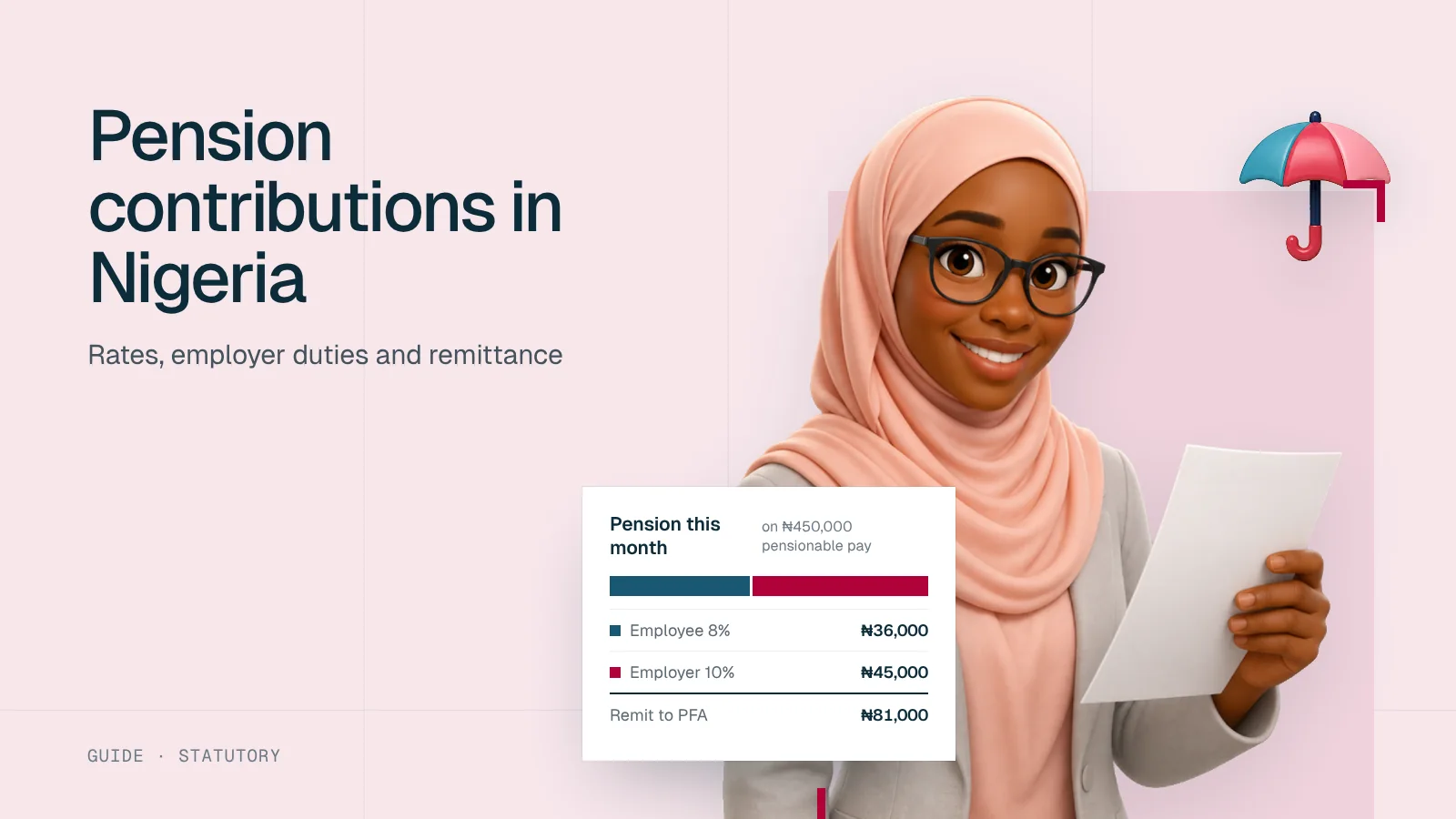
On a ₦500,000 monthly salary with 50% basic, 25% housing and 15% transport, the pension base is ₦450,000:
| Monthly | Annual | |
|---|---|---|
| Employee contribution (8%) | ₦36,000 | ₦432,000 |
| Employer contribution (10%) | ₦45,000 | ₦540,000 |
| Total into the RSA | ₦81,000 | ₦972,000 |
The employee’s 8% is deducted before PAYE is worked out, so it lowers their tax. The pension calculator shows the figures for any salary and projects a balance at retirement.
Voluntary contributions
Employees can pay more than 8% through voluntary contributions, deducted through payroll and sent to the PFA with the mandatory amount. Set them up in writing, show them as a separate payslip line, and stop them when the employee asks.
Which employers must take part
The Act applies to employment in the public service and to private employers with 15 or more employees. Self-employed people and employers with fewer than three employees may join voluntarily under PenCom guidelines.
A gap in the Act
Commentators have pointed out that the Act does not say clearly what applies to private employers with between three and fourteen staff. If you are in that range, ask PenCom or a Pension Fund Administrator for the current position, and keep their answer on file. Joining voluntarily is always open to you.
The private sector already accounts for close to half of all contributions made since the scheme began.
Cumulative pension contributions by sector
From the start of the scheme to the end of March 2026, out of ₦14.10tn in total.
Show the numbers
| Item | Value |
|---|---|
| Public sector 51.78% of the total | ₦7.3tn |
| Private sector 48.22% of the total | ₦6.8tn |
Source: PenCom Q1 2026 dashboard.
Setting up a new employee
Every employee in the scheme has a Retirement Savings Account with a Pension Fund Administrator (PFA) of their choice, identified by an RSA PIN. Staff who change jobs keep the same RSA and PIN.
- Ask for the RSA PIN and PFA on day one. Add both to the payroll record.
- New to the scheme? The employee chooses a PFA and opens an RSA. The employer cannot choose the PFA for them.
- Check the details match. Contributions sent with a wrong PIN or name sit unallocated, and the employee sees a gap in their statement.
Our onboarding checklist includes the RSA PIN with the other details to collect.
Remitting contributions
Deduct the employee’s contribution when you pay salaries, add the employer’s contribution, and send the total to each employee’s PFA within 7 days. Each PFA receives the money through its Pension Fund Custodian, with a schedule showing each employee’s name, RSA PIN and contribution.
The penalty is “not less than two per cent (2%) of the total contribution that remains unpaid or unremitted by the employer.”
Pension Reform Act 2014, as summarised by Proshare
The penalty is a cost to the business. It cannot be passed to employees, and paying it does not remove the duty to pay the contributions.
One month of pension compliance
For salaries paid on the 25th.
- Day 25
Salaries paid
Employee’s 8% deducted in the same run
- Day 26
Schedules prepared
One line per employee, grouped by PFA
- Day 30
Remittance
Within 7 days of paying salaries; earlier is safer
Group life insurance
Separately from contributions, the Act requires employers to keep a group life insurance policy for each employee, worth at least three times the employee’s annual total emolument. The premium must be paid no later than the date the cover starts.
For an employee whose annual total emolument is ₦6,000,000, the cover must be at least ₦18,000,000.
If cover lapses
If an employee dies while the employer has no group life cover in place, the employer is directly liable to pay the death benefit that the policy would have paid, according to the Act as summarised by Proshare.
Common pension mistakes
- Contributing on basic salary only. The base is at least basic, housing and transport.
- Holding contributions. Money deducted from staff and not remitted is the most serious failure, and staff can see it in their RSA statements.
- Missing RSA PINs. New staff are paid for months before their PIN is collected, and their contributions are delayed.
- Letting group life lapse. Renewal dates pass unnoticed, and the business carries the risk.
- No records for leavers. Keep final contribution schedules and payment evidence for staff who leave.
Pension checklist
Set-up
Every month
Every year
Ticks are saved in this browser only.
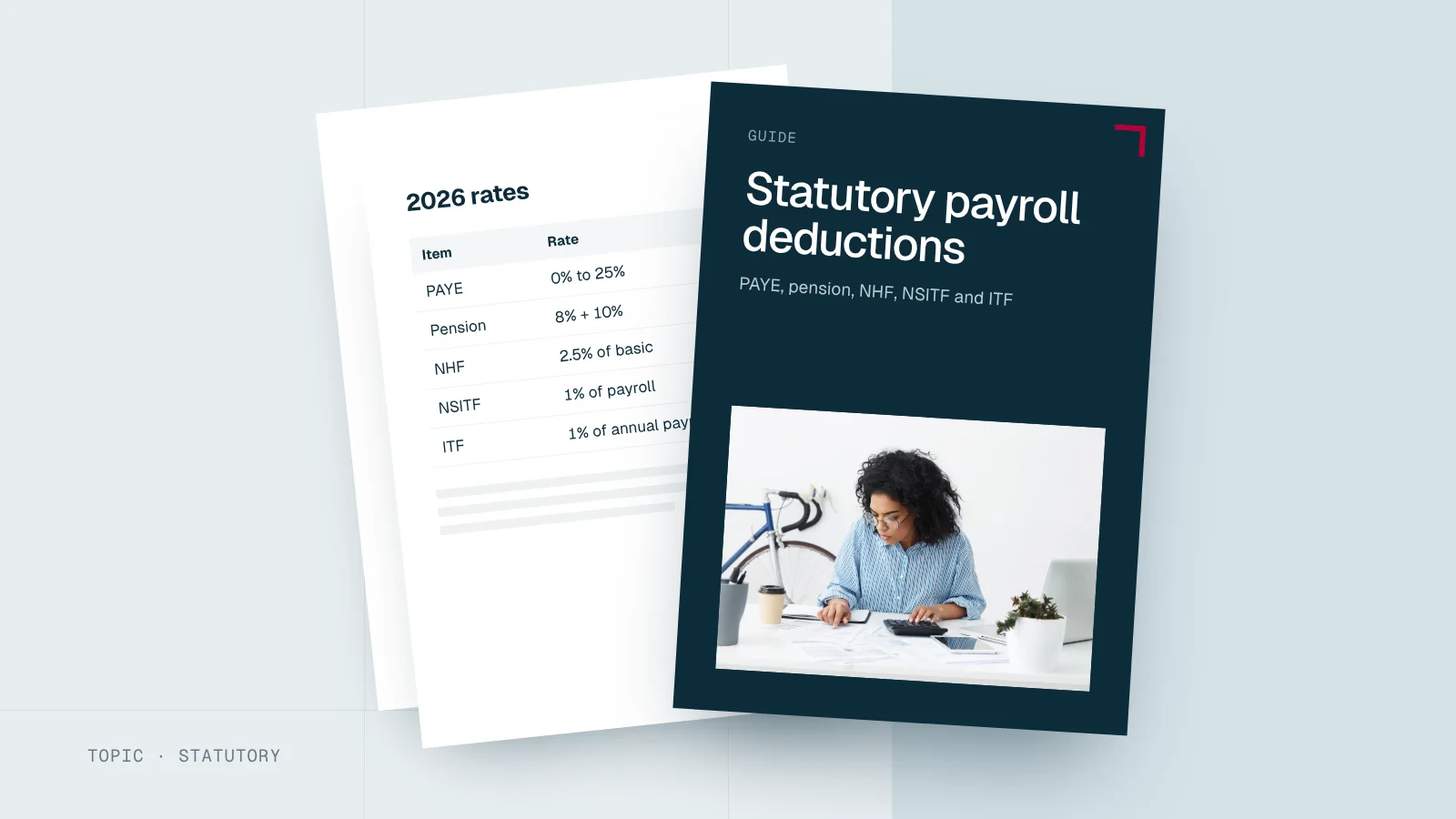
Pension is one of five statutory items on Nigerian payroll. See statutory payroll deductions for the others.
Run payroll with Paystat
Process payroll with structured, consistent calculations and a full history of every pay cycle.
Written for: Payroll officers, employees
Run payroll with Paystat
Process payroll with structured, consistent calculations and a full history of every pay cycle.
Sources
Frequently asked questions
Short answers to what employers ask us most about this topic.
What is the pension contribution rate in Nigeria?
At least 10% of monthly emoluments from the employer and at least 8% from the employee, a total of 18%. An employer can choose to pay the whole contribution, which must then be at least 20%.
Is pension compulsory for small businesses in Nigeria?
The Act requires private employers with 15 or more employees to take part. Employers with fewer than three employees and self-employed people may join voluntarily. Commentators have noted that the position of employers with between three and fourteen staff is not clearly stated, so check with PenCom or your PFA.
When must pension contributions be remitted?
Within 7 days of paying salaries, to each employee's Pension Fund Administrator. Late remittance attracts a penalty of not less than 2% of the unpaid contribution.