Key takeaways
- Before the first payroll, register with your state tax authority for PAYE and with NSITF, and collect each employee's TIN, PFA and RSA PIN.
- Each month: collect changes, calculate gross pay, deduct PAYE, pension and NHF, approve, pay, then remit and file.
- Key deadlines: pension within 7 days of paying salaries, PAYE by the 10th, NSITF by month end, NHF within one month.
- Each year: the employer PAYE return by 31 January, NSITF payroll statements by 28 February and the ITF levy by 1 April.
Payroll is where HR promises become money. Get it right and nobody notices. Get it wrong and you have unhappy staff, penalties from tax and pension authorities, and records that do not add up at year end. This guide covers payroll in Nigeria from first set-up to annual returns, and links to a detailed guide for each part.
Before the first payroll
Set these up once, before you pay anyone:
- A salary structure. Decide how gross pay splits into basic, housing, transport and other allowances. The split affects pension and NHF, which are calculated on parts of pay. See how to build a salary structure.
- PAYE registration. Register as an employer with the internal revenue service of the state where your staff live, so you can remit PAYE and file returns. Lagos employers deal with LIRS; see our Lagos PAYE guide.
- Pension. Employers with 15 or more employees must operate the contributory pension scheme. Each employee chooses a Pension Fund Administrator and has a Retirement Savings Account PIN. See pension contributions.
- NSITF. Register for the Employees’ Compensation Scheme and pay 1% of monthly payroll. See NSITF registration and payment.
- NHF and ITF. Set up NHF remittance for contributing employees, and register with the ITF if you have five or more employees or turnover of ₦50 million or more. See NHF and ITF.
- Employee records. For each person: contract, bank details, TIN, PFA and RSA PIN, NHF number where they have one, and next of kin. Our onboarding checklist lists them.
The numbers payroll runs on
Statutory rates and limits for Nigerian payroll in 2026
Employee pension
8 %
Of basic, housing and transport, deducted from pay
Employer pension
10 %
Of the same emoluments, paid on top
NHF
25 %
Of basic salary, deducted from pay
NSITF
1 %
Of total monthly payroll, paid by the employer
ITF
1 %
Of annual payroll, for employers over the threshold
PAYE 0% band
800000 ₦ a year
The first slice of taxable income
Minimum wage
70000 ₦ a month
Pay at or below this is exempt from PAYE
Source: Nigeria Tax Act 2025; Pension Reform Act 2014; NHF Act; Employees' Compensation Act 2010; ITF (Amendment) Act 2011; National Minimum Wage (Amendment) Act 2024.
The monthly cycle
Running payroll in Nigeria each month
Collect changes
New hires, leavers, pay changes, overtime, unpaid leave and loans
Calculate gross pay
Basic, housing, transport and every allowance, pro-rated where needed
Work out deductions
PAYE, employee pension, NHF and deductions the employee agreed in writing
Check and approve
Compare with last month and explain every large change
Pay, remit and file
Net pay to staff, then pension, PAYE, NHF and NSITF by their deadlines
1. Collect changes
Close inputs a few days before pay day: starters and leavers, promotions, overtime approved by managers, unpaid leave, new loans and the end of old ones. Late changes are the main cause of payroll errors.
2. Calculate gross pay
Apply the salary structure, then pro-rate for anyone who joined, left or took unpaid leave during the month. Add overtime and one-off payments on separate lines.
3. Work out deductions
Deduct PAYE under the 2026 rules, the employee’s pension contribution, NHF for contributing staff, and any deduction the employee has agreed to in writing, such as a staff loan.
Under section 5(7) of the Labour Act, total deductions in any month cannot exceed one third of that month’s wages.
4. Check and approve
Compare the payroll with last month. Every large change should have a reason: a new hire, a pay rise, a bonus. A second person should approve before money moves.
5. Pay, remit and file
Pay net salaries on the agreed date, then remit each deduction by its deadline.
Where the pay period is longer than a month, wages must be paid “at intervals not exceeding one month.”
Labour Act, section 15
Monthly deadlines
The timeline assumes salaries are paid on the 25th. If you pay on a different date, the pension deadline moves with it, because it runs from the day salaries are paid.
A payroll month, if salaries are paid on the 25th
Deadlines from the Nigeria Tax Administration Act 2025, Pension Reform Act 2014, NHF Act and Employees' Compensation Act 2010.
- Day 1
Pension for last month
Due within 7 days of paying last month’s salaries on the 25th
- Day 10
PAYE for last month
Remit to each employee’s state tax authority
- Day 25
Pay day, and NHF for last month
NHF is due within one month of the deduction
- Day 30
NSITF for this month
1% of the month’s total payroll, by the last day of the month
Late payment is expensive. Late pension remittance attracts a penalty of at least 2% of the amount due for each month it is late, and an employer that fails to deduct or remit PAYE pays the tax, a 10% penalty and interest.
The annual calendar
| Deadline | What | Who receives it |
|---|---|---|
| 31 January | Employer annual return of each employee’s pay and PAYE for the previous year | State internal revenue service |
| 28 February | Statement of actual and projected payroll for the Employees’ Compensation Scheme | NSITF |
| 31 March | Annual returns by individuals who file their own | State internal revenue service |
| 1 April | ITF levy of 1% of the previous year’s payroll | Industrial Training Fund |
Our statutory deductions guide explains each one, with the rates and penalties side by side.
Records to keep
Keep these for every pay period, and keep them safe, because they hold personal data protected by the Nigeria Data Protection Act 2023:
- The payroll register: every employee, every earning and every deduction.
- Payslips issued.
- Proof of each remittance: PAYE receipts, pension schedules and payment confirmations, NHF and NSITF receipts.
- Approvals for pay changes, overtime and one-off payments.
- Employee declarations, such as rent for rent relief, and written consent for loan deductions.
Common payroll mistakes in Nigeria
- Old tax logic. Spreadsheets carried over from 2025 still applying CRA or the old bands. See what changed in 2026.
- Pension on the wrong base. Pension is calculated on basic, housing and transport. A consolidated salary line makes the base unclear.
- Paying PAYE to the wrong state. PAYE goes to the state where the employee lives, not where the office is.
- Missing the pension window. Seven days from pay day is short. Prepare schedules before pay day.
- No second check. One person preparing and approving payroll is the easiest route to errors and fraud.
- Undocumented deductions. Loan and cooperative deductions without written consent invite disputes.
Tools that help
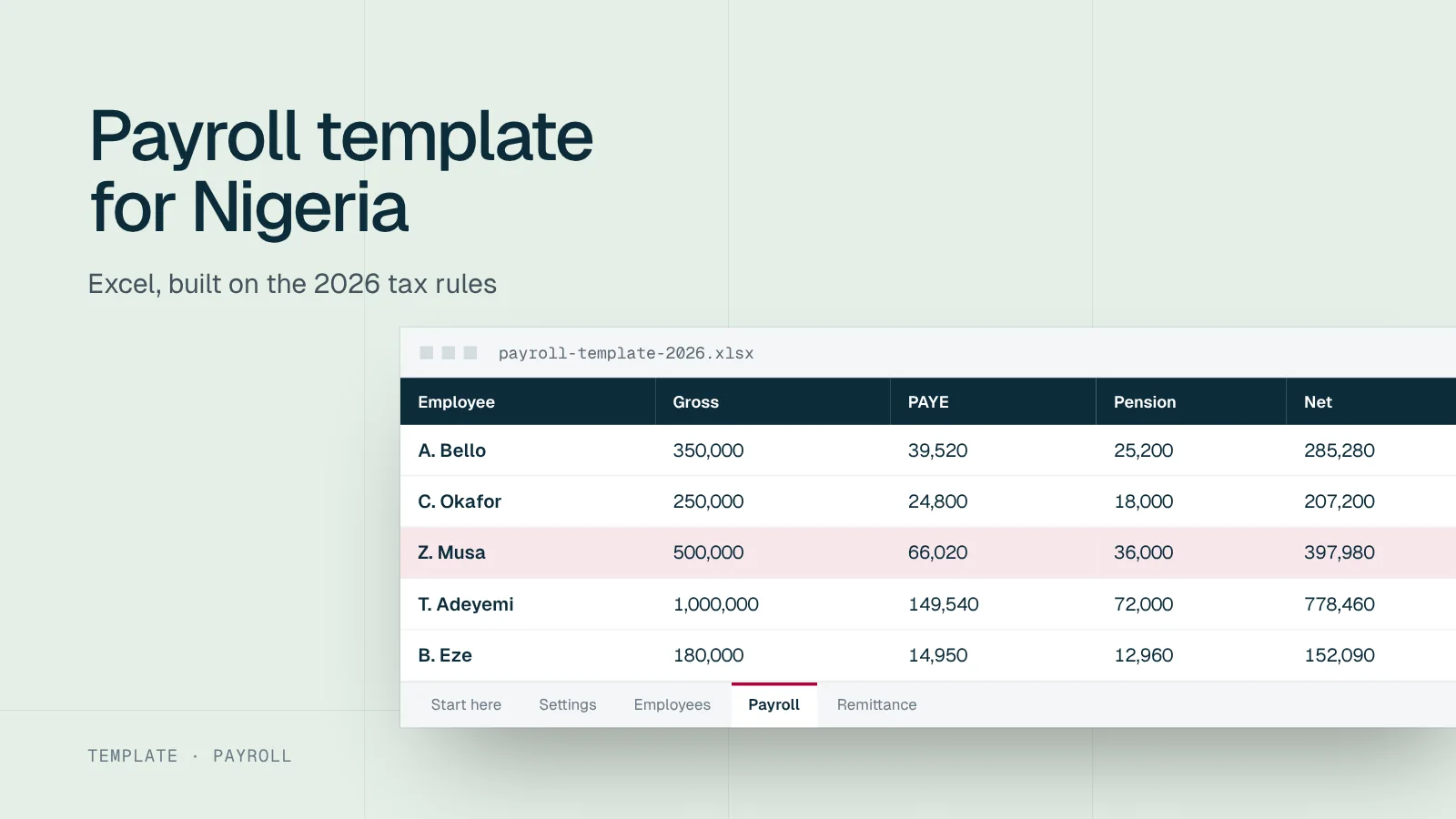
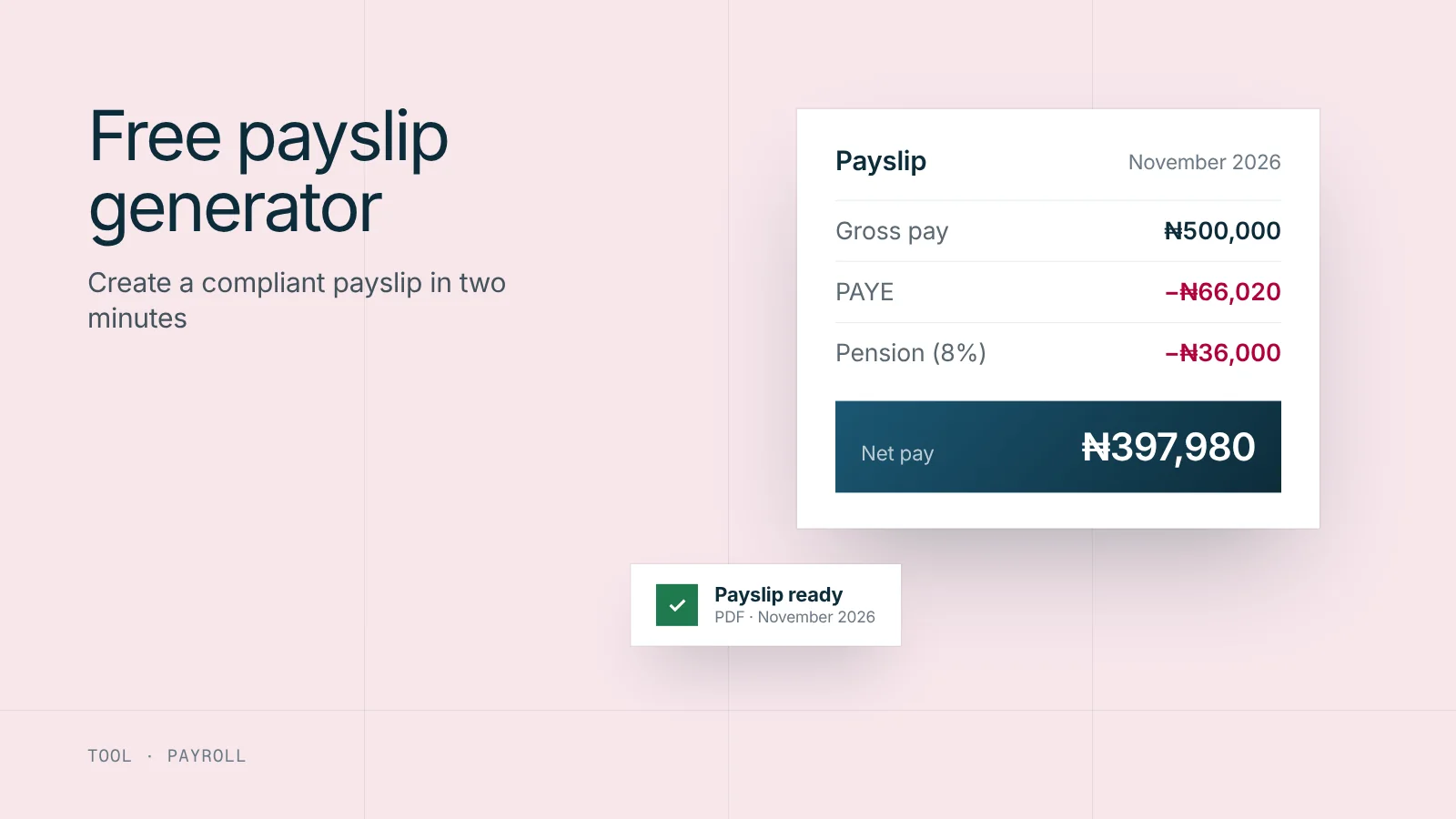
You can run payroll for a small team in a spreadsheet, as long as the formulas are right and someone checks them. The free payroll template applies the 2026 rules for up to 50 staff, the PAYE calculator checks individual salaries, and the payslip generator produces a payslip for one employee. As headcount grows, payroll software saves time and reduces risk; our payroll software buyer’s guide explains how to choose.
Run payroll with Paystat
Process payroll with structured, consistent calculations and a full history of every pay cycle.
Guides in this section
- How to calculate PAYE in Nigeria (2026 worked examples)The five-step method for calculating PAYE under the Nigeria Tax Act 2025, with worked examples at four salary…
- ITF contribution in Nigeria: who pays and how it is calculatedEmployer guide to the Industrial Training Fund levy: the 5-employee and ₦50 million turnover thresholds, 1% of annual…
- NHF deduction in Nigeria: rate and whether it is compulsoryThe National Housing Fund deduction explained for employers and staff: the 2.5% rate on basic salary, who the…
- NSITF Employees’ Compensation Scheme: registration and paymentWhat every Nigerian employer needs to know about NSITF's Employees' Compensation Scheme: registration, the 1% monthly contribution, the…
- Overtime pay in Nigeria: rules and calculationWhat the Labour Act says about working hours and overtime, why the overtime rate comes from your contract,…
- Payroll software in Nigeria: how to choose (2026 buyer’s guide)A practical buyer's guide to payroll software for Nigerian employers: the statutory work it must handle under the…
- Pension contribution in Nigeria: rates, employer duties and remittanceEmployer guide to the Contributory Pension Scheme: minimum rates of 10% and 8%, the salary base, which employers…
- Statutory payroll deductions in NigeriaThe five statutory items on a Nigerian payroll in 2026, in one place: PAYE, pension, NHF, NSITF and…
Written for: SME owners, HR, payroll officers
Run payroll with Paystat
Process payroll with structured, consistent calculations and a full history of every pay cycle.
Sources
- Labour Act, section 15 (when wages are due)
- Labour Act, section 5 (deductions from wages)
- Taxation of employment income under the Nigerian tax reform Acts (Mondaq)
- Pension Reform Act 2014 compliance highlights (Proshare)
- National Housing Fund Act
- Employees' Compensation Act 2010, section 33 (Mondaq)
Frequently asked questions
Short answers to what employers ask us most about this topic.
How do I prepare payroll in Nigeria?
Set a salary structure, register for PAYE with your state tax authority and for NSITF, and collect each employee's tax and pension details. Each month, calculate gross pay, deduct PAYE, pension, NHF and any agreed deductions, pay net salaries, and remit each deduction by its deadline.
How often must salaries be paid in Nigeria?
At the end of each agreed pay period. Under section 15 of the Labour Act, where the period is longer than a month, wages must still be paid at intervals of no more than one month.
Which payroll deductions are compulsory in Nigeria?
PAYE for taxable employees, pension for employers covered by the Pension Reform Act 2014, and NHF under the National Housing Fund Act. NSITF and ITF are employer contributions rather than deductions from staff pay.