Key takeaways
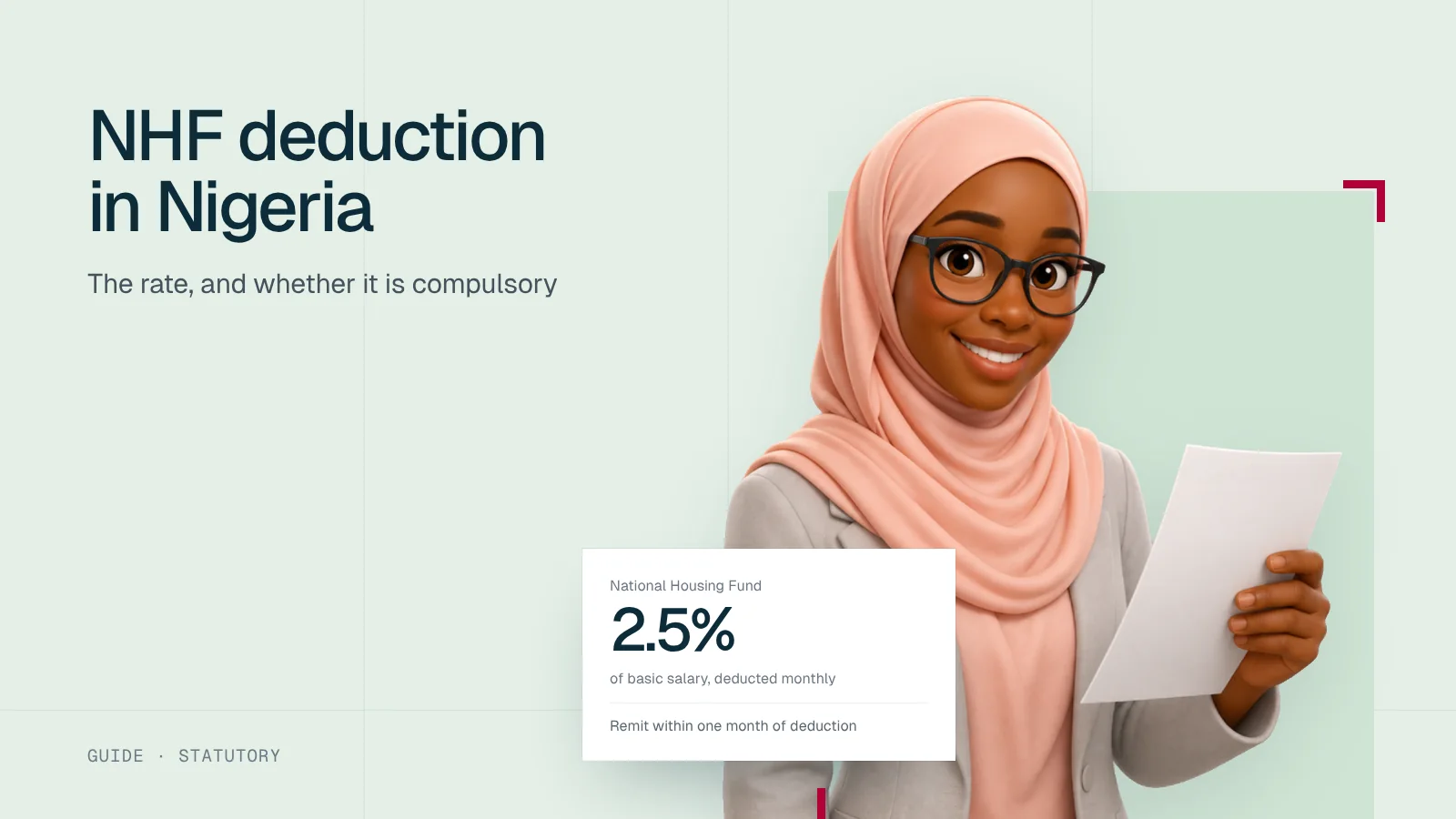
- The NHF Act requires Nigerian workers earning ₦3,000 or more a year to contribute 2.5% of their basic monthly salary.
- Employers deduct the contribution and remit it to the Federal Mortgage Bank of Nigeria within one month of the deduction.
- NHF contributions are deducted before PAYE is worked out, so they lower the employee's tax.
- Contributors who have not taken an NHF housing loan can have their contributions refunded at 60, or on retirement if they can no longer contribute.
The National Housing Fund (NHF) deduction is the smallest of the statutory items on a payslip and the one employers ask about most. Is it compulsory? Is it worked out on gross or basic? What happens to the money? This guide answers each question from the text of the NHF Act.
The National Housing Fund in four numbers
What the Act requires of workers and employers.
What the NHF is
The National Housing Fund was set up by the NHF Act to fund housing loans for Nigerians. Contributions are remitted to the Federal Mortgage Bank of Nigeria (FMBN), which the Act refers to as “the bank”.
Who must contribute
Section 4(1) of the Act covers Nigerian workers in public and private employment who earn ₦3,000 or more a year. The threshold in the Act is still ₦3,000 a year, so in practice it covers every Nigerian employee on a formal payroll.
A Nigerian worker earning an income of ₦3,000 and above per annum “shall contribute 2.5 percent of his basic monthly salary to the Fund.”
National Housing Fund Act, section 4(1)
Section 4 refers to Nigerian workers, so it does not cover foreign nationals on your payroll. Self-employed people are covered by section 10, which requires them to contribute from their monthly income and remit within one month.
How much to deduct
NHF is 2.5% of basic salary only. Housing, transport and other allowances are left out, which is why the split between basic and allowances matters.
| Monthly gross | Basic (50%) | NHF (2.5% of basic) | Per year |
|---|---|---|---|
| ₦100,000 | ₦50,000 | ₦1,250 | ₦15,000 |
| ₦250,000 | ₦125,000 | ₦3,125 | ₦37,500 |
| ₦500,000 | ₦250,000 | ₦6,250 | ₦75,000 |
| ₦1,000,000 | ₦500,000 | ₦12,500 | ₦150,000 |
NHF lowers PAYE
NHF contributions are an allowable deduction under the Nigeria Tax Act 2025, so they come off income before tax is worked out. For an employee on ₦500,000 a month:
₦500,000 a month, with and without NHF
Take-home pay falls by ₦5,125, not the full ₦6,250, because the employee pays ₦1,125 less tax. The PAYE calculator shows the effect for any salary when you tick NHF.
The employer’s duties
Section 9 puts two duties on employers: deduct the contribution from each Nigerian worker’s salary every month, and pay it to FMBN.
The amount deducted “shall be remitted to the bank within one month of the making of the deduction.”
National Housing Fund Act, section 9(2)
Running NHF through payroll
Register
Register the business and each contributing employee with FMBN, so contributions are credited to the right person.
Deduct
Take 2.5% of basic salary in every payroll run, and show it as its own line on the payslip.
Remit
Pay the month’s total to FMBN within one month of the deduction, with a schedule of each employee’s contribution.
Keep records
Keep schedules and payment evidence. Staff need them when they apply for a loan or a refund.
NHF has the longest deadline of the monthly statutory items. Remitting it in the same week as pension keeps the process simple and avoids missed months. See statutory payroll deductions for how NHF fits with PAYE, pension and NSITF.
Penalties
Section 20 makes it an offence to fail to deduct NHF, or to deduct it and fail to remit it.
| Who | Penalty under section 20 |
|---|---|
| Company | Fine of ₦50,000 |
| Staff authorised to make the deductions | Fine of ₦20,000 or imprisonment for a term of five years |
| Self-employed person | Fine of ₦5,000 or imprisonment for one year |
The fines are low by today’s standards, but the second line matters: the Act reaches the individual staff responsible for payroll, not only the company. Money deducted from employees and not remitted is also money the employee can see is missing when they check their contributions.
If you have not been deducting NHF
If your business has never run NHF, take advice on how to start and whether to settle past months, then begin deductions from a fixed payroll month and tell staff in writing before the first deduction.
What contributors get
The Fund exists to provide housing loans to contributors through mortgage institutions. Loan amounts, interest rates and eligibility rules are set by FMBN and change from time to time, so ask FMBN or a primary mortgage bank for the current terms.
For contributors who never take a loan, section 17 provides a refund. A contributor becomes eligible on reaching 60 years of age, or on retiring from employment and becoming unable to continue contributing to the Fund. The Act does not set out the refund procedure, so ask FMBN for its current requirements.
Common NHF mistakes
- Working NHF out on gross pay. The base is basic salary only.
- Leaving it out of the PAYE calculation. NHF is an allowable deduction, so PAYE should be lower for contributors.
- Deducting from foreign nationals. Section 4 covers Nigerian workers.
- No employee registration. Contributions without the employee’s details cannot be credited, which causes problems at loan or refund time.
NHF checklist
Set-up
Every month
Every year
Ticks are saved in this browser only.
Run payroll with Paystat
Process payroll with structured, consistent calculations and a full history of every pay cycle.
Written for: Payroll officers, employees
Run payroll with Paystat
Process payroll with structured, consistent calculations and a full history of every pay cycle.
Sources
Frequently asked questions
Short answers to what employers ask us most about this topic.
Is NHF compulsory in Nigeria?
The NHF Act says a Nigerian worker earning ₦3,000 or more a year, in the public or private sector, shall contribute 2.5% of basic monthly salary. Failing to deduct or remit is an offence under the Act.
Is NHF calculated on gross salary?
No. NHF is 2.5% of basic salary only. On a ₦500,000 salary with ₦250,000 basic, NHF is ₦6,250 a month.
Can I get my NHF contributions back?
Under section 17 of the Act, a contributor who has not obtained a housing loan from the Fund is eligible for a refund on reaching 60, or on retiring from employment and becoming unable to continue contributing. Ask the Federal Mortgage Bank of Nigeria for its current refund process.