Employee handbook template for Nigerian companies
An employee handbook template built for Nigerian employers, covering employment terms, pay and statutory deductions, leave, conduct and leaving, with an acknowledgement page.

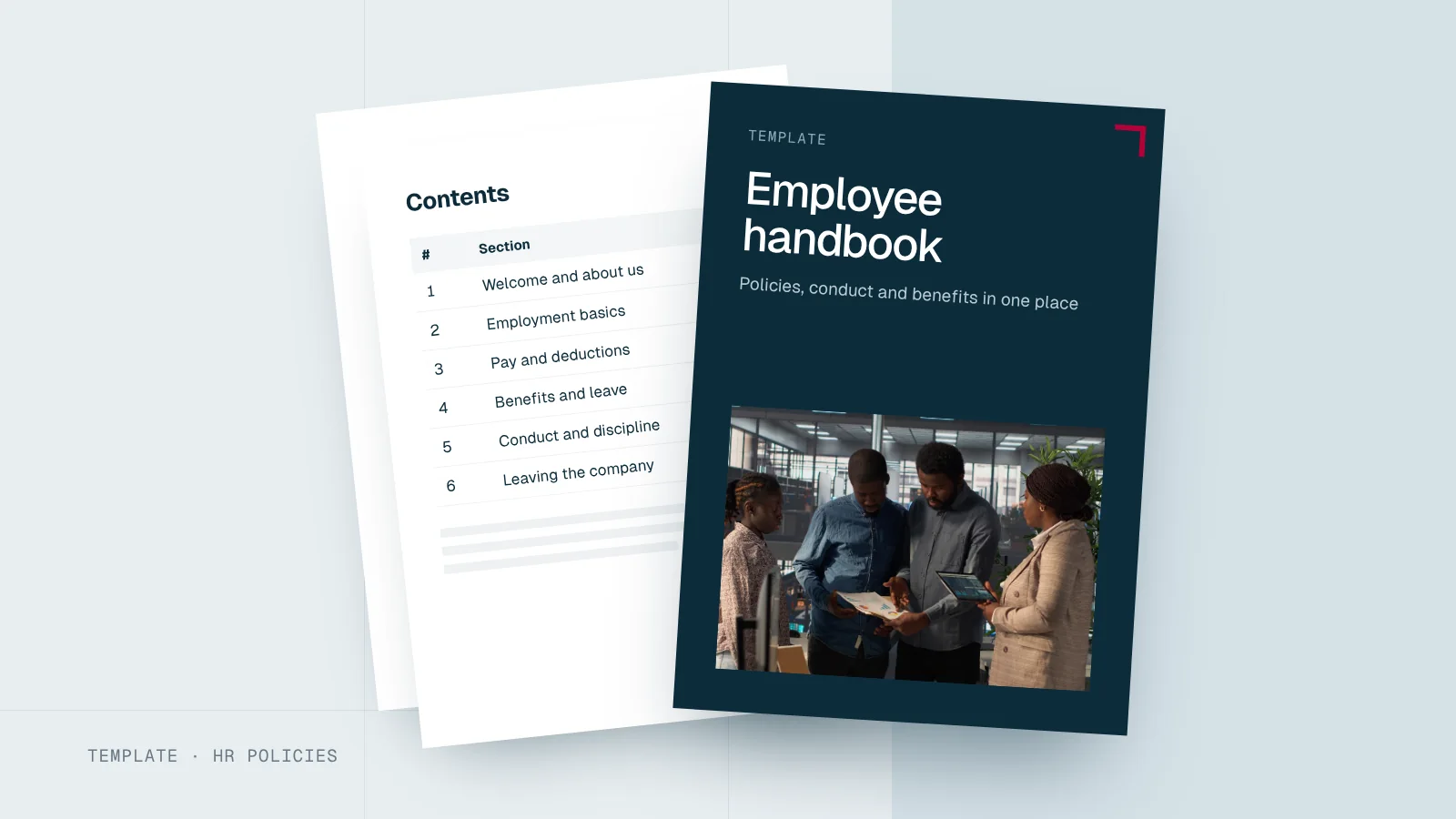
An employee handbook answers the questions new and existing staff ask most: when am I paid, what comes off my salary, how do I book leave, what happens if something goes wrong? This template gives Nigerian employers a complete structure. It links to our separate HR policies and leave policy rather than repeating them, so each rule exists in one place.
The main sections of this handbook
- 01
Welcome and about us
Who you are and what you stand for
- 02
Employment basics
Contracts, probation, hours and attendance
- 03
Pay and statutory deductions
Pay day, payslips, PAYE, pension and NHF
- 04
Benefits and leave
Benefits, and a link to the leave policy
- 05
Conduct, discipline and grievance
Standards and the procedures that enforce them
- 06
Leaving and acknowledgement
Notice, final pay and the signed receipt
How to use the template
- Download the Word version and replace every item in [brackets].
- Insert your policies where the template points to them, or attach them as appendices.
- Mark what is contractual. State in section 1 which parts form part of the contract of employment.
- Issue it on day one with the contract, and file the signed acknowledgement. Our onboarding checklist includes this step.
The handbook
1. Welcome and how to use this handbook
Welcome to [Company name]. This handbook explains how we work, what you can expect from us and what we expect from you.
It applies to all employees. [Sections [numbers] form part of your contract of employment. The rest is guidance that we may update from time to time.] If anything in this handbook conflicts with your contract, your contract applies. If you have a question that the handbook does not answer, ask [HR contact].
2. Employment basics
Contract and written terms. You will receive a contract or letter of appointment setting out your job title, pay, hours, leave and notice period.
Probation. New employees serve a probation period of [three/six] months. Your manager will review your progress at [one month] and before the end of probation, and confirm the outcome in writing.
Hours and attendance. Normal working hours are [8:00 a.m. to 5:00 p.m., Monday to Friday], with a [one-hour] break. Attendance rules are set out in the Attendance and Punctuality Policy.
Changes to your details. Tell HR promptly if your address, bank details, next of kin or other details change.
3. Pay and statutory deductions
Pay day. Salaries are paid into your bank account on the [25th] of each month, or the last working day before it if the 25th is a weekend or public holiday.
Payslips. You will receive a payslip each month showing your earnings, deductions and net pay. Check it and raise any query with [payroll contact] within [five] working days.
Statutory deductions. The law requires us to deduct PAYE income tax, your pension contribution of [8]% of basic, housing and transport, and, for Nigerian employees, the National Housing Fund contribution of 2.5% of basic salary. We pay these to the relevant authorities and your Pension Fund Administrator by the legal deadlines. We also pay a [10]% employer pension contribution and other employer contributions, which are not deducted from your pay.
Other deductions. We make other deductions, such as loan repayments, only with your written agreement or where the law allows.
Pay reviews. Pay is reviewed [annually in month]. Any change will be confirmed in writing.
4. Benefits and leave
Benefits. [List benefits, for example health insurance through [provider], group life insurance, leave allowance, staff loans.]
Leave. Your entitlement to annual, sick, maternity, paternity and other leave, and how to request it, is set out in the Leave Policy. Public holidays declared by the Federal Government are paid days off.
5. Conduct, discipline and grievance
We expect everyone to act honestly, treat colleagues and customers with respect, follow safety rules and protect company property and information.
Breaches of our standards are handled under the Disciplinary Procedure, which gives you the allegation in writing, the chance to respond and a decision with reasons. Concerns you have about your work or treatment can be raised under the Grievance Procedure. Harassment of any kind is not tolerated; see the Anti-harassment Policy.
6. Health, safety and data
Health and safety. Report any accident, injury or unsafe condition to [contact] at once. Injuries at work are recorded and reported under the Employees’ Compensation Act.
Data protection. We hold personal data about you for employment and payroll purposes, and protect it in line with the Nigeria Data Protection Act 2023. You must protect the personal data you handle at work in the same way. See the IT and Data Protection Policy.
7. Leaving the company
Notice. Your notice period is set out in your contract and will not be less than the minimum in the Labour Act.
Final pay. Your final salary includes pay to your last day, any untaken annual leave and any other amounts due under your contract, less statutory deductions.
Company property. Return all company property, documents and access cards on or before your last day.
8. Acknowledgement
I confirm that I have received and read the [Company name] Employee Handbook dated [date], including the policies it refers to, and that I will follow it.
Name: ________ Signature: ________ Date: ________
Keeping the handbook useful
- Keep it short. A handbook people read beats a complete one they do not.
- One version only. Store it where staff can always find the current copy, and remove old versions.
- Review once a year and when the law changes, such as the 2026 tax rules. Announce changes in writing before they take effect.
- Train managers on it. Managers who apply it differently undo the point of having one.
Content
Issuing
Maintenance
Ticks are saved in this browser only.
Employee management made easy
Keep employee records, attendance, leave, payroll and performance in one connected system.
Employee management made easy
Keep employee records, attendance, leave, payroll and performance in one connected system.
Sources
Frequently asked questions
Short answers to what employers ask us most about this topic.
Is an employee handbook required in Nigeria?
No law requires a handbook, but the Labour Act requires written terms of employment, and a handbook is the simplest way to set out the rules and benefits that apply to everyone. Contracts can refer to it.
What should be in an employee handbook?
A welcome and company overview, employment basics such as probation and hours, pay and benefits, leave, conduct rules, disciplinary and grievance procedures, health and safety, IT and data protection, leaving the company, and an acknowledgement page.
Is the handbook part of the employment contract?
Only if the contract says so, or the handbook is clearly intended to be. State in the handbook which parts are contractual. Either way, follow it, because inconsistency is what gets challenged.