HR policy templates for Nigerian companies
Six core HR policies, written for Nigerian workplaces and ready to edit: attendance, discipline, grievance, anti-harassment, IT and data protection, and remote work.

HR disputes are hardest to settle when the rule was never written down, or was applied differently to different people. Short, clear policies prevent both. This pack gives you six core policies written for Nigerian workplaces. For leave, use our separate leave policy template, and bring everything together in the employee handbook.
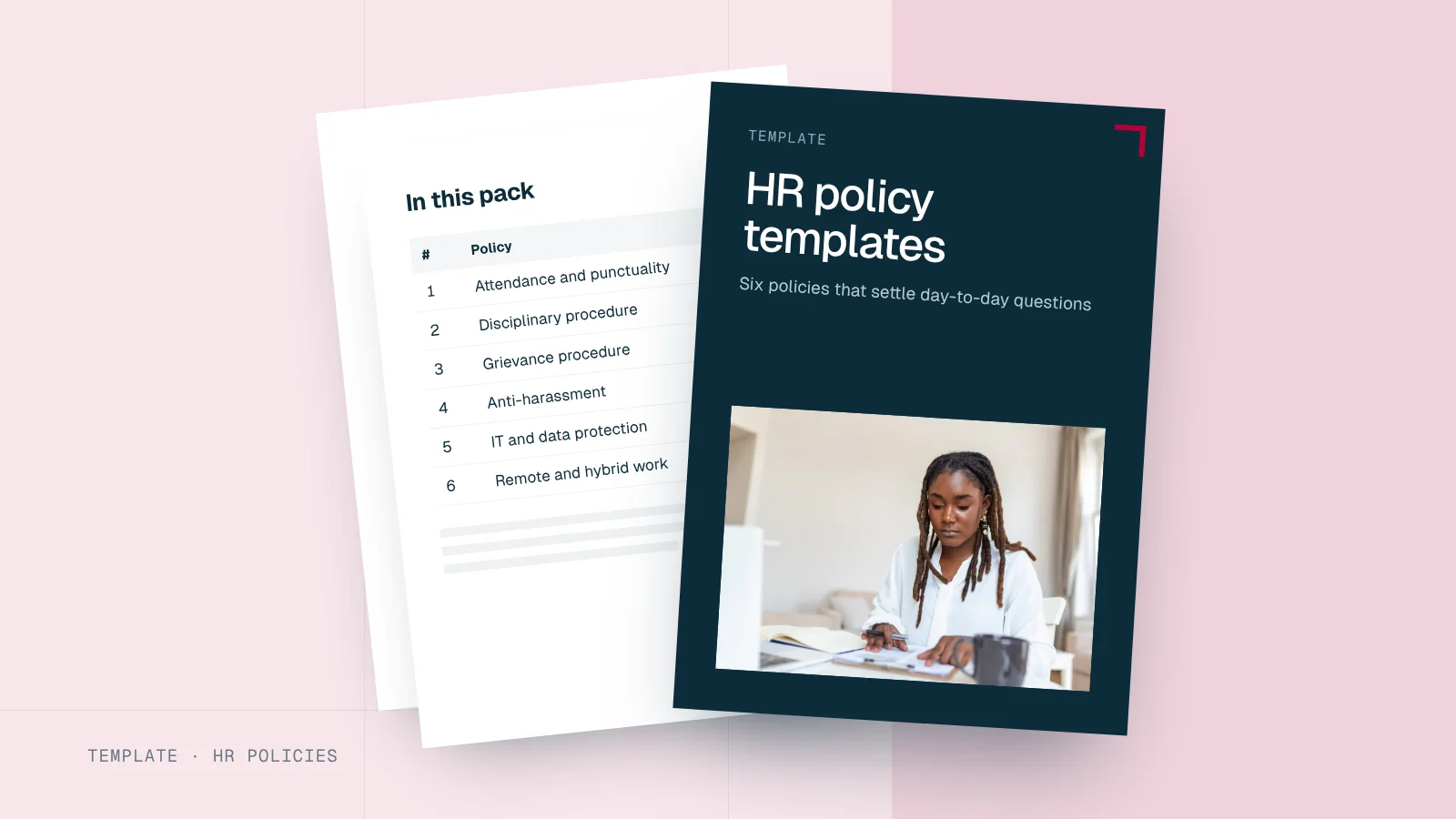
The six policies in this pack
Add the leave policy and handbook for a complete set.
How to use these policies
- Edit the brackets. Replace every [item] with your own rules, names and times.
- Check fit. A policy you will not follow is worse than none, because inconsistency is what gets challenged.
- Say whether it is contractual. Policies that form part of the contract are harder to change later.
- Issue and record. Give every employee a copy and keep their signed acknowledgement.
- Review yearly. Date each policy and review it at least once a year.
The policies
1. Attendance and punctuality policy
Normal working hours are [8:00 a.m. to 5:00 p.m.], [Monday to Friday], with a [one-hour] lunch break. Employees must record their arrival and departure using [the attendance register / clock-in system].
An employee who arrives after [8:15 a.m.] is late. Lateness on more than [three] occasions in a month will be discussed by the line manager and may lead to a query under the disciplinary procedure.
An employee who cannot come to work must tell their line manager by [9:00 a.m.] on each day of absence, by [phone call]. Absence without notice for [three] consecutive working days may be treated as misconduct.
2. Disciplinary procedure
This procedure applies to misconduct and poor performance. Its aim is to correct, not punish.
Step 1: Query. The employee receives a written query setting out the allegation and the evidence, and has [48 hours] to reply in writing.
Step 2: Hearing. If the reply does not resolve the matter, a disciplinary hearing is held. The employee may bring a colleague and will have the chance to respond to the evidence.
Step 3: Decision. The outcome is confirmed in writing with reasons. Outcomes include no action, a verbal or written warning, a final warning, suspension, or dismissal for gross misconduct.
Step 4: Appeal. The employee may appeal in writing to [title] within [five] working days.
Gross misconduct includes theft, fraud, violence, serious insubordination and serious breach of safety rules. It may lead to dismissal without notice after the procedure above.
3. Grievance procedure
Employees who have a concern about their work, colleagues or treatment should first raise it with their line manager. If that is not appropriate or does not resolve it, they may raise a written grievance with [HR].
HR will acknowledge the grievance within [two] working days, meet the employee within [five] working days, and give a written response with reasons within [ten] working days. The employee may appeal to [title] within [five] working days of the response.
No employee will be treated less favourably for raising a grievance in good faith.
4. Anti-harassment policy
[Company name] does not tolerate harassment, bullying or sexual harassment by or against employees, customers, suppliers or visitors.
Harassment includes unwanted conduct that violates a person’s dignity or creates an intimidating, hostile or offensive environment, whether in person, by phone, by message or on social media.
Anyone who experiences or witnesses harassment should report it to [their line manager, HR or a named alternative contact]. Reports will be investigated promptly and confidentially. Anyone found to have harassed another person will face disciplinary action, which may include dismissal. Making a report in good faith will never lead to disciplinary action.
5. IT and data protection policy
Company systems, email and devices are for business use. Limited personal use is allowed if it does not interfere with work.
Employees must keep passwords private, lock devices when unattended, and report lost devices or suspected security incidents to [IT contact] at once.
Personal data about employees, customers and others must be used only for the purpose it was collected for, shared only with people who need it, and stored securely, in line with the Nigeria Data Protection Act 2023. Payroll, medical and disciplinary records are confidential and may be seen only by authorised staff.
6. Remote and hybrid work policy
Roles that can be done away from the office may be approved for remote work for up to [number] days a week, at the line manager’s discretion.
Remote workers keep their normal working hours, stay reachable by [phone and chat] during those hours, and attend the office when asked with reasonable notice.
[Company name] provides [laptop and data allowance of amount]. Employees are responsible for a safe, quiet place to work and for keeping company data secure under the IT and data protection policy.
Remote work arrangements can be reviewed or withdrawn with [two weeks’] notice.
A fair process protects you
Nigerian courts look closely at whether an employee was given a fair chance to answer an allegation before being disciplined. The disciplinary procedure above builds that in: the allegation in writing, time to respond, a hearing and reasons for the decision. Our query letter samples give you the first letter in the process.
Two further points keep policies defensible:
- Apply them the same way to everyone. Treating similar cases differently is the quickest way to lose an argument about fairness.
- Keep records. Queries, replies, hearing notes and decisions should all be filed.
Policy checklist
Before issuing
Issuing
Every year
Ticks are saved in this browser only.
Employee management made easy
Keep employee records, attendance, leave, payroll and performance in one connected system.
Employee management made easy
Keep employee records, attendance, leave, payroll and performance in one connected system.
Sources
Frequently asked questions
Short answers to what employers ask us most about this topic.
What HR policies should a Nigerian company have?
At a minimum: leave, attendance and punctuality, disciplinary and grievance procedures, anti-harassment, health and safety, and IT and data protection. Add remote work, expenses and conflicts of interest as the business needs them.
Do HR policies form part of the employment contract?
It depends on how they are issued. If the contract says the handbook and policies form part of it, the courts may treat them as contractual terms. Say clearly in each policy whether it is contractual, and follow it either way.
How often should HR policies be reviewed?
Once a year, and whenever the law changes. Record the review date on each policy.