Query letter samples for staff (lateness, absence, negligence, misconduct)
Six query letter samples Nigerian employers can adapt, a template for the employee's reply and the outcome letter, and the fair process to follow before any disciplinary decision.

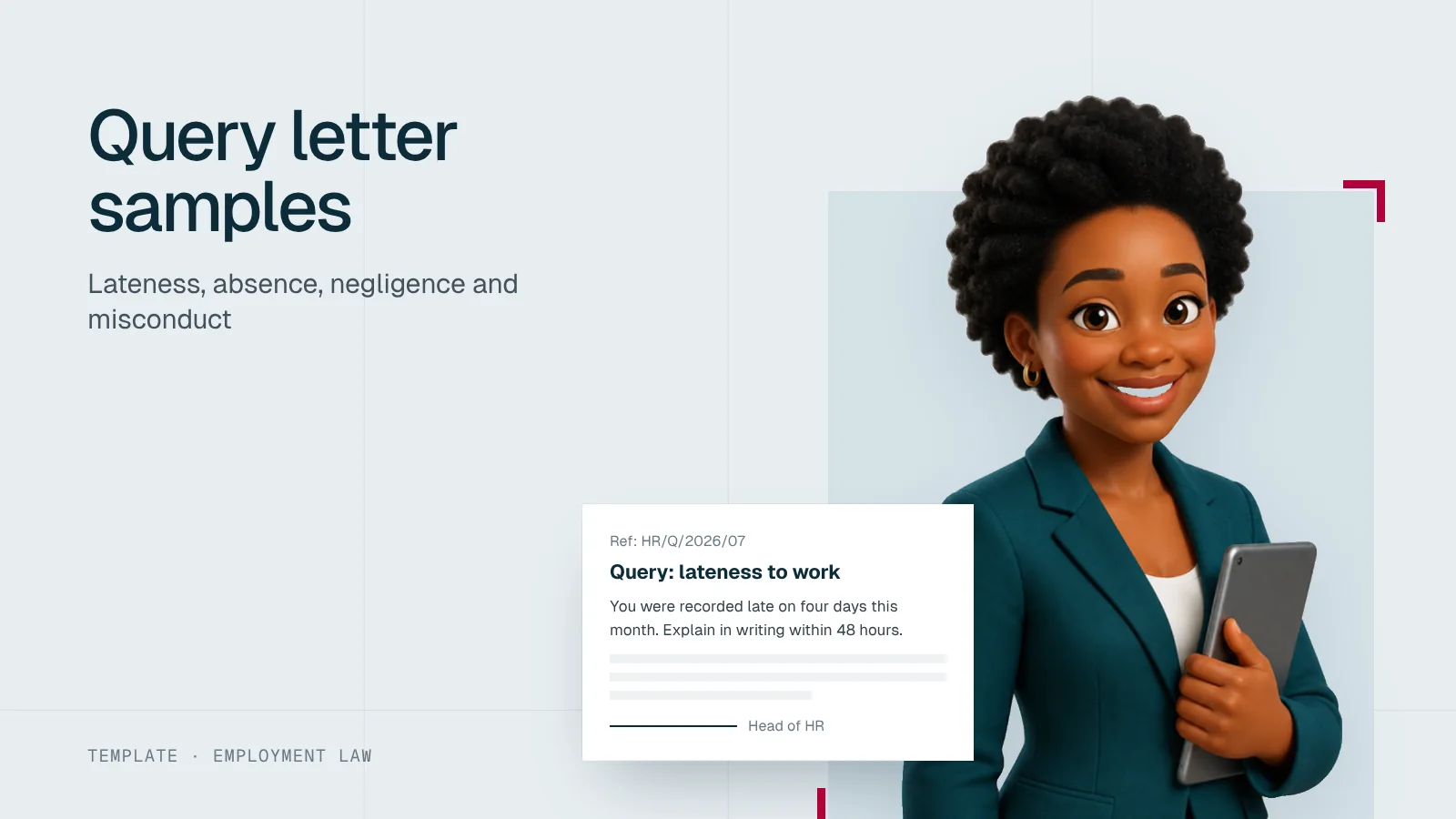
A query letter asks an employee to explain, in writing, something that appears to have gone wrong: lateness, an unexplained absence, a mistake that cost money, or behaviour that broke a rule. It gives the employee a chance to tell their side before you decide what, if anything, to do. Used well, it settles most problems early. Used carelessly, it becomes evidence that the process was unfair.
This page gives you six samples to adapt, a template for the employee’s reply, an outcome letter, and the steps to follow. The download contains all of them in Word format.
Issuing a query fairly, step by step
- 01
Check the facts
Dates, times, records and witnesses, before anything is written
- 02
Write the query
What happened, the rule involved, the deadline and who to reply to
- 03
Allow a real reply
Enough time to respond, and a meeting if the matter is serious
- 04
Decide and record
Consider the reply, decide in line with your handbook, and write to the employee
- 05
Follow up
Review after a set period, and close the matter if conduct improves
When to issue a query
Issue a query when conduct may break a rule in the contract, handbook or a clear instruction, and you need the employee’s explanation before deciding. Do not use a query for ordinary feedback or coaching; talk first. Persistent lateness after a conversation, an absence without permission, or a serious complaint from a customer are typical triggers.
The fair hearing principle
Nigerian courts have long held that an employee accused of misconduct should be heard before being dismissed.
Before summary dismissal, the employee should be given “an opportunity of being heard.”
Supreme Court, Yusuf v Union Bank of Nigeria Ltd (1996), as summarised by Legalpedia
The employer does not have to wait for a criminal trial where the misconduct is also a crime, but it does have to tell the employee the allegation and consider their response. A query, followed by a meeting for serious matters, is the usual way to show that. Our guide to termination of employment covers what follows if dismissal is considered.
What every query letter should contain
- The date, the employee’s name, job title and department.
- A clear heading, such as “Query: lateness to work”.
- The facts: what happened, when and where, and how you know.
- The rule, standard or instruction the conduct appears to breach.
- A request for a written explanation, the deadline and who to send it to.
- A statement that the explanation will be considered before any decision.
- The name, title and signature of the person issuing it.
Avoid conclusions in the query itself. “You were rude to a customer” decides the matter; “a customer complained that you spoke rudely to her” asks for an explanation.
Sample 1: lateness
Query for persistent lateness
[Company letterhead]
[Date]
[Employee name]
[Job title], [Department]
Query: lateness to work
Our attendance records show that you arrived after the 8:00 a.m. start time on [number] occasions between [date] and [date]: [list dates and arrival times]. Your supervisor, [name], discussed punctuality with you on [date].
Regular lateness breaches the attendance and punctuality rules in section [number] of the Employee Handbook.
Please explain in writing why you were late on these dates, and any circumstances you would like us to consider. Send your reply to [name, title] by [time] on [date].
Your explanation will be considered before any decision is made.
[Name]
[Title]
Sample 2: absence without permission
Query for absence without permission
[Date]
[Employee name], [Job title]
Query: absence from work without permission
You were absent from work on [date or dates]. Our records show no approved leave, and you did not contact your line manager, [name], before or during the absence, as the absence procedure in the Employee Handbook requires.
Please explain in writing the reason for your absence and why you did not notify your manager. If the absence was due to illness, attach any medical certificate. Send your reply to [name, title] by [time] on [date].
Your explanation will be considered before any decision is made.
[Name], [Title]
Sample 3: negligence in the course of duty
Query for negligence
[Date]
[Employee name], [Job title]
Query: [short description, for example “unreconciled cash shortfall on 12 March”]
On [date], [describe what happened factually, for example “the cash count at the close of business showed a shortfall of ₦[amount] against the till report for your station”]. The [procedure or instruction] requires [state the standard, for example “each cashier to count and sign off their till before handover”].
Please explain in writing what happened, the steps you took, and anything that prevented you from following the procedure. Send your reply to [name, title] by [time] on [date].
This query does not mean a decision has been made. Your explanation will be considered first.
[Name], [Title]
Sample 4: insubordination or rude conduct
Query for insubordination
[Date]
[Employee name], [Job title]
Query: refusal to carry out a reasonable instruction
On [date] at about [time], your supervisor, [name], asked you to [describe the instruction]. It is reported that you refused and [describe what was said or done, factually]. [Name of witness] was present.
The Code of Conduct in section [number] of the Employee Handbook requires staff to carry out reasonable instructions and to treat colleagues with respect.
Please give your account of what happened in writing, including anything you think we should know, to [name, title] by [time] on [date].
[Name], [Title]
Sample 5: breach of company policy
Query for breach of policy
[Date]
[Employee name], [Job title]
Query: [policy name], for example “use of company vehicle outside approved duties”
[Describe the facts: what record, report or observation shows the possible breach, with dates.] The [policy name] states that [quote the relevant rule].
Please explain in writing the circumstances, and attach any document you want us to consider. Send your reply to [name, title] by [time] on [date].
[Name], [Title]
Sample 6: reply to a query
Give staff a simple structure for their reply. It helps them answer the actual question and gives you a clear record.
Template for an employee’s reply
[Date]
[Name of manager], [Title]
Re: Query dated [date] on [subject]
Thank you for your letter dated [date].
What happened: [your account of events, in order, with dates and times].
Reasons or circumstances: [anything that explains or contributed to what happened].
Supporting documents: [list any attached documents, such as a medical certificate or receipts].
What I will do differently: [optional].
[Employee name], [Job title]
Sample 7: outcome letter
Outcome of a query: written warning
[Date]
[Employee name], [Job title]
Outcome of query dated [date]
Thank you for your reply dated [date]. We have considered your explanation that [summarise the explanation fairly].
[Choose one: “We accept your explanation and will take no further action.” / “We do not consider that your explanation justifies [the conduct]. This letter is a written warning under section [number] of the Employee Handbook. It will remain on your file for [period].”]
[If a warning: State what improvement is expected and by when, and that further breaches may lead to further disciplinary action.]
You may appeal this decision in writing to [name, title] within [number] working days.
[Name], [Title]
Before you send a query
Facts
Process
Records
Ticks are saved in this browser only.
What not to do
- Do not fine through payroll. The Labour Act restricts deductions from wages for fines, so a query should never end in an automatic deduction.
- Do not issue a query in anger. Wait until you have the facts.
- Do not copy the whole office. Keep disciplinary letters between the employee, their manager and HR.
- Do not skip your own handbook. If it promises a hearing, a witness or an appeal, provide them. Our HR policy templates include a disciplinary procedure you can adapt.
Download the Word file to edit these samples with your letterhead.
Employee management made easy
Keep employee records, attendance, leave, payroll and performance in one connected system.
Sources
Frequently asked questions
Short answers to what employers ask us most about this topic.
What is a query letter in Nigeria?
A formal letter from an employer asking an employee to explain an incident or behaviour, such as lateness, absence or a breach of policy, within a stated time. The reply is considered before any disciplinary decision.
How many days should an employee have to answer a query?
No law sets a period. Many employers give 24 to 72 hours, depending on how serious the matter is and what the handbook says. Give enough time for the employee to gather facts, and state the deadline clearly.
Can an employee be dismissed without a query?
Summary dismissal for serious misconduct is possible, but courts look at whether the employee was told the allegation and given a chance to respond. Issuing a query, or holding a hearing, is the usual way to show that. Check your contract and handbook and take legal advice for serious cases.
How many queries lead to dismissal?
There is no set number in law. Your handbook should explain how repeated misconduct moves from queries to warnings, final warnings and dismissal.