Insight · 2026 in reviewNovember 7, 20262 min read
2026: the year payroll changed
Nigeria's first year under the new tax laws, in numbers: a new PAYE system, a renamed tax authority, record pension assets, cooling inflation and a fresh push on the minimum wage.

Six numbers that tell the story
For payroll teams, 2026 started with a rewrite. A new tax law changed how every PAYE figure is worked out, the federal tax agency took a new name, pension savings hit a record, prices cooled without falling, and labour reopened the minimum wage. Here is the year so far, in the order payroll felt it.
January: a new tax system
The Nigeria Tax Act 2025 took effect on 1 January 2026. Employers removed the Consolidated Relief Allowance from payroll, applied a 0% band to the first ₦800,000 of annual taxable income, and moved to six bands topping out at 25%. Rent relief of 20% of annual rent, capped at ₦500,000, replaced CRA, and earnings at or below the minimum wage became exempt.
| Before 2026 | From 2026 | |
|---|---|---|
| Relief | CRA: ₦200,000 or 1% of gross, plus 20% of gross | Rent relief: 20% of rent, up to ₦500,000 |
| First band | 7% on the first ₦300,000 | 0% on the first ₦800,000 |
| Top rate | 24% above ₦3.2 million | 25% above ₦50 million |
| Minimum wage earners | Exempt | Exempt |
| Federal agency | Federal Inland Revenue Service | Nigeria Revenue Service |
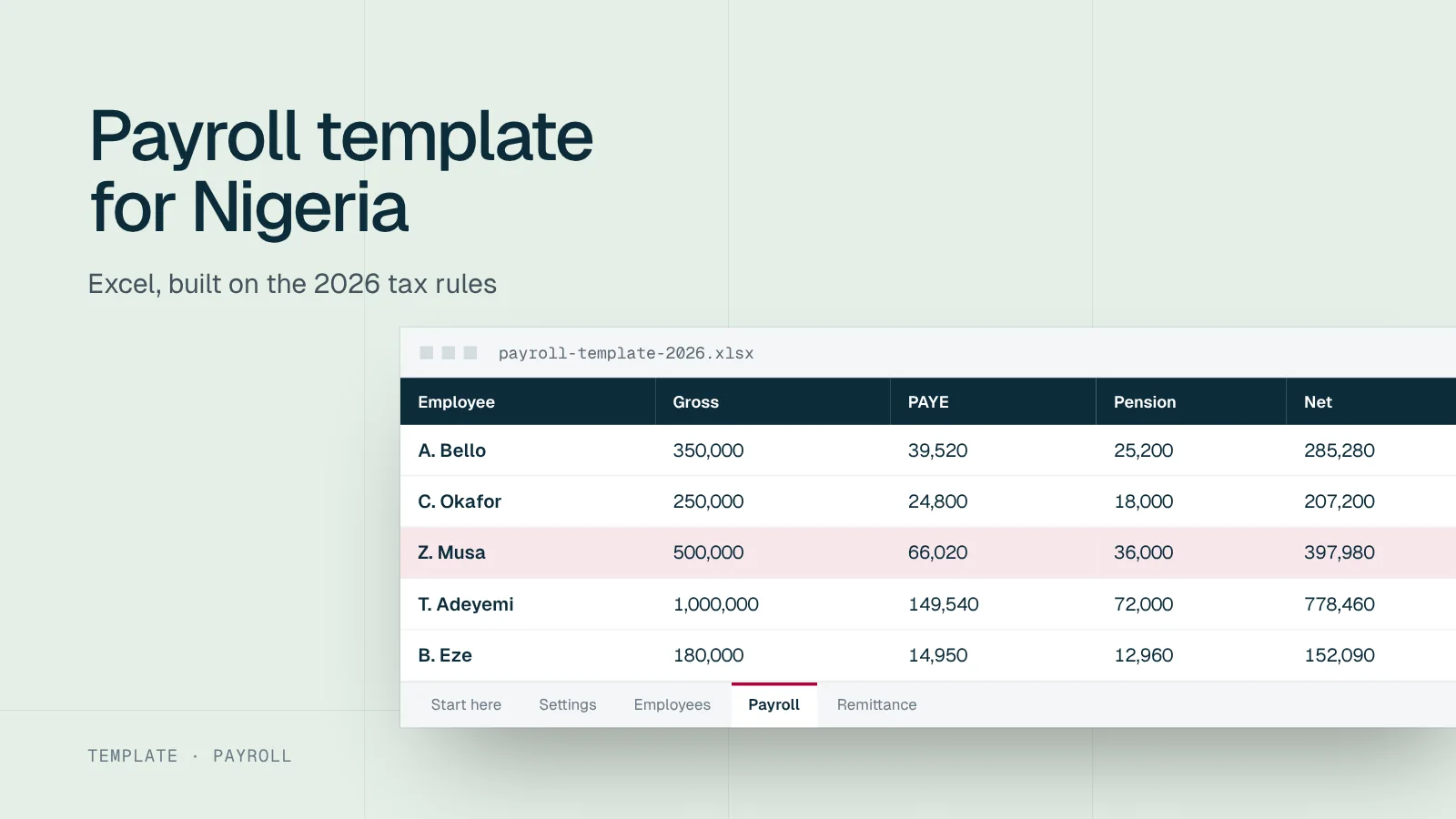
PAYE for most employees still goes to the state where they live. What changed is the arithmetic. Our Take-Home 2026 report runs the old and new laws side by side at 15 salaries.
Who felt it
Low earners came out ahead: PAYE on ₦100,000 a month fell from ₦5,420 to ₦3,920. Between about ₦150,000 and ₦1.3 million a month, the two laws landed within a few thousand naira. Above that, the new law cost more every time, 26% more at ₦10 million a month.
Pensions kept growing
Pension assets rose from ₦28.04 trillion in January to a record ₦31.8 trillion at the end of August, with 11.39 million retirement savings accounts. About 56% of the money sits in Federal Government securities. The Pension Picture 2026 has the detail.
Prices cooled, slowly
On the rebased NBS index, headline inflation stayed between 15% and 16% for most of the year, peaked at 15.93% in May, and fell to 14.63% in September. Food inflation was still 19.59%.
The wage question returned
In August the NLC set ₦500,000 as its benchmark for the next national minimum wage, against today’s ₦70,000. The 2024 Act provides for a review at least every three years, which points to 2027. Our report The ₦70,000 Question puts the floor in today’s prices.
What to prepare for in 2027
Five things to have ready for 2027
- 01
Check payroll settings
2026 bands, rent relief and the minimum wage exemption
- 02
Refresh rent declarations
Ask every employee to confirm rent for the new year
- 03
File annual PAYE returns
By 31 January, to each state you pay
- 04
Load the 2027 holidays
And watch for substitute days on weekend holidays
- 05
Model a new minimum wage
Cost two or three scenarios before the review
Most of this is housekeeping. The employers who had the easiest 2026 were the ones whose payroll settings, staff records and remittance calendar were in order before 1 January.
How we made this
This review brings together published data from the National Bureau of Statistics and the National Pension Commission, the text of the Nigeria Tax Act 2025, and Workstat's own PAYE and calendar calculations. Each figure is linked to its source below.
Employee management made easy
Keep employee records, attendance, leave, payroll and performance in one connected system.
Sources
- Nigeria Tax Act 2025: taxation of employment income (Mondaq)
- Nigeria's pension assets grow by ₦3.8 trillion in eight months (Nairametrics)
- Nigeria's headline inflation drops to 14.63 per cent (Voice of Nigeria)
- NLC demands ₦500,000 minimum wage (Legit.ng)
- National Bureau of Statistics, Consumer Price Index reports