Leave policy template for Nigerian companies
A ready-to-edit leave policy for Nigerian companies. It covers annual, sick, maternity, paternity, compassionate, study and unpaid leave, with the Labour Act minimums built in.

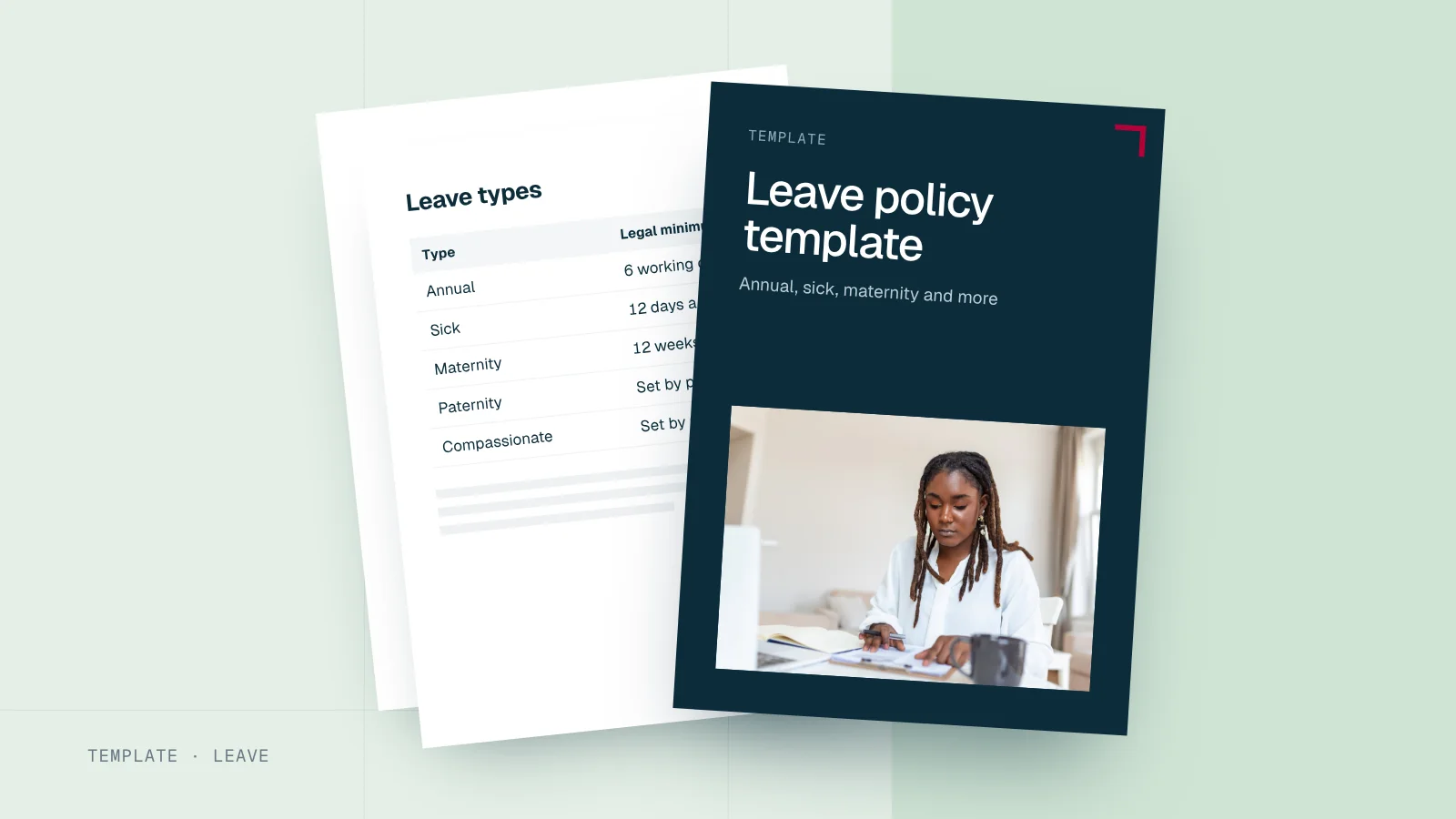
A leave policy saves arguments. When the number of days, the booking process and the pay rules are written down, managers stop deciding case by case and staff know what to expect. This template gives Nigerian employers a complete policy to adapt, with the Labour Act minimums already built in.
The leave types in this policy
With the legal minimum where the Labour Act sets one.
How to use the template
- Download the Word version or copy the sections below.
- Replace every item in [brackets] with your own figures and names.
- Check your numbers against the legal floors. You can give more than the Labour Act, never less. Our guides on annual leave, sick leave and maternity leave explain each one.
- Issue it with the handbook and ask staff to acknowledge it. Our employee handbook template has a place for it.
| Leave type | Legal minimum | Fill in for your policy |
|---|---|---|
| Annual leave | 6 working days after 12 months (12 for under-16s) | Days per year, by grade or service |
| Sick leave | 12 paid working days a year, certified | Paid days, self-certification rule |
| Maternity leave | 6 weeks before and 6 weeks after confinement; at least 50% pay after 6 months’ service | Length and pay |
| Paternity leave | None in the Labour Act | Days, if any |
| Compassionate, study, unpaid | None | Days and conditions |
The policy
1. Purpose, scope and leave year
[Company name] Leave Policy
This policy sets out the leave available to employees of [Company name], how to request it and how it is paid. It applies to all employees, including those on probation, unless their contract says otherwise.
The leave year runs from [1 January] to [31 December]. All leave is counted in working days. Where this policy gives more than the Labour Act or any other law, this policy applies. Where the law gives more, the law applies.
2. Annual leave
Employees are entitled to [number] working days of paid annual leave in each leave year, rising to [number] days after [number] years of service. Employees who join during the year receive a pro-rata entitlement.
Leave must be requested at least [two weeks] in advance through [system or form] and approved by the employee’s line manager. Requests are approved in the order received, subject to the needs of the business.
Up to [number] days of unused leave may be carried over to the next leave year with written approval, and must be taken by [date]. Leave cannot be exchanged for pay while employment continues.
[If applicable: A leave allowance of [amount or formula] is paid in [month or with the first leave of the year].]
3. Public holidays
Public holidays declared by the Federal Government are paid days off in addition to annual leave. If a public holiday falls during an employee’s annual leave, [the day is added back to their leave balance / the day counts as leave].
4. Sick leave
Employees who are absent through illness must tell their line manager by [time] on the first day of absence, by [phone call / message].
Employees are entitled to [twelve] working days of sick leave on full pay in each calendar year. Absences of more than [two] days must be covered by a certificate from a registered medical practitioner. The company may ask an employee to be examined by a medical practitioner it nominates, at the company’s cost.
[After the paid days are used, further certified sick leave is paid at [half pay] for up to [number] days / is unpaid.]
5. Maternity and paternity leave
An employee who is expecting a baby may begin maternity leave up to six weeks before the expected date of confinement on producing a medical certificate, and will not work for at least six weeks after. Maternity leave is [number] weeks in total, paid at [full pay / the rate set out here]. Employees with six months’ or more continuous service receive at least 50% of their pay, as the Labour Act requires.
On return, a nursing mother is allowed two half-hour nursing breaks each working day.
Employees whose partner gives birth, or who adopt a child, are entitled to [number] working days of paid paternity leave, to be taken within [number] weeks of the birth or adoption.
6. Other leave
Compassionate leave: up to [number] working days of paid leave on the death or serious illness of a close family member.
Study and examination leave: up to [number] working days a year for approved courses and examinations, with evidence of the examination date.
Unpaid leave: may be granted at the company’s discretion for up to [number] [weeks/months], agreed in writing. Pension and other benefits during unpaid leave are set out in the approval letter.
7. Leaving the company and records
When employment ends, untaken annual leave for the current leave year is calculated pro rata and [paid in the final salary / taken during the notice period]. Leave taken in excess of the pro-rata entitlement may be deducted from final pay, within the limits allowed by law.
HR keeps a record of every employee’s leave entitlement, leave taken and balance. Employees can request their balance at any time.
Approved by: [Name, title] Date: [date] Review date: [date]
Making the policy work
Write the leave year, entitlements and booking rules into offer letters as well as the policy, so the two never disagree. Track balances in one place rather than in managers’ notebooks. Staff requesting leave can use our leave application letter samples.
Leave policy for government employees
Federal civil servants are covered by the Public Service Rules, under which all leave has been counted in working days since a Head of Service circular in November 2022. That circular also introduced 14 working days of paternity leave. State public services have their own rules. A company policy like this one applies only to private employers.
Employee management made easy
Keep employee records, attendance, leave, payroll and performance in one connected system.
Employee management made easy
Keep employee records, attendance, leave, payroll and performance in one connected system.
Sources
Frequently asked questions
Short answers to what employers ask us most about this topic.
What should a leave policy include?
The leave year, each type of leave and how much, who qualifies, how to request and approve leave, how leave is paid, carry-over rules, what happens to untaken leave when someone leaves, and how records are kept.
Can a leave policy give less than the Labour Act?
No. For workers covered by the Act, the policy cannot go below the minimums in sections 16, 18 and 54. It can always give more.
What is the leave policy for government employees in Nigeria?
Federal civil servants are covered by the Public Service Rules, under which leave is counted in working days. State services have their own rules. A private company's leave policy does not apply to them.