Key takeaways
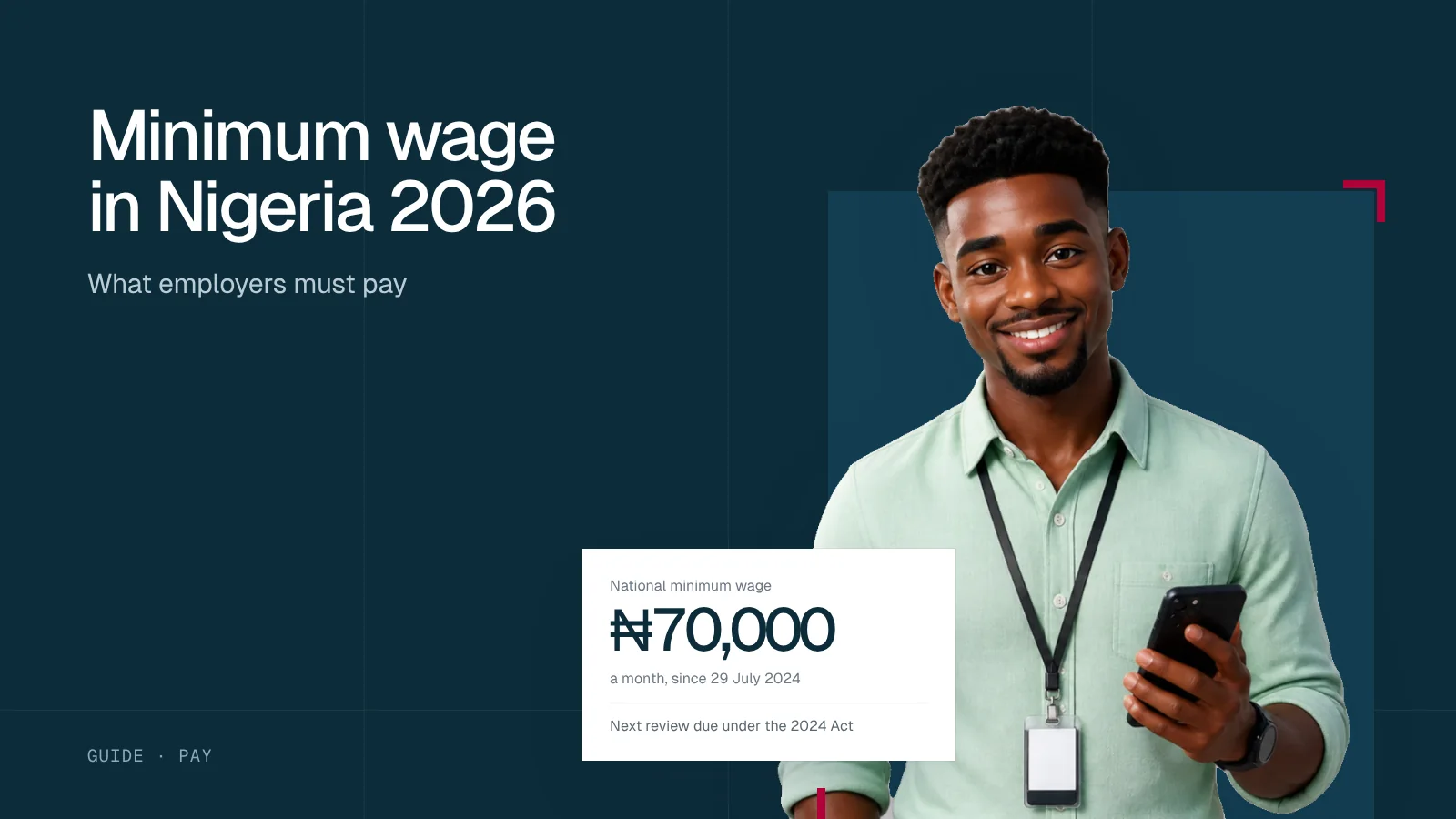
- The national minimum wage is ₦70,000 a month, under the National Minimum Wage (Amendment) Act 2024, in force from 29 July 2024.
- Establishments with fewer than 25 workers, part-time and commission or piece-rate workers, seasonal workers and workers on vessels or aircraft are exempt.
- Pay at or below the minimum wage is exempt from PAYE under the Nigeria Tax Act 2025.
- The law now provides for a review at least every three years, so the next one is due by 2027.
Nigeria’s national minimum wage is ₦70,000 a month. The National Minimum Wage (Amendment) Act 2024 set it with effect from 29 July 2024, more than doubling the ₦30,000 set in 2019. This guide explains who must pay it, who is exempt, how it interacts with tax and pension, and what to expect at the next review.
Nigeria's national minimum wage in 2026
How the minimum wage has changed
National minimum wage, naira per month
Each figure is the amount set by the Act in that year.
Show the numbers
| Item | Value |
|---|---|
| 2011 National Minimum Wage (Amendment) Act 2011 | ₦18,000 |
| 2019 National Minimum Wage Act 2019 | ₦30,000 |
| 2024 National Minimum Wage (Amendment) Act 2024 | ₦70,000 |
Source: National Minimum Wage Acts 2011 and 2019; National Minimum Wage (Amendment) Act 2024.
Who must pay ₦70,000
The minimum wage applies to employers in the public and private sectors, unless an exemption below applies. It is a floor for the total monthly wage for full-time work. Paying more is always allowed.
Exemptions
The Act does not apply to:
- Establishments employing fewer than 25 workers.
- Workers employed part-time.
- Workers paid by commission or by piece rate.
- Seasonal workers, such as those in agriculture.
- Workers on a vessel or aircraft to which the laws on merchant shipping or civil aviation apply.
The exemption for small establishments is the one most employers ask about. It does not stop a small employer paying ₦70,000, and many do, because candidates compare offers against it.
Check your own position with the tool below. It tells you whether the Act applies and how far a monthly wage is from the minimum.
Minimum wage check
National minimum wage: ₦70,000 a month.
Source: National Minimum Wage Act 2019, as amended in 2024; Nigeria Tax Act 2025. The Act does not apply to establishments with fewer than 25 workers, part-time and piece-rate workers, seasonal workers, or workers on ships and aircraft covered by other laws.
Penalties
Paying below the minimum wage where the Act applies is an offence. Employers must also keep wage records. Failure to keep or produce those records can lead to a fine of up to ₦75,000, and a further ₦10,000 for each day the failure continues. A worker paid below the minimum can also recover the shortfall.
The minimum wage and PAYE
The Nigeria Tax Act 2025 exempts employment income at or below the national minimum wage from PAYE. A worker on ₦70,000 a month pays no income tax. One on ₦75,000 pays tax, because their income is above the minimum. Our PAYE calculator applies the exemption automatically.
Pension still applies
The PAYE exemption does not switch off pension. Where the employer is covered by the Pension Reform Act 2014, the 8% employee and 10% employer contributions apply to minimum wage earners too. On ₦70,000 a month with 90% in basic, housing and transport, the employee contributes ₦5,040 and takes home ₦64,960.
Minimum wage and salary structure
The minimum wage is a floor for total monthly pay, not for basic salary alone. A structure that pays ₦70,000 split into basic, housing and transport meets it. When checking compliance, count only pay that is guaranteed every month; irregular allowances and bonuses are a weak basis for meeting the minimum. Our salary structure guide explains how to set the split.
Daily, weekly and part-month pay
The minimum wage is stated as a monthly figure for full-time work. Employers who pay daily or weekly, or who pay for part of a month, need a consistent way to convert it.
| Situation | A common method | Example at ₦70,000 a month |
|---|---|---|
| Daily-paid full-time worker | Monthly minimum ÷ working days in the month | ₦70,000 ÷ 22 days = about ₦3,182 a day |
| Weekly-paid worker | Monthly minimum × 12 ÷ 52 | About ₦16,154 a week |
| New starter joining mid-month | Monthly minimum ÷ working days × days worked | 10 of 22 days = about ₦31,818 |
These methods are illustrations, not formulas set by the Act. Whatever method you use, write it in your pay policy and make sure a full month of full-time work never pays less than ₦70,000.
Part-time workers are exempt from the Act, but paying a part-timer a lower hourly rate than full-time staff doing the same work is hard to defend and can damage recruitment. Many employers apply the same rate pro rata.
Gross pay, deductions and take-home pay
The minimum wage is a gross figure. Statutory deductions still apply: on ₦70,000 a month there is no PAYE, but pension can reduce take-home pay to about ₦64,960 where the employer is covered by the Pension Reform Act 2014. Other deductions, such as staff loans, are limited by the Labour Act to one third of wages in total each month, and should be agreed in writing.
If the Act applies and you pay below ₦70,000
Treat it as a priority. List affected workers, work out the monthly cost of bringing them to ₦70,000, and set a date. Tell staff what will change and when. Do not reclassify full-time staff as part-time or commission-only to fit an exemption; the label on a contract does not change the reality of the work, and staff and labour officers will look at what people actually do.
If cost is the problem, look at the whole pay structure before cutting roles: overtime that could be planned better, allowances that no longer serve a purpose, or grades that overlap. Our salary structure guide explains how to rebuild a structure from the bottom up.
States, sectors and consequential adjustments
The ₦70,000 figure is the national floor. State governments negotiate with labour unions on how to implement it for their own workers, and some sectors and collective agreements set higher rates. When the national minimum rises, employers paying above it often face pressure to adjust other salaries to keep differences between grades. Plan for that in budgets ahead of the next review.
When is the next review?
The 2024 amendment shortened the review cycle to at least every three years. With the current rate set in July 2024, a review is due by 2027. Reviews involve government, employers and labour, and usually take months, so the outcome is normally known before it takes effect.
What to do now
- Check whether the Act applies to you, using the exemptions above.
- List every worker paid below ₦70,000 a month and plan the change if the Act applies.
- Check that your payroll applies the PAYE exemption at or below ₦70,000.
- Keep wage records for every worker, including hours and pay.
- Put the 2027 review in your budget planning.
Written for: Employers, HR
Run payroll with Paystat
Process payroll with structured, consistent calculations and a full history of every pay cycle.
Sources
Frequently asked questions
Short answers to what employers ask us most about this topic.
What is the minimum wage in Nigeria in 2026?
₦70,000 a month. The National Minimum Wage (Amendment) Act 2024 raised it from ₦30,000 with effect from 29 July 2024, and it remains the national minimum in 2026.
Do small businesses have to pay the ₦70,000 minimum wage?
The Act exempts establishments employing fewer than 25 workers. Many small employers pay it anyway to recruit and keep staff, and some states and sectors set their own expectations.
Do minimum wage earners pay tax?
No. Employment income at or below the national minimum wage is exempt from PAYE under the Nigeria Tax Act 2025. Pension contributions can still apply.
When will the minimum wage be reviewed?
The 2024 amendment provides for a review at least every three years, which points to a review by 2027.