Key takeaways
- Section 11 of the Labour Act sets minimum notice from one day to one month, depending on length of service. Notice of a week or more must be in writing.
- Either side may accept payment in lieu of notice.
- The Court of Appeal has held that an employer may end employment without giving a reason, as long as it acts within the contract. Some National Industrial Court decisions take a stricter view.
- Follow the contract exactly, avoid protected periods such as maternity leave, and pay everything due in the final salary.
When ending employment goes wrong, it is usually because of how it was done: the notice given, the reason stated or the money paid at the end. This guide covers the minimum legal requirements and a process that keeps you within them.
Termination, dismissal, redundancy and resignation
| What it is | Notice | |
|---|---|---|
| Termination | The employer ends the contract under its terms | Contract notice, at least the Labour Act minimum, or pay in lieu |
| Summary dismissal | Ending the contract at once for serious misconduct | None, if the conduct justifies it |
| Redundancy | Ending roles because there is more staff than work | Notice plus the redundancy process. See redundancy in Nigeria |
| Resignation | The employee ends the contract | The employee gives notice under the contract |
Minimum notice
Section 11 of the Labour Act sets the minimum notice for workers covered by the Act. Check how long the employee has worked for you:
Minimum notice under the Labour Act
For workers covered by the Labour Act, unless the contract gives more.
Source: Labour Act, section 11. Where notice is a week or more, it must be in writing. The contract can require longer notice than these minimums, never shorter.
| Length of continuous employment | Minimum notice |
|---|---|
| Three months or less | One day |
| More than three months, less than two years | One week |
| Two years or more, less than five years | Two weeks |
| Five years or more | One month |
Notice of one week or more must be in writing, and the day notice is given does not count. If the contract requires longer notice, the contract applies. For managers and professionals outside the Act’s definition of “worker”, notice depends on the contract alone. See our Labour Act guide.
Payment in lieu of notice
Section 11 allows either party to waive notice or accept “a payment in lieu of notice.” Under the Act, that payment is worked out on money wages only, without overtime or other allowances. A contract may define pay in lieu more generously, for example as basic plus allowances; follow the contract where it gives more.
Do you need a reason?
This is the most debated question in Nigerian employment law. The Court of Appeal has twice held that a private employer may end employment without giving a reason, provided it keeps to the contract.
An employer may dismiss “even without assigning any reasons,” but must do so “within the four walls of the contract.”
Keystone Bank v Afolabi (Court of Appeal, 2017), as summarised by Templars
In Oak Pensions v Olayinka (2017), the Court of Appeal also held that unfair labour practice and international best practice cannot override the parties’ contract. But some National Industrial Court decisions have required a valid reason, relying on ILO Convention 158, and in Biragbara v Unity Bank (2022) the court held a termination for “services no longer required” wrongful. Other NICN decisions have held that Convention 158 is not enforceable in Nigeria because it has not been ratified.
What this means in practice
Follow the contract’s termination clause to the letter. Where there is a genuine reason, such as poor performance or restructuring, it is safer to give it, with the evidence, than to rely on a bare “services no longer required”. Take legal advice before a contested termination.
Situations to avoid
- During maternity leave. Section 54(4) prohibits giving notice of dismissal during a woman’s maternity absence, or notice that expires during it. See maternity leave.
- Where the contract sets a process. If the handbook requires a query, a hearing or a warning first, follow it. Our query letter samples cover the first step.
- Public service and statutory employment. Employment governed by statute or public service rules can only be ended in the way those rules allow.
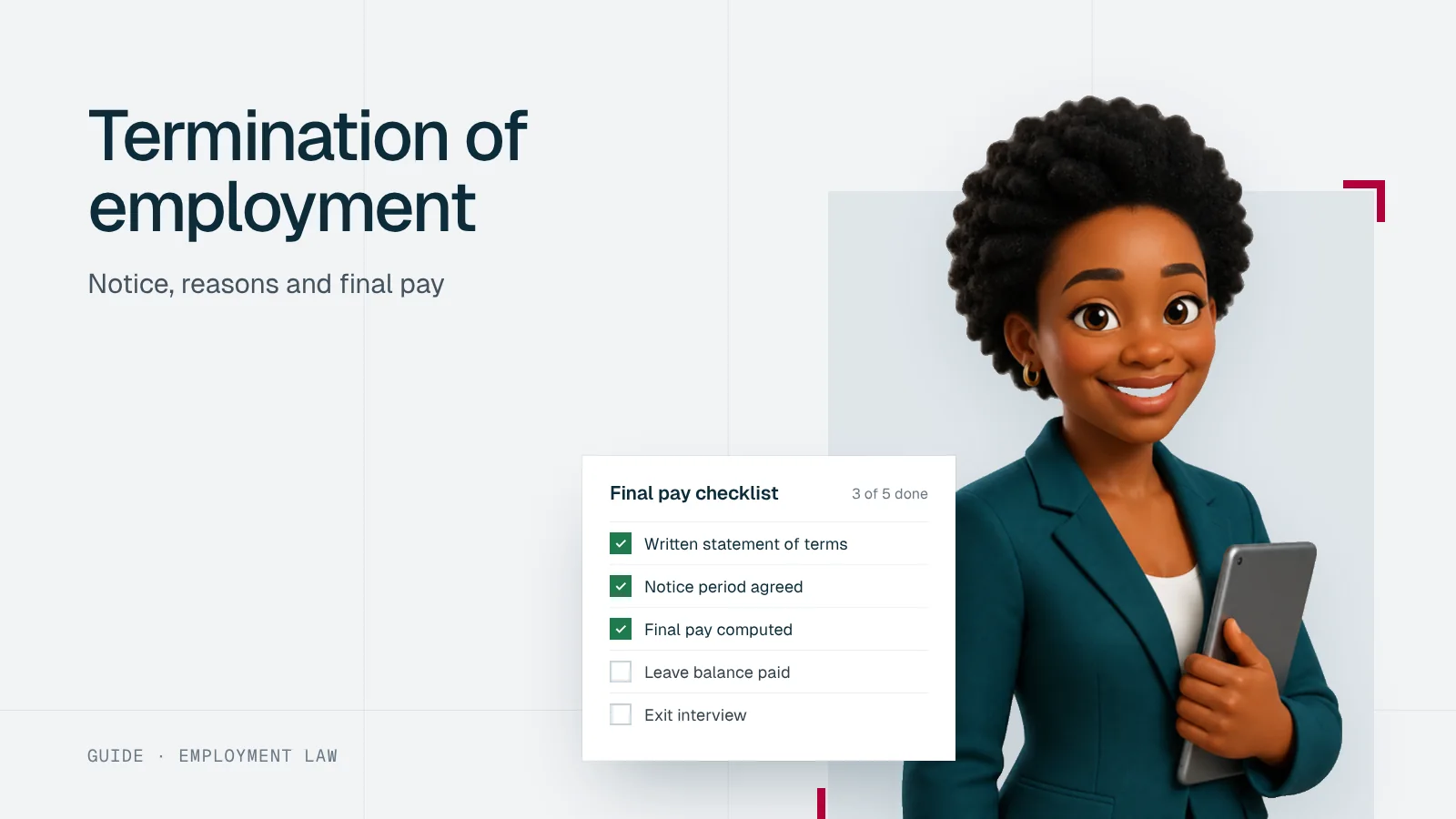
Final pay
What to include in the final salary
Salary to the last day
Pay for days worked in the final month.
Notice or pay in lieu
For the notice period, if the employee is not working it.
Untaken leave
Pro-rata leave for the current year, under the contract and section 18 of the Labour Act.
Contractual benefits
Gratuity or terminal benefits if the contract or handbook provides them. See gratuity in Nigeria.
Statutory deductions
PAYE, pension and NHF on the final pay, remitted on the usual dates.
Recover company property, loans and advances openly, with a statement the employee can check.
Sample letters
Termination with notice
[Company letterhead]
[Date]
[Employee name]
[Job title]
Dear [Employee name],
Termination of employment
This letter gives you notice that your employment with [Company name] will end on [date], in accordance with clause [number] of your contract of employment, which provides for [period] notice.
[Reason, if given: The reason for this decision is [reason], as discussed with you on [date].]
Your final salary will include your pay to [date], [number] days of untaken annual leave and [any contractual benefits]. Please return all company property to [name] by [date].
We thank you for your service and wish you well.
Yours sincerely,
[Name]
[Title]
Termination with payment in lieu of notice
[Company letterhead]
[Date]
Dear [Employee name],
Termination of employment with payment in lieu of notice
This letter confirms that your employment with [Company name] ends with effect from today, [date]. In accordance with clause [number] of your contract, you will receive [period] salary in lieu of notice.
Your final payment, which will be made on [date], will include [salary to date, pay in lieu of notice, untaken leave and any contractual benefits]. PAYE, pension and other statutory deductions will be made as required.
Please return all company property to [name] by [date].
Yours sincerely,
[Name]
[Title]
Termination checklist
Before deciding
The letter
Final pay
Ticks are saved in this browser only.
Employee management made easy
Keep employee records, attendance, leave, payroll and performance in one connected system.
Written for: HR, business owners
Employee management made easy
Keep employee records, attendance, leave, payroll and performance in one connected system.
Sources
Frequently asked questions
Short answers to what employers ask us most about this topic.
What is the notice period for termination in Nigeria?
Under section 11 of the Labour Act: one day if employment has lasted three months or less, one week up to two years, two weeks from two to five years, and one month after five years. A contract can require longer notice, and that longer period applies.
Does an employer need a reason to terminate employment in Nigeria?
The Court of Appeal in Keystone Bank v Afolabi and Oak Pensions v Olayinka held that an employer may terminate without giving reasons if it follows the contract. Some National Industrial Court decisions have required a valid reason, so the position is not fully settled. Take advice before relying on a no-reason termination.
Can an employer pay instead of giving notice?
Yes. Section 11 allows either party to waive notice or accept payment in lieu. Under the Act, pay in lieu is worked out on money wages, excluding overtime and allowances, unless the contract says otherwise.