Key takeaways
- Section 20 of the Labour Act defines redundancy as an involuntary and permanent loss of employment caused by an excess of manpower.
- Before redundancies, the employer must inform the trade union or workers' representative of the reasons and the extent of the redundancy.
- Selection follows 'last in, first out' within the affected category, subject to relative merit such as skill, ability and reliability.
- There is no fixed statutory redundancy payment for the private sector. The employer must use its best endeavours to negotiate one.
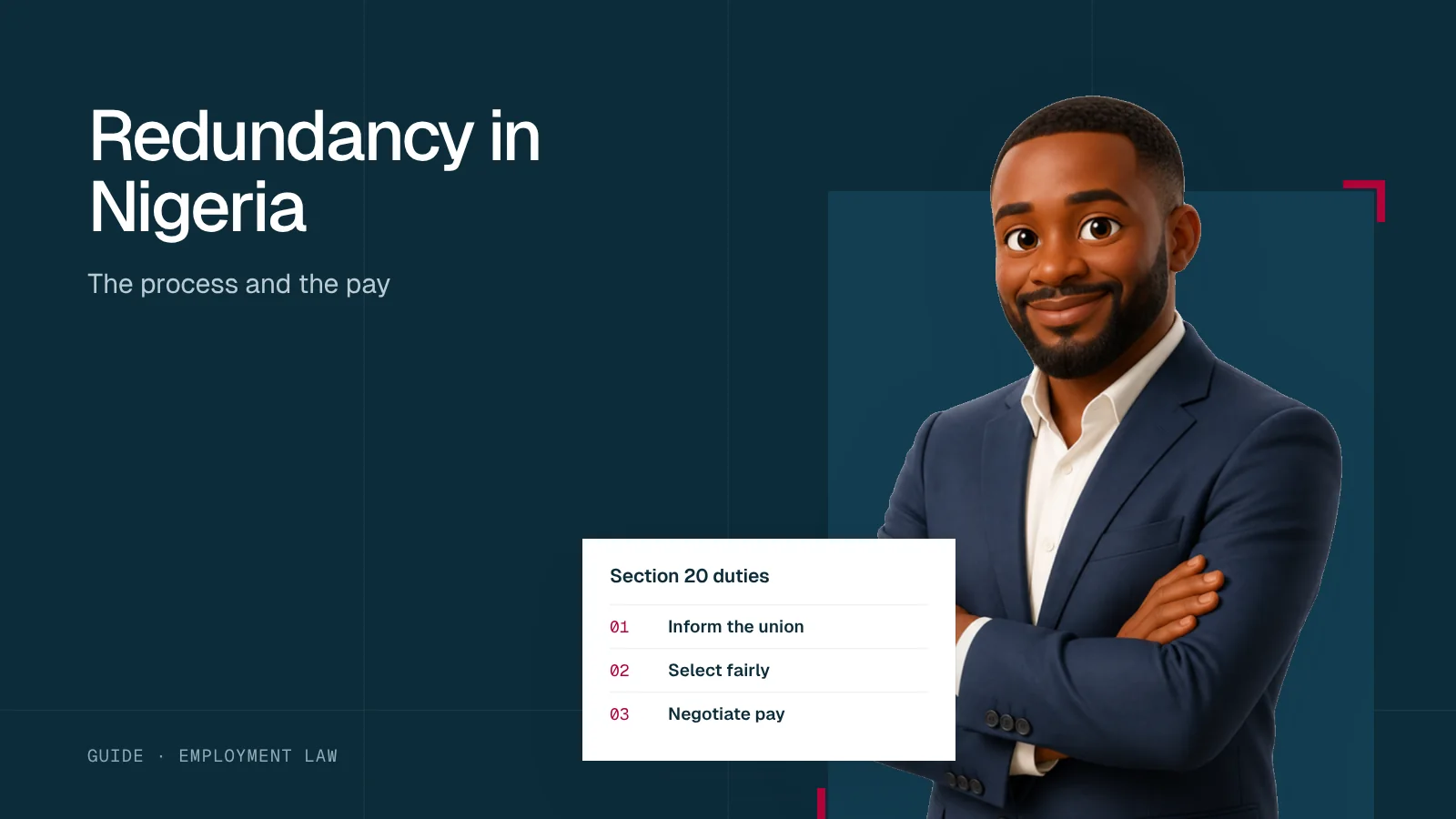
Redundancy is one of the hardest people decisions a business makes, and one of the few with a statutory process. Section 20 of the Labour Act sets three duties: inform, select fairly and negotiate pay. This guide takes each in turn and adds the practical steps that keep a redundancy exercise orderly.
Three duties before making staff redundant
- 01
Inform
Tell the trade union or workers' representative the reasons for and extent of the redundancy
- 02
Select fairly
Last in, first out within the category, subject to skill, ability and reliability
- 03
Negotiate pay
Use best endeavours to agree redundancy payments with those affected
What counts as redundancy
Section 20(3) defines redundancy as an involuntary and permanent loss of employment caused by an excess of manpower. Two things follow:
- It is about roles, not people. The business needs fewer people to do a type of work, for example after a contract ends, a branch closes or a process is automated.
- It is permanent. A temporary shortage of work is better handled by other means, such as agreed short time or unpaid leave, than by redundancy.
If the real issue is one person’s performance or conduct, use the termination or disciplinary process instead. Calling it redundancy brings section 20 duties and invites a challenge.
Duty 1: inform the union or workers’ representative
The employer “shall inform the trade union or workers’ representative concerned of the reasons for and the extent of the anticipated redundancy.”
Labour Act, section 20(1)(a)
Tell them early, in writing, before decisions on individuals are made. Explain the business reason, the roles and numbers affected, the selection method and the timetable, and invite comments. Keep minutes of every meeting.
Duty 2: select fairly
Section 20(1)(b) requires the employer to apply the principle of “last in, first out” to the category of workers affected, subject to all factors of relative merit, including skill, ability and reliability.
Applying last in, first out with merit
Define the pool
The category of workers affected, such as all sales officers in the Abuja branch.
Rank by service
List the pool by start date, latest first.
Check merit
Adjust for documented differences in skill, ability and reliability.
Record the reasons
Write down why anyone was kept or selected out of service order.
Use evidence that existed before the redundancy, such as appraisal ratings, qualifications and attendance records. Criteria created after the event look like a way to pick particular people.
Duty 3: negotiate redundancy pay
The Act does not fix an amount for the private sector. Section 20(1)(c) requires the employer to “use his best endeavours to negotiate redundancy payments” with workers who are not covered by regulations. Section 20(2) allows the Minister to make regulations for compulsory redundancy allowances.
In practice, redundancy pay is set by a collective agreement, the company’s policy or negotiation, and is often expressed as a number of weeks’ or months’ basic pay for each year of service.
| Example formula: 2 weeks’ basic pay per year of service | Figure |
|---|---|
| Monthly basic salary | ₦150,000 |
| One week’s basic (₦150,000 × 12 ÷ 52) | ₦34,615 |
| Completed years of service | 6 |
| Redundancy payment (₦34,615 × 2 × 6) | ₦415,385 |
The formula is an illustration only. Check whether a collective agreement covers your staff before you propose one.
Alternatives to consider first
Redundancy is permanent, so look at the alternatives before you start, and record that you did:
- Stop hiring into the affected area, and do not renew fixed-term contracts that are ending anyway.
- Redeploy affected staff into open roles elsewhere in the business, with training if needed.
- Agree reduced hours or unpaid leave for a fixed period, in writing, where the shortage of work is likely to be temporary.
- Invite volunteers, with clear terms, before compulsory selection.
Telling the people affected
Tell each affected employee in a private meeting before anything is announced more widely, and give them the decision in writing the same day. Explain the reason, the selection method, their notice and their redundancy payment, and what support you can offer, such as references or time off to attend interviews.
Notice and final pay
Each employee made redundant is still owed notice under the contract, at least the Labour Act minimum, or pay in lieu. The final payment then includes:
- salary to the last day worked
- notice pay, if notice is not worked
- untaken annual leave
- the agreed redundancy payment
- any contractual gratuity or terminal benefit
Deduct and remit PAYE, pension and NHF as usual, and confirm the tax treatment of the redundancy payment with your tax adviser.
A redundancy timetable
A typical redundancy exercise
Timings are examples. Allow longer where many roles are affected.
- Week 1
Business case
Reasons, roles affected and alternatives considered
- Week 2
Inform
Written notice to the union or workers’ representative, first meeting
- Weeks 3 to 4
Consult and select
Pool, criteria, scoring and negotiation of redundancy pay
- Week 5
Individual meetings
Each affected employee told in person, then in writing
- Week 6 onwards
Notice and exit
Notice period, final pay and support with the next job
Redundancy checklist
Before
Selection
Exit
Ticks are saved in this browser only.
Employee management made easy
Keep employee records, attendance, leave, payroll and performance in one connected system.
Written for: HR, business owners
Employee management made easy
Keep employee records, attendance, leave, payroll and performance in one connected system.
Sources
Frequently asked questions
Short answers to what employers ask us most about this topic.
How is redundancy pay calculated in Nigeria?
The Labour Act does not set an amount. Section 20 requires the employer to use its best endeavours to negotiate redundancy payments with affected workers or their union. Collective agreements and company policies can set a formula, such as a number of weeks' basic pay for each year of service.
Do I need to consult the union before redundancy?
Section 20(1)(a) requires the employer to inform the trade union or workers' representative concerned of the reasons for, and the extent of, the anticipated redundancy. Where there is no union, inform the workers' representatives.
Is redundancy the same as termination?
No. Termination ends one employee's contract under its terms. Redundancy ends roles because there are more staff than the business needs, and section 20 adds duties on information, selection and pay.