Key takeaways
- No Nigerian statute we found requires private employers to pay gratuity. Where it is paid, the right comes from the contract, handbook or a collective agreement.
- A gratuity formula multiplies years of service by an amount of pay, for example 10% of annual basic, two weeks' basic or one month's basic per year.
- A scheme can set a minimum qualifying period, such as five years. The scheme rules decide what happens to staff who leave earlier.
- Once promised in writing, gratuity is a contractual entitlement. Accrue for it every month so it does not become a surprise cost.
Gratuity is a lump sum paid when an employee leaves after a qualifying period of service. Some employers offer it as a reward for long service. Because no statute sets it for private employers, the questions are all about the contract: who qualifies, on what formula, and when it is paid.
Is gratuity required by law?
For private employers, we found no statutory requirement. The Labour Act sets notice, leave and wage rules but does not provide for gratuity, and the Pension Reform Act 2014 deals with pension contributions. Gratuity is therefore a contractual benefit.
Once it is written down, it is owed
If an employee’s contract, the staff handbook or a collective agreement provides for gratuity, the employer must pay it in line with those terms. Changing or withdrawing a promised gratuity needs care and, usually, the employees’ agreement. Take legal advice before you change a scheme.
The common formulas
Gratuity formulas multiply years of service by an amount of pay. Three common shapes:
| Formula | Example on ₦250,000 basic, 6 years | Result |
|---|---|---|
| 10% of annual basic per year | ₦250,000 × 12 × 10% × 6 | ₦1,800,000 |
| Two weeks’ basic per year | ₦250,000 × 12 ÷ 52 × 2 × 6 | ₦692,308 |
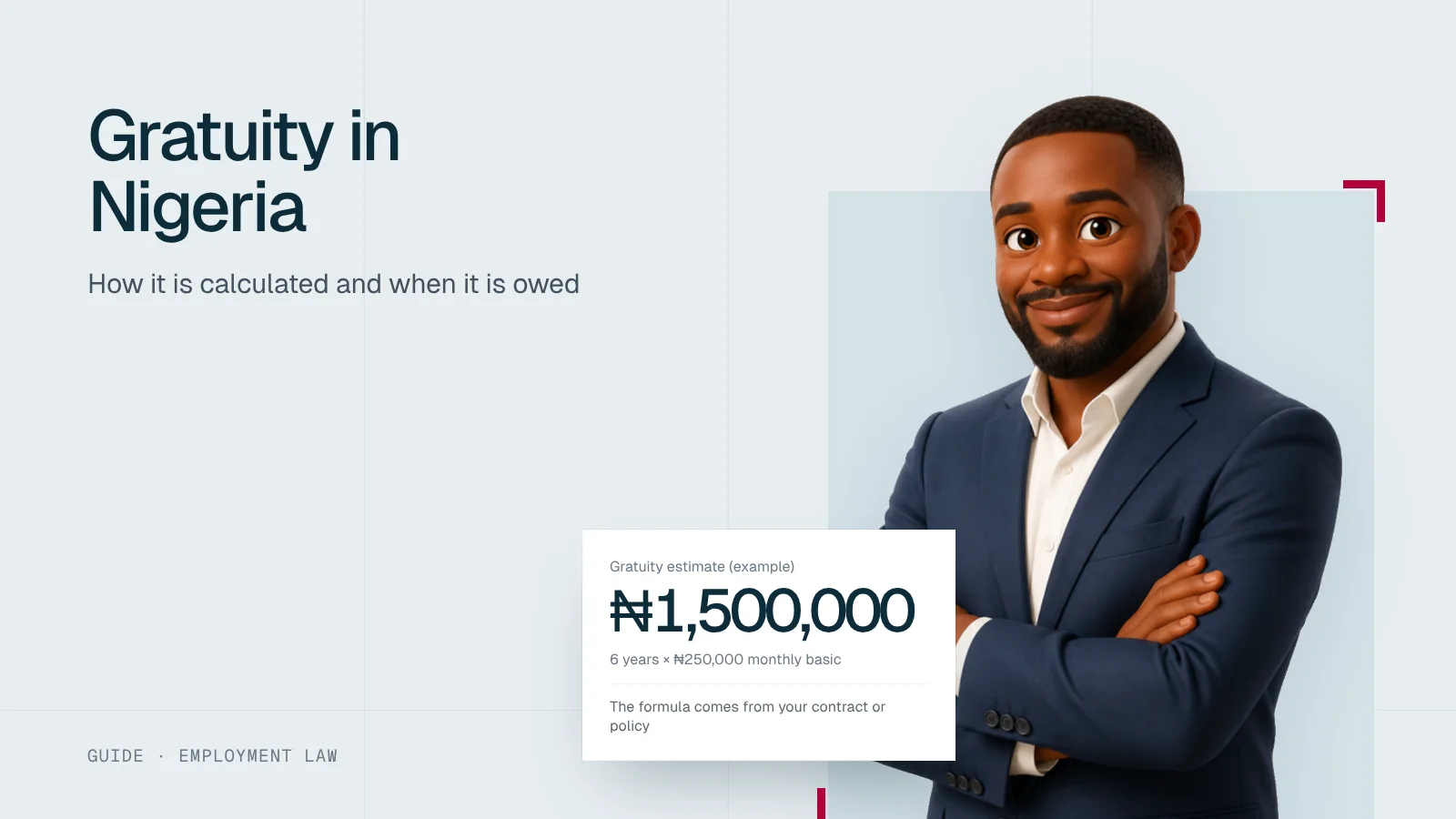
| One month’s basic per year | ₦250,000 × 1 × 6 | ₦1,500,000 |
Use the estimator to apply your own scheme’s formula:
Gratuity estimator
Enter the formula from your contract, handbook or collective agreement.
There is no general statutory gratuity for private-sector employees in Nigeria; the formula comes from the employment terms. The defaults here are examples, not a legal standard.
Read your scheme for four details before you calculate:
- The pay base: final basic salary, average basic over the last few years, or basic plus some allowances.
- The qualifying period: for example five years, with nothing payable before it.
- Partial years: whether service is counted in completed years or months.
- Exclusions: for example, whether gratuity is forfeited on dismissal for gross misconduct.
A worked example with partial years
Take an employee with ₦250,000 final monthly basic salary who leaves after 6 years and 7 months, under a scheme that pays one month’s basic for each year of service with a five-year qualifying period.
| How partial years are treated | Service counted | Gratuity |
|---|---|---|
| Completed years only | 6 years | ₦1,500,000 |
| Pro rata by completed months | 6 years 7 months (6.583 years) | ₦1,645,833 |
The difference is ₦145,833 for one employee. Write the rule into the scheme so it is not argued case by case.
Leavers before the qualifying period
If the scheme sets a qualifying period, staff who leave before it receive nothing under the formula unless the scheme says otherwise. The estimator above shows how many more years of service would be needed. Decide in advance whether there are exceptions, for example for redundancy or death in service, and write them down.
Funding gratuity
Gratuity is a liability that grows every month an employee stays. On the first formula above, each year of service adds ₦300,000, or ₦25,000 a month. Across 40 staff, that is ₦1,000,000 a month of cost that does not appear in payroll unless you put it there.
Gratuity owed to one employee as service grows
10% of annual basic per year of service, on ₦250,000 monthly basic, with a five-year qualifying period.
Show the numbers
| Item | Value |
|---|---|
| Year 4 Not yet qualified | ₦0 |
| Year 5 Qualifies | ₦1,500,000 |
| Year 10 Before any pay rises | ₦3,000,000 |
| Year 15 Before any pay rises | ₦4,500,000 |
Source: Workstat calculation.
Final-salary schemes cost more than the chart shows, because every pay rise increases the gratuity for all past years at once. Two habits help:
- Accrue monthly. Post a provision each month for the gratuity earned, so the cost is spread over the years of service.
- Set money aside. Some employers place the provision in a separate account or fund so the cash is there when long-serving staff retire or leave together.
A sample gratuity clause
Gratuity clause for a staff handbook
Gratuity
An employee who has completed at least [five] years of continuous service with [Company name] is entitled to a gratuity when their employment ends, other than by summary dismissal for gross misconduct.
The gratuity is [one month’s] final basic salary for each completed year of continuous service. Service of less than a complete year is [not counted / counted pro rata by completed months].
The gratuity is paid with the employee’s final salary, subject to any deductions the law requires, and after the return of all company property.
[Company name] may review this scheme. Any change will apply only to service after the date it is announced in writing, unless the employee agrees otherwise.
Gratuity and other exit payments
Gratuity sits alongside the other items in final pay: notice or pay in lieu, untaken leave and, in a redundancy, the agreed redundancy payment. A scheme can say whether gratuity and redundancy pay are both paid or one replaces the other. See termination of employment and redundancy.
Gratuity checklist
Scheme rules
Each month
On exit
Ticks are saved in this browser only.
Run payroll with Paystat
Process payroll with structured, consistent calculations and a full history of every pay cycle.
Written for: HR, employees
Run payroll with Paystat
Process payroll with structured, consistent calculations and a full history of every pay cycle.
Sources
Frequently asked questions
Short answers to what employers ask us most about this topic.
Is gratuity compulsory in Nigeria?
Not under the Labour Act or the Pension Reform Act 2014 for private employers. Gratuity becomes payable when the contract of employment, staff handbook or a collective agreement provides for it, and then the employer must pay it as written.
How do I calculate gratuity in Nigeria?
Use the formula in your contract or handbook. A common form is final monthly basic salary multiplied by a number of weeks or months for each completed year of service. On ₦250,000 basic, one month per year for six years gives ₦1,500,000.
Is gratuity taxable in Nigeria?
Confirm the treatment under the Nigeria Tax Act 2025 with a tax adviser before paying. The answer can depend on how the payment is structured.