Key takeaways
- HRM software keeps employee records in one place and runs HR processes such as leave, attendance, payroll and appraisals.
- HRIS, HRMS and HCM overlap. Vendors use the terms loosely, so compare modules rather than labels.
- For Nigerian employers, the deciding modules are usually payroll under the 2026 tax rules, leave and attendance.
- Employee data is personal data under the Nigeria Data Protection Act 2023. Ask every vendor how it is stored and protected.
HRM software (human resource management software) is any system that keeps employee information in one place and runs the routine work of HR: records, leave, attendance, payroll and appraisals. This guide explains the jargon, the modules that matter for Nigerian employers and how to tell when you need one.
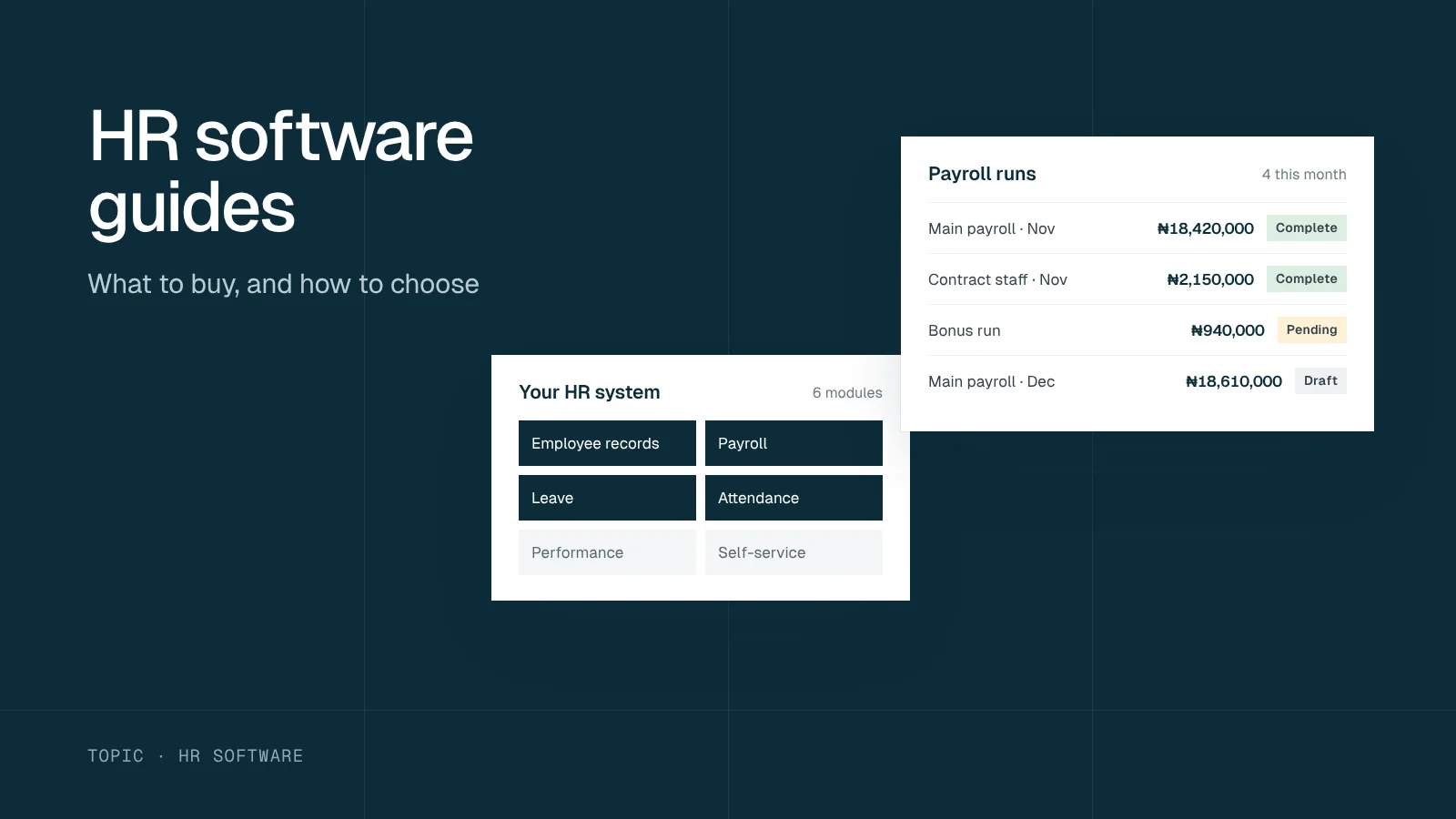
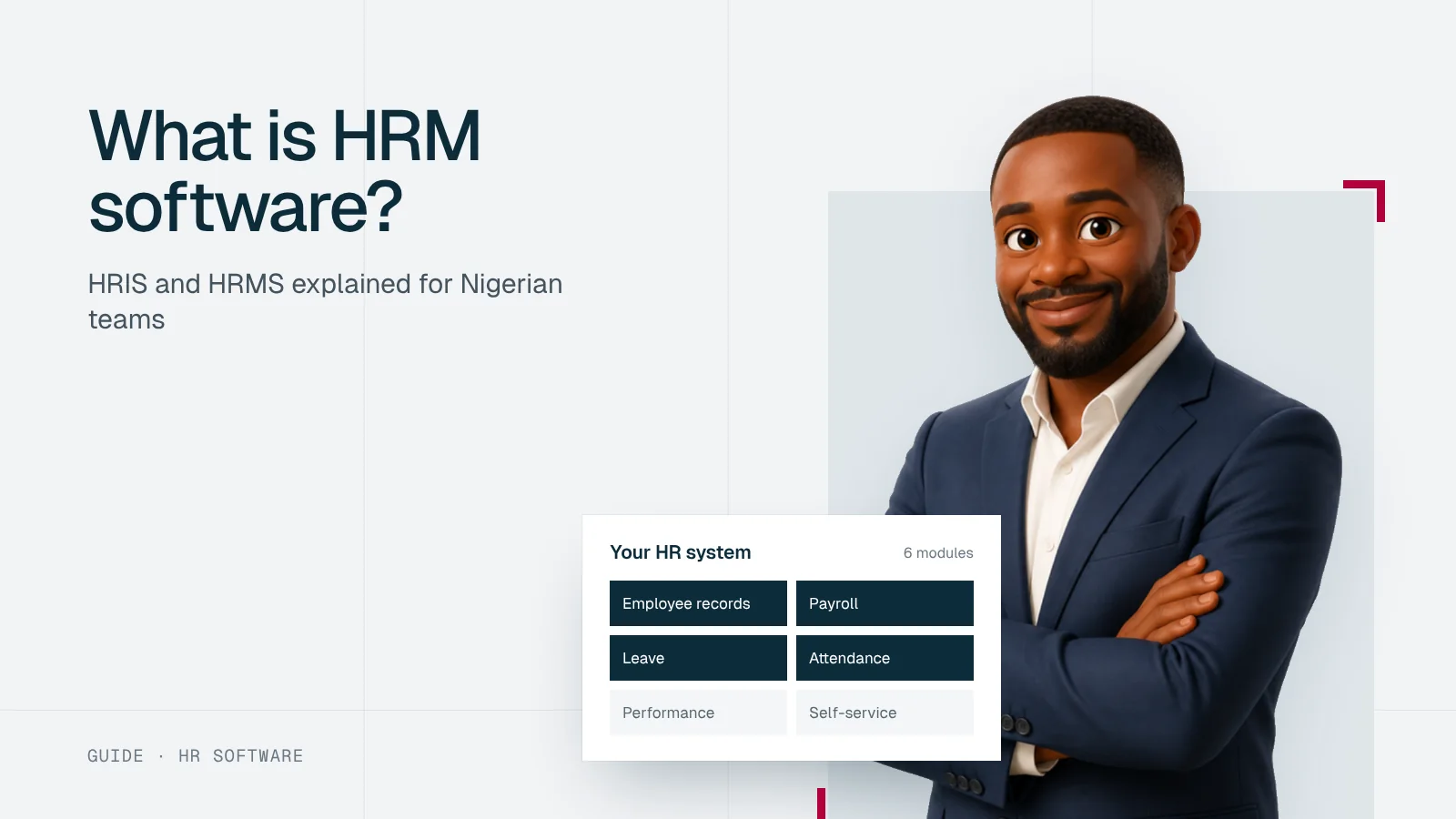
The six modules most HR systems are built from
Not every product has every module. Check which ones you need.
Tap the modules you need.
What HRM software does
At its simplest, HRM software replaces the spreadsheets, paper files and email threads that HR work otherwise lives in. Instead of a staff list in one file, leave in another and payroll in a third, there is one record per employee that every process draws on.
| Module | What it does | Nigerian detail to check |
|---|---|---|
| Employee records | Stores personal details, contracts and documents | Tax ID, RSA PIN, PFA, NHF number, guarantor details |
| Leave | Handles requests, approvals and balances | Labour Act minimums; leave counted in working days |
| Time and attendance | Records clock-in, shifts and overtime hours | Data protection for biometrics; multiple sites |
| Payroll | Calculates pay, deductions and payslips | PAYE under the Nigeria Tax Act 2025; remittance to each state |
| Performance | Runs objectives and appraisals | Your own rating scale and review cycle |
| Self-service | Lets staff see payslips and request leave | Works well on mobile phones and low bandwidth |
HRIS, HRMS and HCM
The three acronyms describe overlapping products, and vendors use them in different ways.
How the terms are usually used
HCM (human capital management) is usually used for broader suites that add recruitment, learning and workforce planning. In practice, ignore the label and compare the modules each product includes.
What Nigerian employers should look for
Products built for other markets can miss local rules. Before you buy, check:
- Payroll rules: the 2026 PAYE bands and reliefs, pension on basic, housing and transport, NHF on basic, NSITF and ITF. Our payroll software guide has a full checklist.
- Multi-state staff: PAYE remitted to the state where each employee lives.
- Leave rules: leave types, balances and working-day counting that match your policy.
- Data protection: employee records are personal data under the Nigeria Data Protection Act 2023, and biometric data needs particular care. See time and attendance systems.
- Exports: you should be able to get all your data out in a usable format.
- Support: local support hours and the ability to fix problems before a payroll deadline.
Ask for a demo with your own data
A demo on the vendor’s sample company shows you the screens. A demo on one month of your own payroll and leave records shows you whether the product works for you.
When do you need HRM software?
There is no headcount at which software becomes compulsory. These signs suggest spreadsheets are costing more than they save:
- Payroll takes days and needs the same person every month.
- Leave balances are disputed because records live in several places.
- Staff ask HR for payslips and letters that a portal could provide.
- You have several sites and attendance is reported by phone or WhatsApp.
- Audits are stressful because remittance evidence is hard to find.
If only one or two apply, good templates may be enough for now. Our payroll template, attendance register and leave policy are free.
What HRM software costs
Prices vary widely, so compare the total cost over two or three years rather than the monthly fee alone. Most products are priced in one of three ways:
| Pricing model | How it works | Watch for |
|---|---|---|
| Per employee per month | A fee for each active employee | Minimum charges, and whether leavers still count |
| Tiered plans | Fixed price bands by headcount or modules | Jumping to a higher tier as you grow |
| Licence and support | A one-off licence, with yearly support and updates | Hosting, upgrade and support costs |
Ask every vendor about set-up fees, data migration, training and the cost of adding modules later.
What implementation involves
Even simple systems need preparation. Plan for four stages:
- Clean your data. Check names, tax IDs, RSA PINs, bank details, salaries and leave balances before you load them.
- Set up the rules. Pay components, leave types, approval routes and public holidays.
- Run in parallel. Run at least one payroll in the old and new systems and compare every line.
- Train people. Managers and staff need to know how to approve leave, view payslips and update details.
A start at the beginning of a month or quarter makes the switch cleaner, because the year-to-date figures carry over at a natural break.
Choosing a product
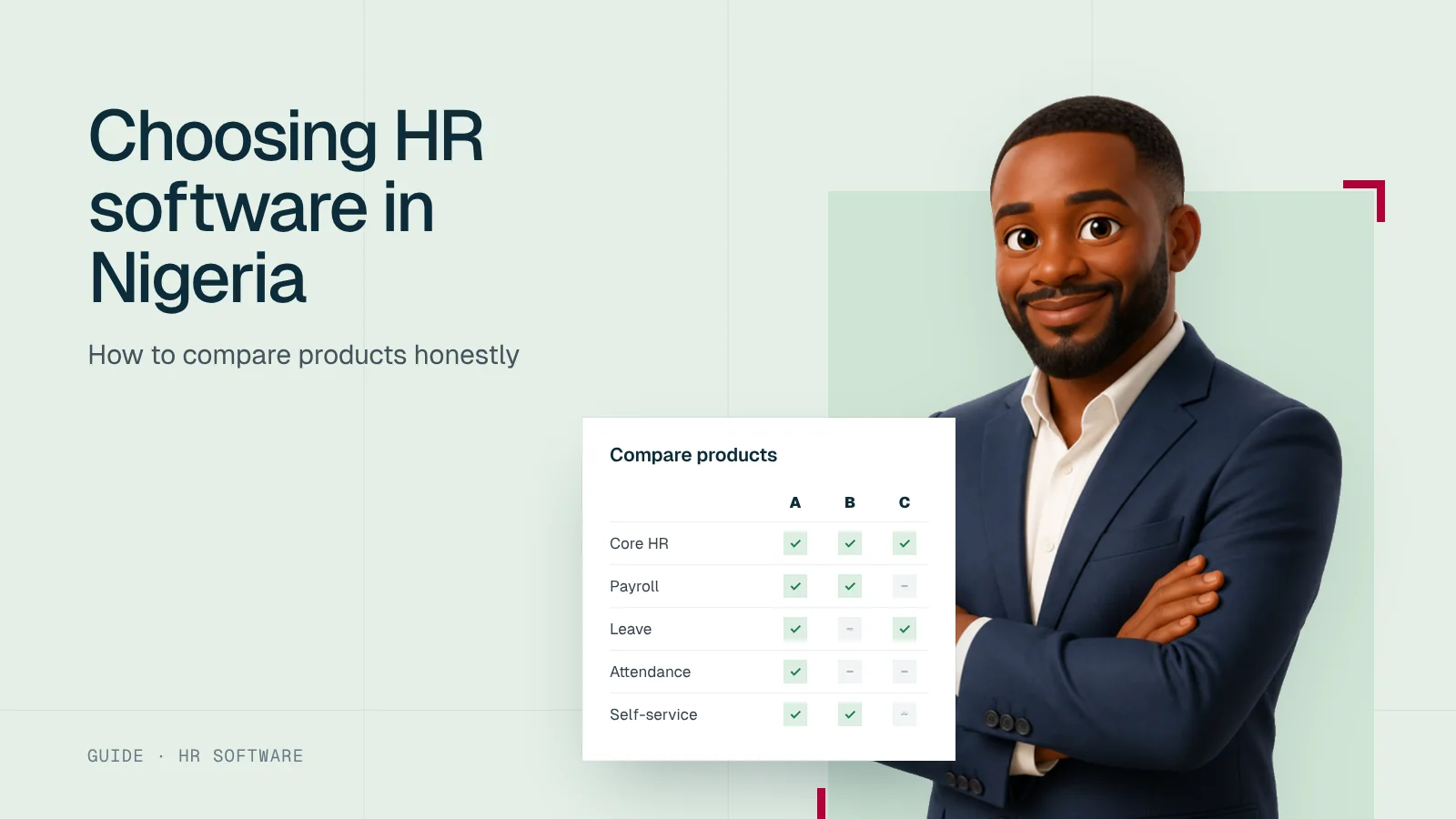
Shortlist two or three products, test each with your own data, and compare total cost, including set-up and support. Our honest comparison of HR software in Nigeria includes a weighted scorecard you can use.
Employee management made easy
Keep employee records, attendance, leave, payroll and performance in one connected system.
Written for: Business owners
Employee management made easy
Keep employee records, attendance, leave, payroll and performance in one connected system.
Sources
Frequently asked questions
Short answers to what employers ask us most about this topic.
What is the difference between HRIS and HRMS?
An HRIS (human resources information system) usually means the core employee database and reporting. An HRMS (human resources management system) usually adds processes such as payroll, leave, attendance and performance. The terms overlap and vendors use them differently.
Do small businesses need HRM software?
Not always. A business with a handful of staff can run HR well with good spreadsheets and templates. Software starts to pay off when records are scattered, payroll takes days, leave is tracked in several places or staff are spread across locations.
Is HRM software the same as payroll software?
Payroll is one module. Many HRM systems include payroll; others connect to a separate payroll product. Check which approach a vendor uses and how data moves between the two.