Key takeaways
- Section 13 of the Labour Act says normal hours are fixed by agreement, collective bargaining or an industrial wages board, and hours beyond them are overtime.
- The Act does not set an overtime rate. The rate comes from the contract, handbook or collective agreement.
- One way to find the hourly rate is monthly pay × 12 ÷ 52 ÷ normal weekly hours, the method our calculator uses.
- Workers are entitled to one rest day in seven. If it is reduced, they get time off within 14 days or pay at overtime rates.
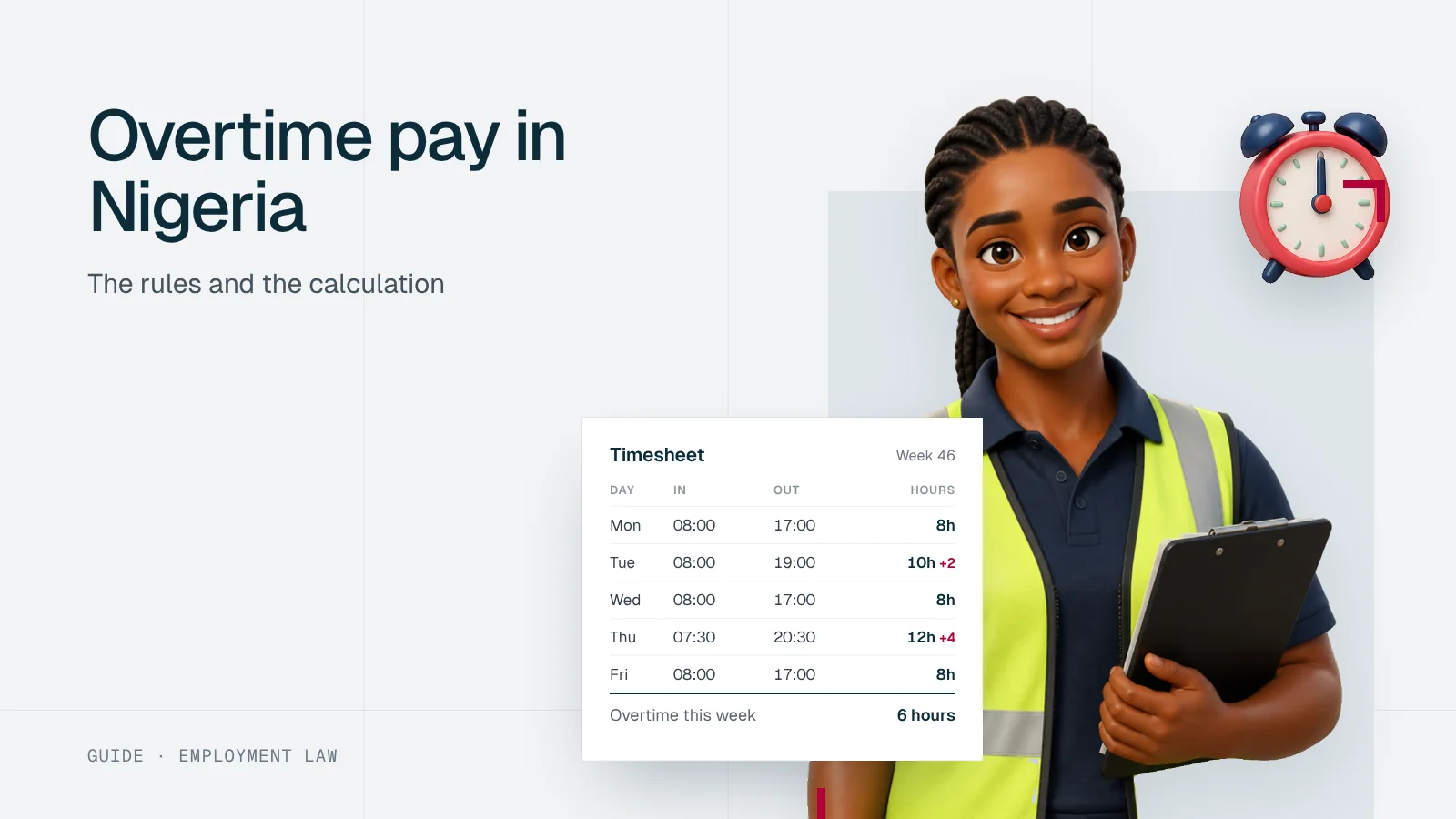
Overtime disputes usually start with a missing number: nobody wrote down the normal hours, the overtime rate or how hours are approved. The Labour Act sets the framework and leaves the numbers to employers and staff. This guide explains section 13 and shows how to calculate overtime pay correctly.
What the Labour Act says
Section 13 starts with normal hours. They are fixed by mutual agreement, by collective bargaining in the organisation or industry, or by an industrial wages board where there is no bargaining machinery. Then:
Hours worked beyond the normal hours fixed in this way “shall constitute overtime.”
Labour Act, section 13(2)
The rest of section 13 deals with rest:
Rest rules in section 13
Source: Labour Act, section 13.
Where work involves continuous strain, the worker is also entitled to suitably adjusted breaks, which do not count as rest intervals.
Who it covers
Like the rest of the Labour Act, section 13 protects “workers”, which excludes people in administrative, executive, technical or professional roles. Whether managers are paid overtime depends on their contracts. Contracts for senior staff may say their salary covers all hours worked. See our Labour Act guide for the definition.
The overtime rate
The Act does not set an overtime rate. Set it in the contract, the handbook or a collective agreement, and state:
- the normal daily and weekly hours
- the rate for overtime on working days, rest days and public holidays
- who must approve overtime before it is worked
- whether staff can choose time off instead of pay
Write the rate as a multiple of the hourly rate. The calculator below uses 1.5 times as a starting point; change it to the rate your contract sets.
Working out the hourly rate
Salaried staff are paid monthly, so overtime starts with converting the monthly salary to an hourly rate:
Hourly rate = monthly pay × 12 ÷ 52 ÷ normal weekly hours
Multiplying by 12 and dividing by 52 turns monthly pay into weekly pay, which avoids the error of dividing by four weeks a month. Decide in the contract whether “pay” means basic salary or total pay, because it changes the result.
| Example | Figure |
|---|---|
| Monthly pay used for overtime | ₦200,000 |
| Normal hours a week | 40 |
| Hourly rate (₦200,000 × 12 ÷ 52 ÷ 40) | ₦1,154 |
| Overtime hours this month | 10 |
| Overtime rate in the contract | 1.5 times |
| Overtime pay (₦1,154 × 1.5 × 10) | ₦17,308 |
Try your own figures:
Overtime pay calculator
Uses the overtime rate in your contract, handbook or collective agreement.
Hourly rate = monthly pay x 12 / 52 / normal weekly hours. The 1.5 rate is a placeholder: use the figure your contract or agreement sets. Overtime pay is taxable through PAYE.
Overtime on rest days and public holidays
If a worker’s weekly rest day is reduced, section 13 gives them either corresponding time off within the next 14 days or pay at overtime rates. You can set a higher multiple for rest days and public holidays than for weekday overtime. Whatever you choose, write it down and apply it the same way each time. The public holidays page lists the 2026 dates.
Time off instead of pay
Some employers let staff take time off in lieu of overtime pay. If you allow it, write down whether time off is given hour for hour or at the overtime rate, how soon it must be taken, and what happens to unused time when someone leaves. For a reduced weekly rest day, section 13 sets the rule: corresponding time off within 14 days, or overtime pay.
Overtime clause for a contract or handbook
Normal working hours are [40] hours a week, [8:00 a.m. to 5:00 p.m., Monday to Friday]. Work beyond normal hours must be approved in advance by your line manager.
Approved overtime is paid at [1.5] times your hourly rate on working days and [2] times on rest days and public holidays. Your hourly rate is your monthly [basic salary / pay] × 12 ÷ 52 ÷ [40].
[With your manager’s agreement, you may take time off instead of overtime pay, at [one hour for each hour worked], within [one month].]
Overtime in payroll
- PAYE: overtime is employment income, taxed in the month it is paid. A large overtime payment can move PAYE up that month. See the PAYE calculator.
- Pension: the minimum pension base is basic, housing and transport. Overtime is outside that base unless your contracts include it in pensionable pay.
- Payslips: show overtime on its own line with hours and rate, so staff can check it.
- Pay in lieu of notice: under section 11 of the Labour Act, overtime is excluded when working out pay in lieu.
Recording hours
Overtime pay is only as good as the hours record behind it. Record start and finish times and approved overtime for every worker, and keep the approvals. Our attendance register template and the guide to time and attendance systems cover the options, from paper to biometric clock-in.
Overtime checklist
In writing
Each month
Rest
Ticks are saved in this browser only.
Run payroll with Paystat
Process payroll with structured, consistent calculations and a full history of every pay cycle.
Written for: HR, payroll officers
Run payroll with Paystat
Process payroll with structured, consistent calculations and a full history of every pay cycle.
Sources
Frequently asked questions
Short answers to what employers ask us most about this topic.
What is the overtime rate in Nigeria?
The Labour Act does not fix one. The rate is set by the contract of employment, the staff handbook or a collective agreement. One approach is a multiple of the hourly rate, for example 1.5 times for weekdays, with a higher multiple for rest days or public holidays.
How do I calculate overtime pay?
Work out the hourly rate (monthly pay × 12 ÷ 52 ÷ normal weekly hours), multiply by the overtime rate in your contract, then by the overtime hours. On ₦200,000 a month and a 40-hour week, the hourly rate is ₦1,154, and 10 hours at 1.5 times is ₦17,308.
Is overtime taxable in Nigeria?
Yes. Overtime is part of employment income and goes through PAYE in the month it is paid.