Key takeaways
- The Labour Act protects 'workers'. Its definition excludes people in administrative, executive, technical or professional roles, but most employers apply its minimums to everyone.
- Give a written statement of terms within three months of a worker starting, and confirm changes in writing within a month.
- Total deductions from wages in a month cannot exceed one third of the wages for that month.
- Minimums include six working days of paid annual leave after a year, 12 days of paid sick leave, 12 weeks of maternity leave and notice from one day to one month.
The Labour Act is the starting point for employment law in Nigeria. It sets the minimum terms for contracts of employment, how and when wages are paid, what can be deducted, hours and rest, leave, maternity protection, notice and redundancy. This guide goes through the sections employers use most, in plain language, and points to the other laws that sit beside it.
Minimum standards every Nigerian employer should know
Who the Act covers
The Act protects “workers”, defined in section 91 as anyone working under a contract with an employer, whether for manual or clerical work, oral or written. The definition then excludes several groups.
The definition of worker “does not include … persons exercising administrative, executive, technical or professional functions as public officers or otherwise”
Labour Act, section 91
The other exclusions are members of the employer’s family, people employed other than for the employer’s business, representatives and commercial travellers working away from the employer’s premises, people making up articles at home for the employer, and people working on vessels or aircraft covered by shipping or aviation law.
In practice, the exclusion of managerial and professional staff means their rights come mainly from their contracts and from case law. Most employers apply the Act’s minimums to everyone anyway, because it is simpler and fairer.
The sections employers use most
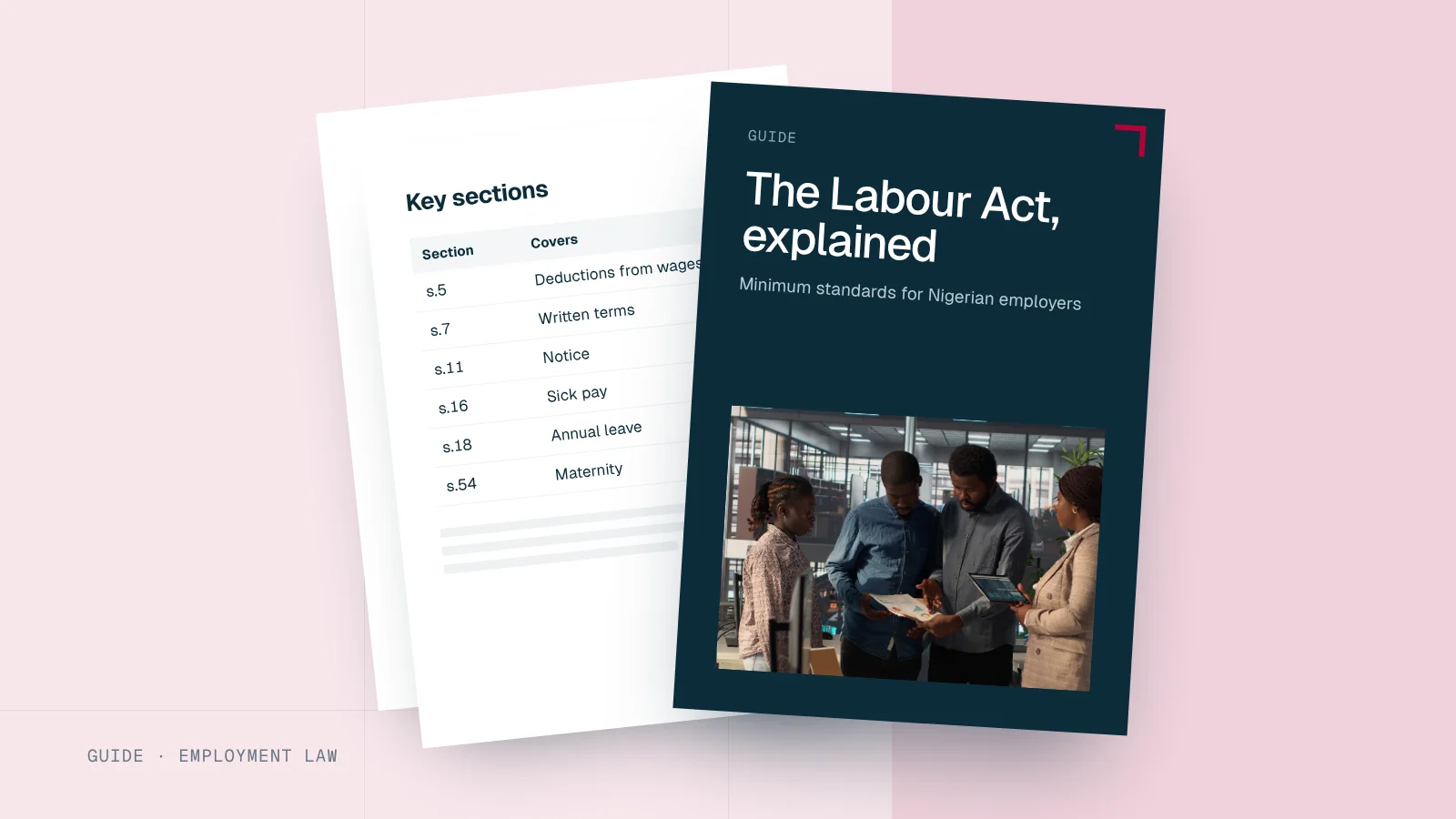
| Section | Topic | What it requires |
|---|---|---|
| 5 | Deductions from wages | No deductions for fines; overpayments recoverable only for the previous three months; total deductions capped at one third of the month’s wages |
| 7 | Written terms | A written statement of terms within three months of starting; changes notified in writing within one month |
| 11 | Notice | Minimum notice from one day to one month by length of service; notice of a week or more in writing; pay in lieu allowed |
| 13 | Hours and rest | Hours set by agreement; extra hours are overtime; at least one hour’s rest for six hours’ work; one rest day in seven |
| 15 | When wages are due | At the end of each agreed pay period, and at least monthly |
| 16 | Sick pay | Up to 12 working days’ paid sick leave a year with a medical certificate |
| 18 | Annual holidays | At least six working days’ paid leave after 12 months’ continuous service |
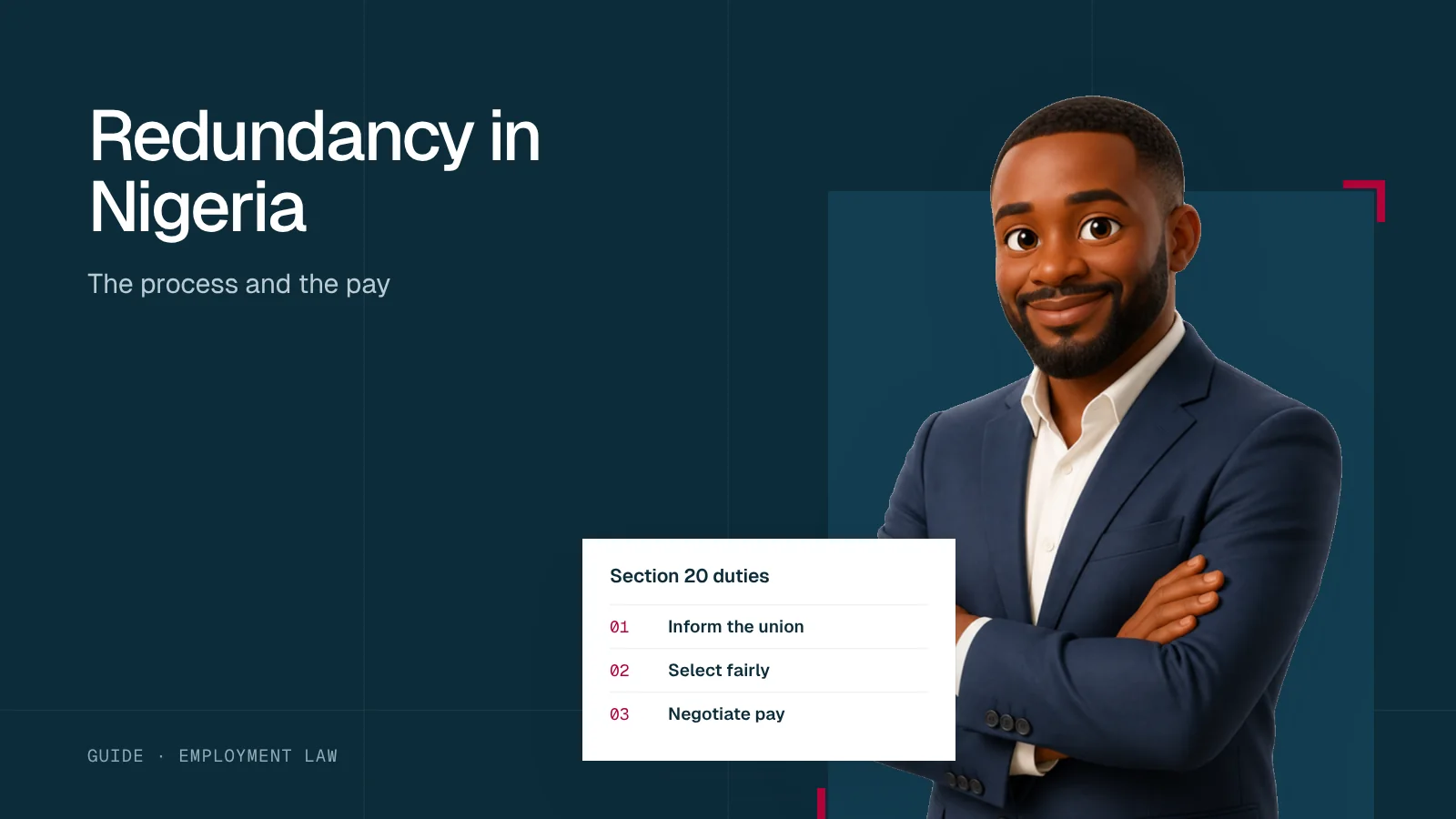
| 20 | Redundancy | Inform the union or workers’ representatives; last in, first out subject to merit; negotiate redundancy pay |
| 54 | Maternity | Six weeks before and six weeks after confinement; at least 50% pay after six months’ service; nursing breaks; no dismissal during leave |
Contracts and written terms
The written statement under section 7 must cover the employer’s and worker’s names, the place and date of engagement, the nature of the job, any fixed-term end date, notice, pay and how it is calculated and paid, hours, holidays and holiday pay, and sickness and sick pay. Our employment letter templates include every particular.
Wages and deductions
Wages fall due at the end of each pay period, and where that period is longer than a month, they must still be paid at least monthly. Deductions are tightly limited. An employer cannot deduct fines from wages, apart from a reasonable deduction for loss caused by wilful misconduct or neglect with a labour officer’s prior written consent.
Total deductions in any month “shall not exceed one-third of the wages of the worker for that month.”
Labour Act, section 5(7)
Overpayments can be recovered from wages only if they were made in the three months before the month in which the overpayment was discovered. Pension deductions and union dues follow their own rules.
Hours, overtime and rest
The Act does not fix a working week. Normal hours are set by agreement between employer and worker, by collective bargaining, or by an industrial wages board where no bargaining machinery exists. Hours beyond normal hours are overtime, and the rate comes from the contract or collective agreement. Our overtime guide explains the calculation.
Rest rules do have fixed minimums: rest intervals of at least an hour in total for a worker on duty for six hours or more a day, extra breaks for work involving continuous strain, and one rest day of at least 24 consecutive hours in every seven days.
Leave
- Annual leave. At least six working days with full pay after 12 months’ continuous service, or 12 working days for workers under 16, including apprentices. Leave can be deferred by agreement, but not beyond 24 months’ service, and it cannot be replaced by pay while the contract continues. See annual leave in Nigeria.
- Sick leave. Up to 12 working days’ wages a year for absence through temporary illness certified by a registered medical practitioner. See sick leave.
- Maternity. Six weeks before confinement with a medical certificate and six weeks after, with at least 50% of wages for women employed for six months or more, two half-hour nursing breaks a day, and protection from dismissal while on leave. See maternity and paternity leave.
Notice and termination
Section 11 sets minimum notice by length of continuous employment. Notice of a week or more must be in writing, either side can accept pay in lieu, and the Act does not remove the right to end a contract without notice for conduct that justifies it. Check the minimum for any length of service here:
Minimum notice under the Labour Act
For workers covered by the Labour Act, unless the contract gives more.
Source: Labour Act, section 11. Where notice is a week or more, it must be in writing. The contract can require longer notice than these minimums, never shorter.
Notice is only the minimum. How termination is handled, and whether a reason is needed, depends on the contract and on case law. Our termination guide covers it.
Redundancy
Section 20 sets the process when jobs are cut because of excess manpower.
Redundancy means “an involuntary and permanent loss of employment caused by an excess of manpower.”
Labour Act, section 20(3)
The employer must inform the trade union or workers’ representatives of the reasons and extent of the redundancy, apply “last in, first out” within the affected category subject to skill, ability and reliability, and use its best endeavours to negotiate redundancy payments. See redundancy in Nigeria.
The other laws that apply
The Labour Act is one piece of a wider set of rules. Most employers also deal with these:
| Law | What it covers | Our guide |
|---|---|---|
| Nigeria Tax Act 2025 and Tax Administration Act 2025 | PAYE on employment income, from 1 January 2026 | How to calculate PAYE |
| Pension Reform Act 2014 | 8% and 10% contributions for employers with 15 or more staff | Pension contributions |
| National Minimum Wage (Amendment) Act 2024 | ₦70,000 a month minimum, with exemptions | Minimum wage |
| Employees’ Compensation Act 2010 | Compensation for work injuries, funded by 1% of payroll | NSITF |
| National Housing Fund Act | 2.5% of basic salary for housing | NHF |
| Industrial Training Fund Act | 1% of payroll training levy | ITF |
| Nigeria Data Protection Act 2023 | How employee personal data is handled | Attendance systems |
Where disputes go
Employment disputes go to the National Industrial Court of Nigeria. Section 254C of the Constitution, added by the Third Alteration Act 2010, gives it jurisdiction over labour matters, including unfair labour practices and international best practice in labour relations. Its decisions have shaped areas the Labour Act is silent on, such as whether an employer must give a reason for termination.
A compliance check for employers
Contracts
Pay
Time and leave
Ending employment
Ticks are saved in this browser only.
The Act sets minimums. Most problems come from contracts and handbooks that are silent or out of date, so review them once a year. Our HR policy templates and employee handbook template are a place to start.
Written for: HR, business owners
Employee management made easy
Keep employee records, attendance, leave, payroll and performance in one connected system.
Sources
Frequently asked questions
Short answers to what employers ask us most about this topic.
What is the main labour law in Nigeria?
The Labour Act (Cap L1, Laws of the Federation of Nigeria 2004) is the main statute on contracts of employment, wages, hours, leave, maternity, notice and redundancy for workers. Other laws cover pensions, tax, minimum wage, workplace injury and data protection.
Does the Labour Act apply to managers?
Strictly, no. Section 91 excludes persons exercising administrative, executive, technical or professional functions from the definition of worker. Their rights come mainly from their contracts, other statutes and case law. Many employers still apply the Act's minimums to all staff for consistency.
Which court handles employment disputes in Nigeria?
The National Industrial Court of Nigeria. Section 254C of the Constitution, added by the Third Alteration Act 2010, gives it jurisdiction over labour and employment matters.